
Unifying City-Wide Fire Alarm Monitoring via a Smart Alarm Communicator
Industry
Smart Cities, Public Safety & Emergency Services
Solution
Cellular Gateway, RT Linux, Custom Cloud
Partner
Advantech

The Client
Elm is a Saudi technology company that develops digital solutions and services for government and enterprise organizations, supporting the Kingdom’s digital transformation through technology-enabled platforms and services.
Its work spans large-scale digital infrastructure and connected services where reliability, centralized visibility, and secure data exchange are critical to day-to-day operations.
As Elm expanded its smart infrastructure capabilities, it needed a way to unify fire alarm monitoring across buildings equipped with different manufacturers, models, and generations of alarm panels.
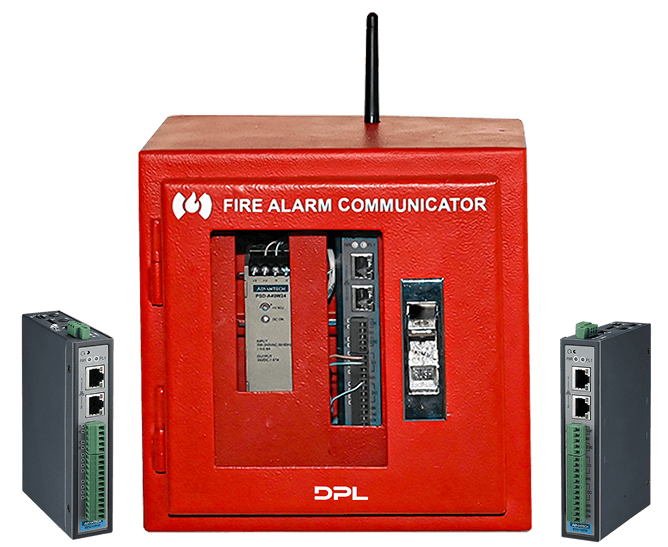
Elm partnered with DPL to develop a smart alarm communicator that connects this fragmented hardware estate to Elm’s proprietary cloud, providing reliable event transmission, device health monitoring, and resilient connectivity at scale.
Business Requirements and Challenges
As Elm worked to unify fire alarm monitoring across buildings, its infrastructure had to accommodate a fragmented hardware and communications landscape. DPL developed a solution designed to connect diverse fire alarm systems to Elm’s existing cloud platform. Key business challenges included:
1. A Mixed Hardware Estate
Buildings were fitted with fire alarm panels from multiple manufacturers, with each vendor using different models and hardware generations. The solution needed to work reliably across this fragmented estate without requiring a single standardized panel.
2. Proprietary Communication Protocols
Most fire alarm panels communicated through closed, vendor-specific serial protocols. Reliably extracting alarm and fault data over these serial channels was impractical, creating a significant integration challenge for centralized monitoring.
3. Resilient, Multi-Path Connectivity
The communicator needed reliable connectivity to transmit critical alarm events. 4G cellular connectivity was required as the primary communication path, with Ethernet supported as an optional secondary connection for greater flexibility and resilience.
4. An Off-the-Shelf Gateway Requirement
Elm wanted to avoid the cost and complexity of designing and manufacturing custom hardware. The solution therefore had to run on an off-the-shelf gateway, enabling faster deployment while simplifying maintenance and future hardware replacement.
5. Integration With Elm’s Proprietary Cloud
Alarm and fault events needed to flow directly into Elm’s existing cloud environment rather than through a third-party monitoring platform. The solution had to bridge the diverse fire alarm hardware estate with Elm’s proprietary cloud while maintaining reliable event transmission.
Business Impact and Considerations


Business Impact and Considerations
Addressing these challenges was critical for Elm’s ability to scale centralized fire alarm monitoring and build a reliable foundation for emergency response, especially as:
- Fragmented alarm infrastructure made city-wide monitoring difficult to standardize across buildings and hardware generations
- Unreliable access to alarm and fault data risked creating blind spots in critical safety events and limiting the value of centralized monitoring
- Connectivity failures could delay the transmission of alarms to Elm’s cloud, making resilient 4G and Ethernet communication essential
- Custom hardware requirements would increase deployment time, maintenance complexity, and the cost of scaling the solution across a diverse building estate
- Dependence on third-party platforms would limit Elm’s control over its monitoring infrastructure, data, and future product roadmap
- Direct integration with Elm’s proprietary cloud was essential to create a scalable monitoring architecture that could support future buildings, devices, and fire safety services
Business Outcomes and Benefits
Reduced from 3–4 minutes to under 30 seconds
Response Time
Approximately 95.2%
Fire Detection Accuracy
Approximately 95.2%
Location Accuracy
Faster detection and automated escalation enable earlier emergency response
Live-Saving Potential
Early transmissions reduce property damage and repair costs by over 20% compared to manual discovery
Loss Mitigation
1. Dry-Contact Signal Capture
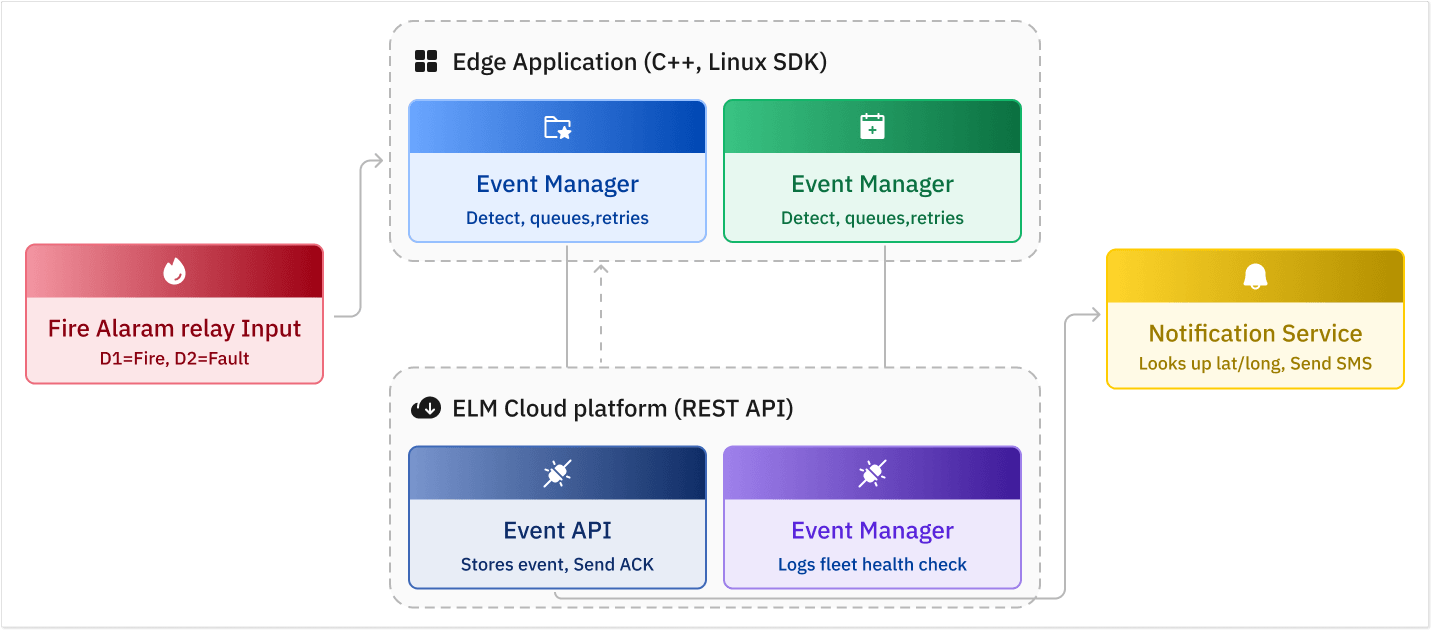
Nearly every fire alarm panel exposes two critical relays — one for fire alarm and one for fault — as dry contacts
The solution reads these dry-contact signals directly instead of attempting to decode proprietary vendor-specific serial protocols
Provides a consistent, hardware-agnostic method for capturing the two most important events across different panel manufacturers and generations
Eliminates the complexity and reliability issues associated with integrating multiple closed serial protocols.
2. Off-the-Shelf Advantech Gateway
Selected an industrial Advantech gateway with built-in 4G cellular and Ethernet connectivity
Four digital inputs and four digital outputs provide the required I/O capacity for alarm and fault signal handling
Integrated RS232 support preserves flexibility for future panel or peripheral integrations
Avoided custom board development, reducing hardware development time and simplifying deployment and maintenance.
3. Custom C/C++ Application on the Gateway
Developed a native C/C++ application using Advantech’s Linux SDK
Continuously monitors the fire and fault dry-contact inputs on the gateway
Converts detected signals into structured events with the required device and event information
Pushes events directly to Elm’s proprietary cloud through REST APIs
Provides a lightweight and purpose-built communication layer between fire panels and Elm’s cloud
Heartbeat Monitoring
Implemented a dedicated heartbeat API that reports each gateway’s operational status at regular intervals
Gives Elm continuous visibility into which units across the deployed fleet are online and communicating
Enables connectivity issues to be identified independently of fire or fault events
Provides the foundation for centralized device health monitoring across the city-wide deployment
5. Persistent Event Queue
Every alarm and fault event is time-stamped and stored in a persistent local queue before transmission
Events remain safely stored on the gateway when cellular or Ethernet connectivity is temporarily unavailable
Automatically retries delivery when connectivity is restored
Prevents transient network failures from resulting in lost safety-critical events
Creates a resilient store-and-forward mechanism between distributed fire alarm panels and Elm’s cloud platform
Here's How It Works
Innovation as a Service
DPL delivers end-to-end cloud and DevOps services, helping organizations modernize their infrastructure, automate deployment pipelines, and accelerate software delivery with greater reliability, speed, and efficiency.
20+ Years
Delivering Innovation since 2003
500+
Projects Completed
Top 1%
Sourcing the Best Talent
Up to
$20M USD
Projects Delivering Capability
Let's work on something new
Contact Us