Enterprise AI Solutions for AI That Meets Corporate Scale and Compliance

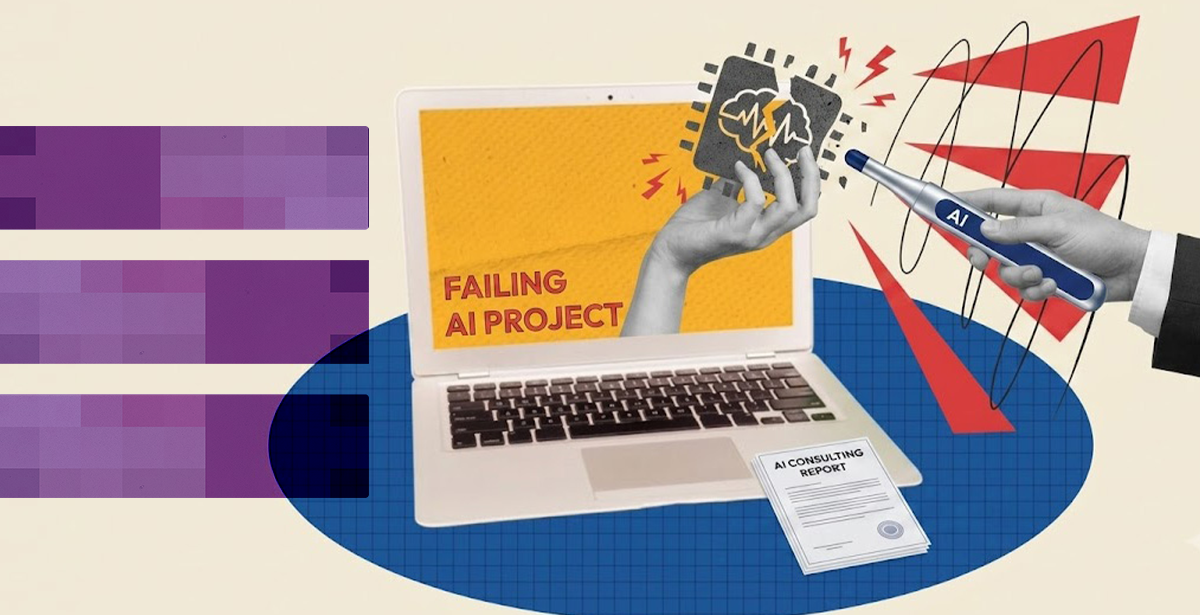
Most AI pilots die quietly.
They work great in a demo. Then they stall the moment legal, security, or a regulator asks how the model actually makes decisions.
Enterprise AI solutions have to clear a different bar than a weekend prototype. They need to run at real transaction volume, survive an audit, and keep working when the underlying data shifts.
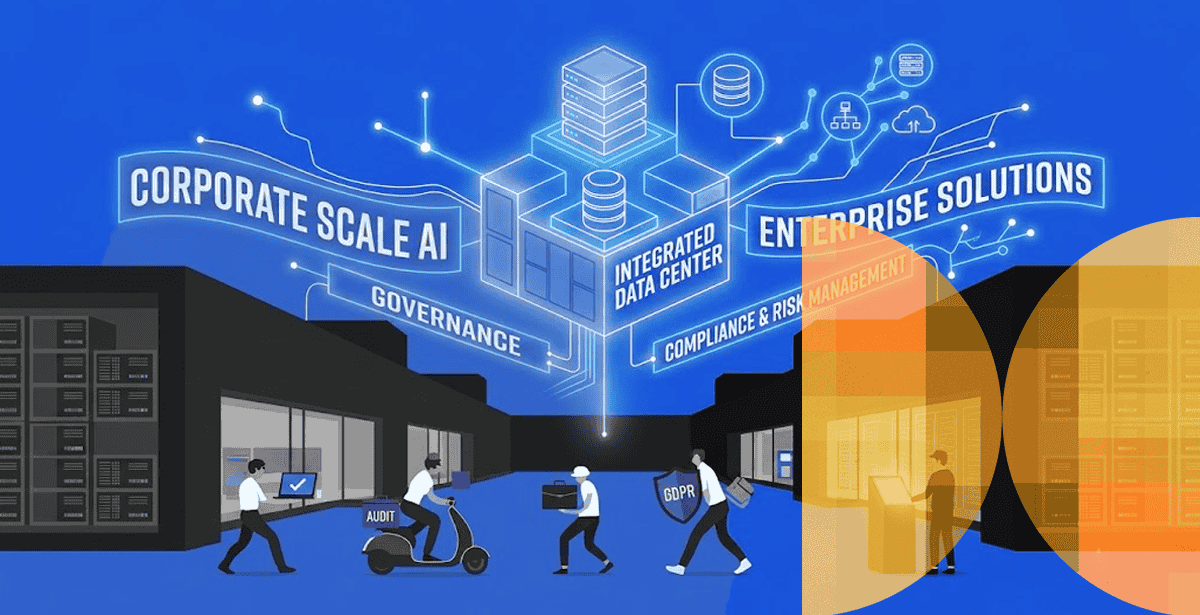
That means enterprise AI is not simply about choosing a powerful model. It’s about building the governance, data discipline, infrastructure, and operational capabilities required to run AI reliably in production.
What Makes an AI Deployment Enterprise-Ready?
An enterprise-ready AI system performs consistently under real load. It exposes its decisions to audit and degrades safely when something breaks instead of failing silently.
That’s a different design target from raw model accuracy.
Three capabilities usually separate a working pilot from a system large organizations can actually operate:
- Documented Data Lineage – Organizations need to know where data originated, how it was processed, and what information influenced a model.
- Continuous Monitoring – Production systems need to detect model drift, accuracy degradation, latency issues, and unexpected behavior early.
- Tested Rollback Paths – Teams need a reliable way to revert to a previous model or system version when a deployment introduces problems.
These requirements should be built into enterprise AI solutions from the beginning rather than added after a pilot has already reached production.
Corporate AI Solutions Need Governance by Design
Corporate AI solutions operate within environments where a model’s output can affect customers, employees, finances, or regulatory obligations.
AI compliance is no longer a checkbox exercise. The EU AI Act, for example, classifies AI systems according to risk levels, with high-risk applications carrying requirements around documentation, testing, transparency, and human oversight.
In the United States, there isn’t currently one comprehensive binding federal AI law covering every enterprise use case. However, frameworks such as the NIST AI Risk Management Framework provide organizations with a structured approach to identifying, measuring, and managing AI risks.
For enterprises operating across jurisdictions, governance therefore needs to be designed into the AI lifecycle.
That includes defining who can access models, what data they can retrieve, how outputs are evaluated, when humans must intervene, and what evidence is retained for audits.
Data Governance and Model Risk Management
Every enterprise AI system needs clear answers to three questions:
- Where did the training or retrieval data come from?
- Who can access model outputs?
- How is a bad prediction detected before it reaches a customer or business process?
Model risk management extends that discipline throughout the system’s lifecycle. Retraining schedules, drift monitoring, model evaluation, approval gates, and version control should form part of the same governance framework as the initial launch review.
For enterprise AI solutions, trustworthy AI is therefore as much about controlling the surrounding system as it is about the model itself.
Enterprise AI Platform: The Foundation for Production
An enterprise AI platform provides the shared infrastructure required to build, deploy, monitor, and govern AI applications across an organization.
Instead of every team building its own AI stack, enterprises can standardize capabilities such as model access, data integration, vector databases, retrieval-augmented generation, identity management, observability, evaluation, and deployment.
This creates a reusable foundation for multiple AI use cases.
It also makes it easier to introduce more sophisticated capabilities, including AI agents that can retrieve enterprise information, interact with business applications, and execute defined workflows under controlled permissions.
A well-designed enterprise AI platform should support experimentation without compromising production controls. Development teams can move quickly while security and governance teams retain visibility into how AI is being used.
Build guardrails before you scale. Enterprise generative AI needs more than model access. Define permissions, data boundaries, human-approval points, output validation, and monitoring before expanding an AI use case across departments. Building these controls into the architecture early is far easier than retrofitting them after deployment.
AI for Enterprises: From Pilots to Production
AI for enterprises becomes valuable when it is connected to measurable business outcomes rather than deployed simply because the technology is available.
Potential applications span intelligent document processing, customer service, software engineering, fraud detection, demand forecasting, knowledge management, and operational automation.
The challenge is turning these use cases into reliable production systems.
Enterprise AI solutions often fail at scale in predictable ways. Latency increases under real traffic. Retraining pipelines break silently. Infrastructure costs climb unexpectedly. Nobody notices model drift until customer complaints start increasing.
The answer isn’t necessarily a larger model. It is stronger engineering around the model.
That includes resilient data pipelines, automated testing, observability, infrastructure designed around actual workloads, and clear operational ownership.
Large-Scale AI Solutions Need MLOps
Large-scale AI solutions require more than model development. They require an operational framework capable of keeping models reliable after deployment.
This is where MLOps becomes the backbone of enterprise AI.
MLOps brings CI/CD discipline to machine learning through versioned datasets, automated testing, model evaluation, controlled releases, automated retraining, staged rollouts, and production monitoring.
Without these capabilities, every model update becomes a gamble.
With them, organizations can identify accuracy drops, data drift, infrastructure problems, and unexpected model behavior before they become business-critical incidents.
The payoff is not simply cleaner engineering pipelines. It shows up in uptime, predictable costs, faster releases, and lower operational risk.
For enterprise AI solutions, MLOps is what turns an AI model into an operational system.
Treat every production model as a moving system. Don’t assume a model that performs well today will perform the same way six months from now. Use automated monitoring, drift detection, model versioning, retraining workflows, and rollback mechanisms to catch performance degradation before it becomes a business problem. Or simply hire MLOps services to take care of this instead.
Designing for Failure
Enterprise AI also needs to assume that things will go wrong.
Models can produce unexpected outputs. Data sources can change. APIs can fail. Infrastructure can become unavailable. A new model version can perform worse than the previous one.
Production architecture needs to account for these scenarios.
Fallback mechanisms, human review, alerting, model versioning, access controls, and rollback procedures give organizations a way to contain failures rather than allowing them to propagate through business workflows.
This is particularly important when AI is connected to customer-facing or regulatory processes.
AI Strategy Consulting: Moving Beyond the AI Pilot
Technology alone doesn’t create an effective enterprise AI program.
AI strategy consulting helps organizations determine where AI can create measurable value, which use cases should be prioritized, and what technical foundation is required to support them.
The strategy should consider data readiness, existing cloud infrastructure, security requirements, AI maturity, regulatory exposure, integration complexity, and expected business impact.
But that doesn’t mean starting with a massive company-wide transformation.
A better approach is often to select one well-bounded workflow with clear success metrics and a manageable blast radius if something goes wrong.
Prove that the technical architecture and governance model work. Then expand.
For organizations investing in enterprise AI solutions, this approach reduces risk while creating a repeatable path from proof of concept to production.
Case Study: Compliance-Grade AI at Government Scale
Pakistan’s Sindh Ombudsman processes more than 1,000 citizen complaints daily. Its paper-based workflow created resolution delays of up to three weeks.
Compliance and auditability weren’t optional. The agency exists specifically to hold government bodies accountable.
DPL built a cloud-native platform using Amazon Bedrock to address this challenge. The system automatically classifies complaints, summarizes unstructured case descriptions, and flags urgent complaints through sentiment analysis, while keeping classifications traceable.
The results were measurable:
- 65% reduction in average resolution time
- 92% classification accuracy
- 99.9% system availability
- 40% reduction in infrastructure costs
- 42% increase in citizen satisfaction
The same production discipline can apply outside highly regulated environments.
National Janitorial Solutions used document AI to process more than 50,000 work orders per day across 18,000 US locations. The system saved approximately 400 hours of manual labor every week while maintaining an audit trail across invoices and purchase orders.
These examples demonstrate an important point: scale and governance aren’t barriers to AI adoption. When designed correctly, they become part of the architecture that makes AI useful.
Frequently Asked Questions
What makes an AI solution enterprise-grade?
An enterprise-grade AI system holds up under real transaction volume, documents its decisions for auditors, monitors its own performance, and has a tested rollback plan. A model that only performs reliably in a controlled demo isn’t enterprise-ready.
Do small and mid-size companies need to worry about AI compliance?
Increasingly, yes. Regulations such as the EU AI Act focus on the risk associated with an AI use case rather than simply the size of the organization. Enterprise customers may also request AI governance and security documentation during procurement.
How long does it take to move an AI pilot into production?
It depends on the use case, data readiness, integrations, and governance requirements. A tightly scoped proof of concept around a workflow such as complaint classification or document extraction can often reach production within a few months when the required data and governance foundations are in place.
Getting Started Without Betting the Company
The right starting point isn’t necessarily a massive AI transformation program.
Start with one well-defined workflow. Choose a use case with clear success metrics, accessible data, and a manageable risk profile. Build governance into the proof of concept rather than retrofitting it later.
That is how organizations can prove not only that an AI model works, but that the surrounding system can be trusted, monitored, audited, and scaled.
Prove the workflow, not just the model. AI proof of concept development can help validate more than accuracy. Test the data pipeline, security controls, integration points, user experience, monitoring, and governance requirements that the production system will depend on. A model that works in isolation is not proof that the business case works.
Enterprise AI solutions are ultimately about making AI dependable enough for the environments where failure has real consequences.
DPL’s AI engineering services team builds production-grade generative AI systems with a guardrail-first approach, combining AI engineering, MLOps, AI DevOps, cloud infrastructure, and governance to move AI from demonstration to deployment.
The objective is simple: build AI that doesn’t just work in a demo, but keeps working when the enterprise starts depending on it.