Enterprise RAG Solutions – A Guide to Deploying Retrieval Augmented Generation on Internal Knowledge Bases

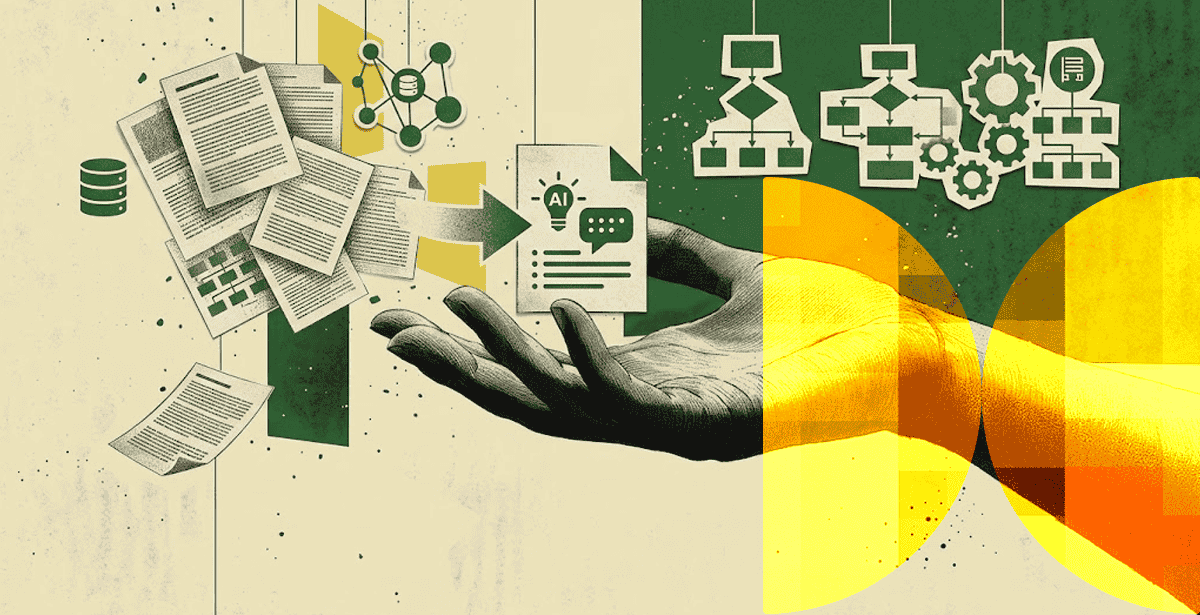
Most enterprises already have the knowledge they need. It just sits scattered across wikis, PDFs, and shared drives nobody fully trusts.
A language model alone cannot fix that. It only knows what it was trained on, not what changed in your company last week.
Enterprise RAG solutions close that gap by connecting a model to your actual knowledge base at query time. The model answers using your real documents, not memory.
💡 Before investing in RAG implementation, start by understanding what Retrieval Augmented Generation actually means and how it works. RAG combines information retrieval with generative AI to ground LLM responses in relevant, up-to-date information rather than relying only on model training. Understanding the fundamentals helps you evaluate RAG implementation services more effectively and make informed decisions about architecture, data sources, retrieval quality, and implementation requirements.
Corporate RAG Platform: Buy, Build, or Assemble?
A corporate RAG platform can be bought as a packaged product. It can also be built entirely in-house, or assembled from managed and custom pieces.
Off-the-Shelf Platforms vs a Custom Stack
Packaged platforms get a pilot running fast, often within days. They trade some flexibility for that speed, which is a fair trade early on.
Most enterprises land somewhere between the two extremes. A packaged retrieval layer paired with custom guardrails is a common, sensible middle ground.
That middle ground usually starts as a packaged pilot. Custom pieces get added later, once the team knows exactly where the packaged option falls short.
Nobody needs to get this decision perfect on day one. Treating it as reversible removes a lot of unnecessary pressure from an early choice.
A short pilot run directly on real internal documents reveals more than any vendor comparison sheet ever could. Watching retrieval behave on your own messy files is worth the extra week and effort it takes.
What a Platform Decision Actually Locks In
Switching platforms later is rarely simple once documents are indexed. Workflows that depend on the system add even more weight to that lock-in.
Forrester’s guide to retrieval-augmented generation notes that retrieval quality, not the platform brand, is usually the limiting factor.
That finding argues for evaluating retrieval quality directly, on your own documents. A slick demo running on someone else’s data proves very little about yours.
Running that evaluation before signing anything costs a week or two at most. It is cheap insurance against a much more expensive platform swap later.
Teams that skip this step often discover the gap only after real users start asking real questions. That is the worst possible time to find out.
RAG for Enterprise Data: Handling What You Actually Have
RAG for enterprise data means dealing with documents that were never written with a model in mind. Formatting is inconsistent, and structure varies wildly.
Structured vs Unstructured Enterprise Data
Structured records, like database tables, are relatively easy to expose to a retrieval system. Unstructured documents are not nearly as forgiving.
Most enterprise knowledge sits in that second, messier category. A retrieval system that only handles clean structured data misses most of the available value.
Scanned PDFs, email threads, and meeting notes all fall into this bucket. Each format needs its own extraction approach before retrieval can work well.
Case Study: Turning Unstructured Work Orders Into Structured Answers
DPL’s work with National Janitorial Solutions shows this challenge at real scale. The system processes over 50,000 unstructured work orders daily across 18,000 locations.
That system extracted structured fields, like purchase order numbers, from documents that were never standardized. A retrieval layer over messy real documents needs that exact same discipline.
Building that extraction step well is what makes retrieval actually useful later on. Skipping it means retrieval returns noise instead of usable answers.
The same lesson carries directly into a RAG deployment. Clean extraction upfront is what determines whether retrieved passages are actually worth reading.
Secure RAG Deployment: Locking Down Access and Output
Secure RAG deployment is not optional once real company documents are involved. A retrieval system can just as easily leak information as surface it.
Document-Level Permissions in Retrieval
A RAG system should only retrieve documents the requesting user is actually allowed to see. That permission check has to happen at retrieval time, not after.
DPL’s approach to enterprise generative AI builds these permission checks in from the start. They are never treated as an afterthought bolted on later.
Skipping this check is exactly how a RAG system accidentally becomes a data leak. An HR document surfaced to the wrong employee is a real incident, not a hypothetical one to worry about later.
Testing permission boundaries before launch matters as much as testing retrieval accuracy itself. A security gap found in production is far costlier than one found in review.
That testing should always include deliberately adversarial questions, not just friendly ones from a script. Someone on the team should actively try to make the system reveal something it truly should not.
Documenting the permission model in plain language also helps everyone involved. Engineers and compliance reviewers need a shared, simple description of exactly who can retrieve what.
Case Study: Generative AI in a Regulated Government Setting
DPL’s AI-powered complaint management platform for Pakistan’s Sindh Ombudsman processes over 1,000 sensitive citizen complaints daily. It runs on generative AI built with Amazon Bedrock.
That deployment needed strict access control and auditability from day one. Citizen data of that sensitivity leaves no room for shortcuts anywhere in the pipeline.
The result was a 65% reduction in resolution time with zero related security incidents. Regulated environments like this one cannot treat security as optional.
The same discipline applies directly to any enterprise RAG deployment touching sensitive internal data. Government-grade rigor is a reasonable bar for any regulated industry.
Internal Knowledge RAG: Keeping the Index Current
Internal knowledge RAG systems face a moving target. Documents get added, edited, and retired constantly, and the retrieval index has to keep up.
Chunking and Indexing Internal Documents
Documents get split into chunks before indexing, and chunk size matters a lot. Chunks too large dilute relevance; chunks too small lose context entirely.
Plain chunking alone cannot match what a graph-based structure captures about relationships between documents. That gap shows up most on complex, multi-part questions.
Document structure should guide chunking wherever possible. Splitting by section or heading usually beats splitting by a fixed character count.
Testing a chunking strategy against real employee questions, rather than synthetic ones, catches problems much earlier. Synthetic test sets tend to be noticeably easier than what people actually end up asking in practice.
Ongoing Maintenance as Knowledge Bases Change
A RAG system is never really finished at launch. New documents get added, old ones get retired, and the index needs to track both continuously.
Assigning clear ownership for this maintenance matters as much as any technical decision made earlier. A system with no owner drifts out of date quietly.
💡 MLOps can help keep RAG systems reliable as their underlying knowledge changes. Continuous monitoring, data pipeline management, index updates, model evaluation, and performance tracking make it easier to detect when retrieval quality starts to decline. With the right MLOps services in place, teams can turn ongoing maintenance into a managed process rather than letting an RAG system quietly become outdated.
Without that ongoing care, retrieval quality degrades slowly and quietly over time. Nobody notices until an answer is confidently, visibly wrong to someone who trusted it.
Regular re-indexing schedules and monitoring dashboards catch this drift early. Waiting for a user complaint is the slowest and most painful way to find it.
Treating maintenance as part of the original project budget, rather than an afterthought, keeps that discipline funded properly over time. A system nobody pays to maintain rarely stays healthy for very long.
Where Enterprise RAG Is Headed
Enterprise RAG is moving toward multi-step retrieval. A system searches, reads, and searches again before answering, rather than stopping after one pass.
A single retrieval pass works fine for simple factual questions. Harder, multi-part questions increasingly need this iterative approach to answer well.
According to Gartner, the large majority of enterprises will have deployed generative AI applications by the end of 2026.
That scale of adoption makes the unglamorous parts, like retrieval quality and access control, matter more, not less. They stop being nice-to-haves once adoption reaches that scale.
Teams building today should plan for that trajectory rather than for where the field stood a year ago. The bar keeps rising quickly.
Building RAG That Employees Actually Trust
Enterprise RAG solutions succeed when retrieval quality, security, and maintenance all get equal attention. The model itself is rarely the part that fails.
Employees stop trusting a system after just one confidently wrong answer. Rebuilding that trust takes far longer than building it correctly the first time.
Getting this right the first time requires real architecture discipline. An API call to a model alone was never going to be enough.
If your team is deploying RAG on internal knowledge bases, DPL’s AI engineering team can help. We build retrieval systems that hold up under real, messy company data.