
How AI Content Generation Helps Leading Enterprises Scale Content Production

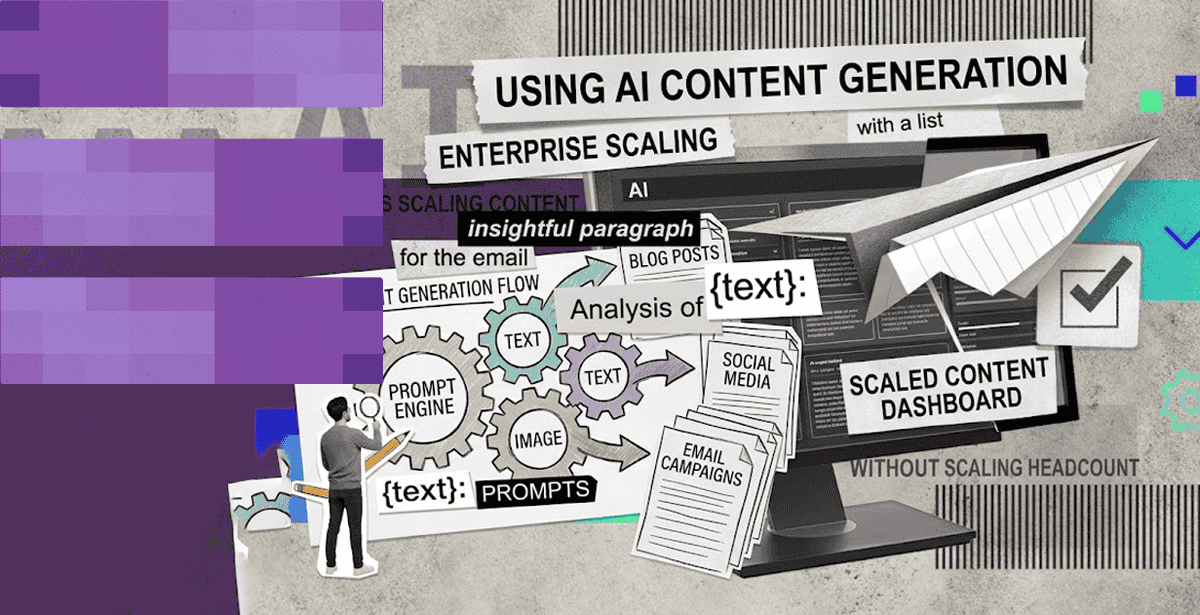
Content demand is climbing faster than content budgets. AI content generation is how enterprise teams are closing that gap: producing more output, in more formats, without adding a single headcount to do it.
More than half of content marketers expect to increase output in the year ahead, and 75% already use AI-powered tools in their standard workflow. The teams pulling ahead aren’t the ones working longer hours. They’re the ones with a system doing the first draft, the summarization, and the repetitive structuring work automatically.
The Content Demand Problem No One Budgeted For
Every new channel adds another content obligation: product pages, support docs, sales enablement, social variants, internal knowledge bases. Headcount plans were never built for this pace. Hiring writers fast enough to match demand is expensive and slow, and it doesn’t scale linearly with the volume of content a modern enterprise now needs.
That’s the actual business case for AI content generation. It isn’t about replacing writers. It’s about removing the bottleneck between “we need this content” and “this content exists,” so the humans on the team spend their time on judgment calls instead of first drafts.
The math is straightforward. If content demand grows 30% year over year and headcount grows 5%, something has to close that gap. Historically, that meant slower turnaround, thinner content, or burned-out teams. AI content generation gives enterprises a fourth option: absorb the volume increase with systems instead of people.
What AI Content Generation Actually Automates
The AI-powered content creation market is projected to more than triple by 2033, and the enterprises capturing that value now are the ones treating AI content generation as infrastructure, not a novelty.
AI content generation covers a wider job than most people assume. It ranges from drafting marketing copy to structuring technical documentation to summarizing long internal reports into something a team can act on in minutes.
Automated Content Creation Across the Content Lifecycle
Automated content creation isn’t a single step. It touches outlining, drafting, formatting for different channels, and localizing content for new markets. A well-built pipeline handles all four without a human re-keying the same information four separate times.
Where Automated Content Creation Still Needs a Human Editor
Automation handles structure and speed. It doesn’t yet handle judgment calls about brand risk, legal exposure, or tone in a sensitive situation. The enterprises getting the best results treat automated content creation as a draft-and-review loop, not a publish-and-forget pipeline.
AI-Powered Content That Doesn’t Sound Like a Robot Wrote It
The biggest objection to AI-powered content is quality. Generic, ungrounded output is a real risk when a model is left to generate from its own training data alone.
Grounding AI-Powered Content in Your Own Data
The fix is retrieval-augmented generation. Instead of guessing, the model pulls from your verified product data, style guide, and prior content before it drafts a word. DPL builds these pipelines on Pinecone, ChromaDB, and GraphRAG. Grounded AI-powered content reads like your brand because it’s built from your brand’s own material, not a generic internet average.
💡Ground the model in your own knowledge base. Effective RAG implementation services should connect LLMs to trusted, up-to-date enterprise data rather than relying solely on a model’s training knowledge. Use curated sources, metadata, retrieval rules, and evaluation mechanisms to ensure the context supplied to the model is relevant and accurate. The result is content that stays aligned with your brand, products, and latest information.
Choosing Content Generation AI Tools That Fit Your Stack
Not every one of the dozens of content generation AI tools on the market will fit an enterprise’s existing systems, security requirements, or brand voice. The right tool question isn’t “which one is most popular.” It’s “which one can be grounded in our data and governed the way our compliance team requires.”
Build vs. Buy: Where Content Generation AI Tools Break Down at Scale
Off-the-shelf content generation AI tools work well for a single use case. They tend to break down when an enterprise needs consistent voice across twelve product lines, five languages, and three compliance regimes at once. That’s usually the point where a custom-built pipeline, tied into generative AI solutions, earns back its cost.
Nearly a quarter of marketers now say large language models, not human readers, are the primary audience for most of their content, a figure that rises to 32% at enterprise organizations. That shift changes what a content generation AI tool needs to optimize for: structured, machine-readable content that performs in AI-generated answers, not just traditional search rankings.
Building an AI Content Strategy That Scales With Demand, Not Headcount
An AI content strategy is the plan that decides what gets automated, what stays human, and how quality gets checked before anything ships. Without it, AI content generation turns into scattered tools nobody governs.
Governance and Quality Control in an AI Content Strategy
A working AI content strategy defines review checkpoints, brand voice guardrails, and a feedback loop that improves the model’s grounding data over time.
The strategy should start with workflow design, not tool selection. Map the content lifecycle from research and briefing to drafting, review, optimization, publishing, and performance tracking. Then identify where AI can remove repetitive work without compromising accuracy, brand voice, or editorial judgment.
A scalable strategy also needs clear ownership. Define who approves AI-generated content, what requires human review, which sources the system can use, and how errors are reported and corrected. As content volume grows, these guardrails prevent speed from coming at the expense of consistency.
The goal isn’t to automate every step. It’s to build a repeatable content engine where AI handles high-volume tasks while human teams focus on strategy, expertise, creativity, and final judgment.
💡Put guardrails around every automated content workflow. Enterprise generative AI should define where AI can generate, what sources it can access, and when human review is mandatory. Establish approved knowledge sources, brand and compliance rules, output checks, and escalation paths before increasing content volume. This lets teams scale AI-assisted production while keeping quality, accuracy, and accountability under control.
AI Document Summarization: The Quiet Force Multiplier
While marketing content gets most of the attention, AI document summarization is doing some of the heaviest lifting inside enterprise content operations. It turns unstructured reports, complaints, and case files into structured, actionable summaries in seconds.
DPL built exactly this for the Sindh Ombudsman, a Pakistani government body processing over 1,000 citizen complaints daily. Intelligent case summarization, precedent detection, and sentiment analysis cut average resolution time by 65% and lifted classification accuracy to 92%, all powered by generative AI on Amazon Bedrock.
The same pattern applies to enterprise document processing. DPL integrated Google Document AI and GPT-3.5 Turbo for a US facility management company handling 50,000+ work orders daily, automatically classifying documents and extracting invoice data at scale.
What Scaling Without Scaling Headcount Looks Like in Practice
For the facility management client above, automated document classification and AI document summarization saved 400 hours of manual labor every week. That’s not a marginal efficiency gain. It’s the equivalent of ten full-time employees’ worth of processing capacity, freed up without a single new hire.
That’s the real promise of AI content generation at enterprise scale: matching rising content and data demand with systems instead of staffing.
Scale Content Without Scaling Your Payroll
DPL builds grounded, governed AI content generation and document summarization systems for organizations that need output to scale faster than headcount ever could. Explore DPL’s generative AI solutions to see where automation fits your content operation first.

Topics
Related Articles
-

Speech Recognition Services – Building Accurate Voice-to-Text for Enterprise Applications
19-Aug-2026 Salman Naseer
-
Generative AI Consulting Services: How to Turn LLM Investments Into ROI
18-Aug-2026 Shahrukh Satti
-
Generative AI for Business – High-Value Use Cases That Drive ROI
12-Aug-2026 Waleed Riaz