
Balancing Power, Performance, and Cost in Embedded Systems Design for Connected Products

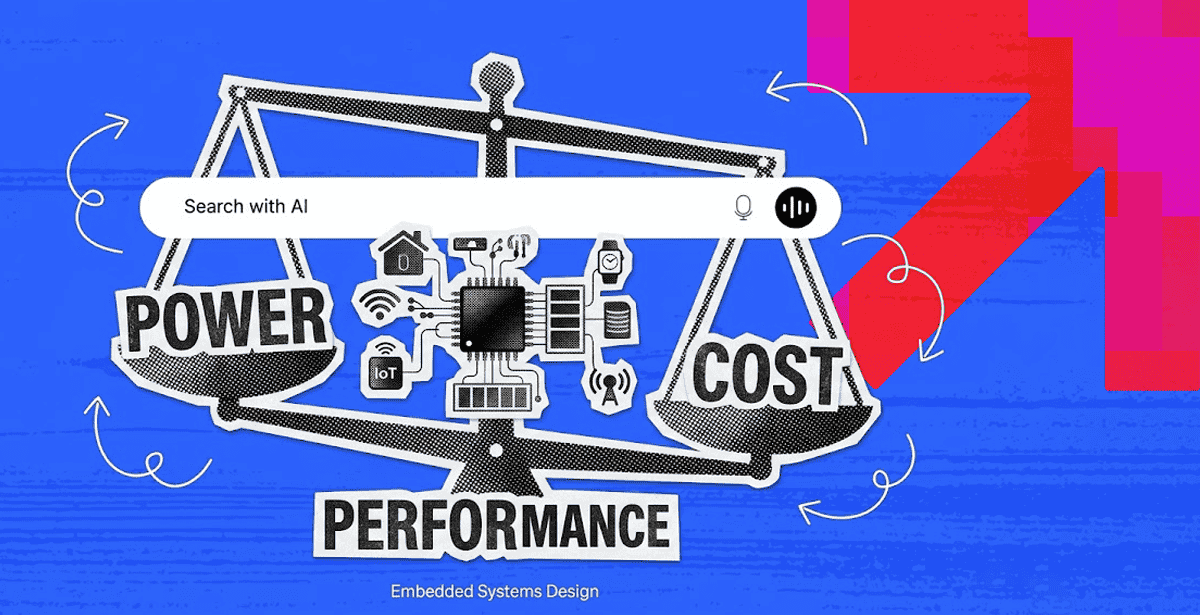
Every connected product starts with the same argument. The firmware team wants more processing headroom. The hardware team wants longer battery life. Finance wants a bill of materials that doesn’t wreck the margin. Embedded systems design is the discipline of resolving that argument — choosing silicon, power architecture, and firmware together so a device does its job for years without draining its battery or its budget.
That argument matters more every year. Connected devices worldwide are projected to hit 21.1 billion by the end of 2025, climbing toward 39 billion by 2030. At that scale, a design decision that adds even a few cents per unit, or a few milliamps of standby draw, compounds into millions of dollars and thousands of premature battery swaps in the field.
In practice, embedded systems design means answering three questions for every component and every line of firmware: does it need to run this fast, does it need to run this often, and does it need to cost this much? Getting those three answers wrong is how connected products end up expensive, short-lived, or both.
The Power-Performance-Cost Triangle in IoT Product Development
Power, performance, and cost pull against each other by nature. A faster processor draws more current. A cheaper microcontroller often lacks the peripherals a feature needs. Longer battery life usually means a bigger cell, which raises the bill of materials.
Good IoT product development doesn’t try to eliminate that tension. It makes deliberate, informed tradeoffs based on how the product will actually be used in the field, not on a spec sheet in isolation.
Embedded systems design is fundamentally about matching capability to requirement. That means tuning power, compute, memory, and connectivity together for the product’s actual job, not maximizing any single spec in isolation.
Firmware Development Decisions That Shape Power and Performance
Most of the power-performance tension gets resolved — or created — in firmware, not silicon. Two products can ship on the identical microcontroller and land worlds apart on battery life, purely because of how the code manages the chip’s power states.
Firmware development teams that understand the hardware deeply can squeeze years of extra battery life out of the same bill of materials. That’s the difference between a sensor that needs a battery swap every six months and one that runs for five years untouched.
Embedded Firmware Techniques for Duty Cycling and Sleep Modes
Power budgeting starts with a simple question: what does this device need to do, and how often? A door lock that wakes once when a resident approaches has a wildly different power profile than a thermostat sampling temperature every few seconds.
The tools that matter most are sleep modes, duty cycling, and picking a microcontroller whose idle current actually matches the use case. A chip with an impressive active-mode benchmark is worthless if its sleep current quietly drains the battery between events.
Radio choice matters just as much. LoRaWAN, for instance, trades bandwidth for dramatically lower power draw, making it a natural fit for sensors that report small payloads infrequently over long distances.
This is precisely the kind of decision our firmware development team works through on every embedded engagement — matching silicon and sleep architecture to real duty cycles, not marketing specs.
Embedded Software Development for Edge vs. Cloud Processing
Performance is easy to over-provision. Teams often reach for the most capable processor available, then never use half its capability. That headroom costs money and power for nothing in return.
The better question is where processing should actually happen: on the device, at the edge, or in the cloud. Embedded software development choices here have real consequences for latency, data cost, and battery life all at once.
Pushing more logic onto the device can cut latency and reduce cloud data costs, but it demands a chip with the right balance of clock speed, memory, and low-power modes. Pushing logic to the cloud instead simplifies the firmware but raises connectivity costs and depends on network reliability.
IoT Hardware Development: Engineering Cost from BOM to Total Cost of Ownership
Unit cost is only part of the picture in IoT hardware development. The number that actually matters is total cost of ownership: BOM cost, connectivity fees, cloud infrastructure, field maintenance, and battery replacement over the device’s lifetime.
McKinsey’s research on IoT economic value puts this bluntly. Installation and deployment costs are consistently cited as one of the biggest cost barriers to scaling connected products, even as the technology promises trillions of dollars in value. A device that’s cheap to build but expensive to install, maintain, or replace isn’t actually cheap.
This is where the ROI conversation has to happen early, not after launch.
Connectivity is often the single biggest lever on both cost and power in IoT hardware development. Cellular modules cost more per unit and per message but need no gateway infrastructure. LoRaWAN and Zigbee cost less to run at scale but require network planning upfront.
💡Calculate ROI across the device lifecycle. The true ROI of IoT development services goes beyond the unit price of hardware. Factor in connectivity, cloud infrastructure, installation, maintenance, battery replacement, and device replacement costs over the product’s expected lifetime. The cheapest device to build may not be the cheapest to operate.
A Real-World Example: How iApartments Balanced All Three at Scale
DPL has been the core technology partner for iApartments since January 2019, building the AWS IoT Core platform behind more than 200,000 connected locks, thermostats, lights, and sensors across residential units.
Hitting that scale meant obsessing over every one of these tradeoffs simultaneously. The result: a sub-$1 monthly operating cost per device, while still supporting real-time control and the reliability residents expect from a lock on their own door.
That kind of outcome doesn’t come from picking the fastest chip or the cheapest radio. It comes from architecting power, performance, and cost together from day one, including the firmware, the cloud backend, and the fleet management layer that keeps thousands of devices healthy at once. You can see how this and other deployments came together in DPL’s project portfolio.
A Framework for Getting the Balance Right
Teams building a new connected product can apply the same framework DPL uses on client engagements, regardless of industry or device type.
- Define the actual duty cycle. How often does the device need to wake, sense, transmit, or compute?
- Right-size the microcontroller. Match active and sleep current to that duty cycle, not to the highest benchmark available.
- Choose connectivity for the payload, not the hype. LoRaWAN, cellular, WiFi, and Bluetooth each fit different range, power, and data tradeoffs.
- Model total cost of ownership, including maintenance and battery replacement, before locking the bill of materials.
- Prototype before committing. A structured proof-of-concept phase surfaces power and performance gaps before they’re baked into tooling.
Pre-Commit Checklist for Firmware, Hardware, and Cost
Security deserves a place in this checklist too. Encryption and authentication both draw power and add cost, and skipping them creates far bigger costs later, in breach risk and recall exposure.
Before locking a design, confirm the firmware supports secure boot and encrypted communication, the microcontroller has enough headroom for those routines without blowing the power budget, and the connectivity choice can carry the security overhead reliably. Our guide on securing IoT covers how to budget for it properly from the start.
Skipping this step is one of the most common reasons IoT hardware development projects need a costly hardware respin months after launch.
Frequently Asked Questions
How do you choose the right microcontroller for an IoT product?
Start with the device’s duty cycle, not a benchmark chart. Match active current, sleep current, and peripheral support to what the product actually does, then confirm the chip leaves enough headroom for security and firmware updates.
Does lower power always mean lower performance in embedded systems design?
No. Modern low-power microcontrollers can hit high clock speeds when active and drop to microamp-level sleep currents between tasks. The tradeoff is usually in memory, peripherals, or price, not raw compute speed.
What drives most of the cost in IoT hardware development?
Connectivity and total cost of ownership usually outweigh the microcontroller’s unit price. Gateway infrastructure, cellular data plans, field maintenance, and battery replacement typically cost more over a device’s lifetime than the chip itself.
The Takeaway
There’s no universal “right” balance between power, performance, and cost. There’s only the right balance for your product, your use case, and your users. Getting there takes embedded engineers who’ve shipped devices at scale, not just prototypes.
If you’re weighing these tradeoffs for a connected product in development, DPL’s embedded and IoT development team has done it across hundreds of thousands of deployed devices, and can help you get the balance right before you commit to hardware.

Topics
Related Articles
-

A Side-by-Side Comparison of Predictive Maintenance Tools for Industrial Operations
31-Aug-2026 Bilal Sattar
-
The Most Common IoT Security Risks — and the Architecture Decisions That Eliminate Them
28-Aug-2026 Waleed Riaz
-

How Property Technology Is Reshaping Operations for Multifamily and Commercial Real Estate
27-Aug-2026 Waleed Riaz