
The Most Common IoT Security Risks — and the Architecture Decisions That Eliminate Them

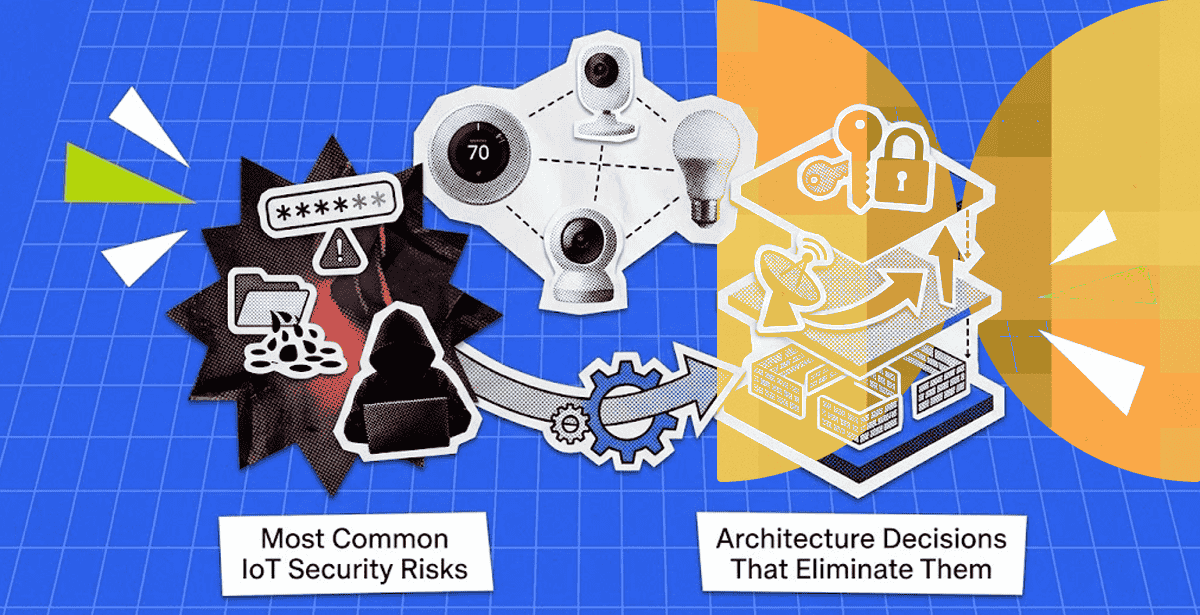
Most IoT security risks are not mysteries. They trace back to the same handful of architecture decisions, made or skipped early in a project.
A device without a hardware root of trust is a risk. A gateway without network segmentation is a risk. These are design choices, not bad luck.
The good news is that every one of these risks has a known fix. It just has to be built in from day one, not bolted on later.
What Are the Most Common IoT Security Risks?
IoT security risks are the specific weaknesses that let attackers compromise connected devices. They also cover attacks on device data and the backend systems behind them. Most fall into a short, well-known list, repeated across industries.
Weak or default credentials, unencrypted data in transit, unsigned firmware updates, and flat networks with no segmentation. These four cover a large share of real-world IoT breaches.
Each one is preventable at the architecture stage. None of them require exotic new technology to fix, only a decision made early enough.
IoT Security Challenges Unique to Connected Devices
IoT security challenges differ from standard IT security in a few important ways. Devices are physically exposed, often for years, in places nobody watches closely.
A server sits in a locked data center behind badge access. A smart lock sits on a customer’s front door, reachable by anyone who walks by.
Devices also run for years without a reboot or a patch cycle. That long lifespan turns small early flaws into long-lived attack surfaces.
Scale adds another layer of difficulty here. A fleet of 200,000 sensors cannot be patched by hand. A handful of servers can be, one at a time.
Physical access is a factor too. Anyone standing next to a device can potentially probe its ports, pull its firmware, or swap its storage chip.
Why Traditional Security Tools Fall Short
Traditional endpoint security tools assume a full operating system and spare compute capacity. Most IoT devices have neither of those things available.
A microcontroller running firmware has no room for a heavyweight antivirus agent. Security has to be designed into the firmware and protocol layer instead.
This is exactly why IoT security cannot be an afterthought bolted on post-launch. It has to be part of the initial device and network architecture.
IoT Device Security Starts with Architecture
IoT device security is strongest when it starts at the hardware layer, not the software layer added on afterward. Two decisions matter most here.
Device Identity and Authentication
Every device needs a unique, unforgeable identity of its own. Shared passwords or hardcoded keys are the most common root cause of device compromise.
DPL’s IoT platforms use X.509 certificates for device identity, paired with mutual TLS. Each device authenticates individually, on its own credentials.
That individual identity matters during incident response. A compromised device can be revoked on its own, without affecting the rest of the fleet.
According to NIST’s IoT cybersecurity guidance, device identification is a core capability. Every connected product should ship with it enabled by default, not as an option.
Firmware Update Pathways
Devices need a reliable way to receive signed firmware updates over the air. Without this, a discovered vulnerability stays open for the entire life of the device.
Firmware signing prevents a compromised update server from pushing malicious code onto a fleet. The device simply refuses to install anything it cannot verify against a trusted signature.
This single decision turns a fixed vulnerability into an actual fix in the field. Skipping it turns every future bug into a permanent one, with no way back.
💡Secure the software layer, too. Strong encryption and authentication cannot compensate for vulnerable firmware. Embedded software quality should include secure coding practices, rigorous testing, vulnerability scanning, and safe update mechanisms to prevent weaknesses from becoming entry points into the device or wider network.
IoT Cybersecurity at the Network Layer
IoT cybersecurity depends heavily on how devices are allowed to talk to the rest of a network. Flat networks are where small breaches turn into big ones.
Segmentation and Zero Trust
Network segmentation puts devices on their own isolated segment, separate from corporate systems and other device classes. A compromised thermostat should never be able to reach a payroll server.
Zero trust principles extend this idea further still. No device is trusted by default, even one already sitting inside the network perimeter.
Our IoT development work applies this by design. Platforms combine AWS IoT Core, Device Defender, and fine-grained IAM policies scoped per device fleet. In fact, our iApartments deployment runs this exact model across more than 200,000 connected devices. Each device carries its own certificate, inside an isolated network policy.
That architecture has held at scale for years. It covers locks, thermostats, and sensors deployed across tens of thousands of apartments.
Device Fleet Monitoring at Scale
Segmentation limits what a compromised device can reach. Monitoring is what tells you a device was compromised in the first place.
AWS IoT Device Defender, for example, watches for behavior that deviates from a device’s normal baseline. A thermostat that suddenly opens hundreds of outbound connections is not behaving like a thermostat.
Fleet-wide dashboards make this practical at scale. A security team reviewing 200,000 individual devices by hand is not a realistic operating model.
IoT Data Security in Transit and at Rest
IoT data security covers two distinct problems: protecting data while it moves, and protecting it once it lands somewhere permanent. Both need separate architecture decisions.
In transit, TLS 1.3 should be the minimum standard for any device talking to the cloud. Older TLS versions carry known weaknesses that attackers actively scan for.
At rest, encryption keys should never live on the same system as the data they protect. AWS KMS, or an equivalent managed key service, handles that separation cleanly.
A third piece often gets missed entirely: data retention policy. Sensor data nobody needs after 90 days is still a liability if it sits around for years unused.
Reducing what you store is itself a security control. Data that no longer exists cannot be stolen in a future breach, no matter how it happens.
Access control matters just as much as encryption itself. A dashboard that lets any employee query raw device data undoes much of the protection encryption was meant to provide.
💡Secure the data beyond the device. When IoT integration connects device data with enterprise applications, security needs to extend beyond the endpoint. Apply encryption, access controls, least-privilege permissions, and appropriate data-retention policies across the entire data flow—from device and gateway to cloud platform and business application.
IoT Security Best Practices for Architecture Teams
IoT security best practices come down to a short, repeatable checklist. Teams that follow it consistently avoid most of the breaches that make headlines.
Assign every device a unique cryptographic identity of its own. Encrypt data in transit and at rest, with keys managed separately from the data itself.
Segment networks by device class and trust level, not by convenience. Ship firmware update pathways from day one, not as a rushed post-launch patch.
Monitor device behavior for anomalies continuously. A device acting strangely, sending unusual traffic or waking at odd hours, is often the first visible sign of compromise.
DPL’s firmware development process bakes these checks into every build from the start. They are not treated as a final review step before shipping.
The OWASP Internet of Things project maintains a widely cited list of top IoT vulnerabilities. It maps closely to this checklist and is worth reviewing during any architecture review.
Frequently Asked Questions About IoT Security Risks
What is the single biggest IoT security risk today?
Weak or default device credentials remain the most common root cause. Unique per-device identity, enforced through certificates, closes this gap directly.
Can IoT security be added after a product ships?
Some of it can, through firmware updates and network changes. Core issues like missing hardware identity are far cheaper to fix before launch than after.
Does encryption alone solve IoT data security?
No. Encryption protects data content on its own. Weak key management or poor access control can still expose that same data to an attacker.
How is IoT security different from regular IT security?
IoT devices are physically exposed, resource-constrained, and long-lived. Standard IT tools built for servers often do not fit device hardware at all.
Who owns IoT security – the device maker or the cloud provider?
Both share responsibility. The device maker secures firmware, identity, and physical hardware; the cloud provider secures the infrastructure the data flows into.
Getting Architecture Right the First Time
The most common IoT security risks are not new or exotic. They are the predictable result of skipping identity, encryption, or segmentation at the design stage.
Every risk covered here has a known, proven fix. The hard part is deciding to build it in before launch, not after an incident forces the issue.
If your team is planning a connected product, we can help you design this in from the start. The same is true if you are auditing one already in the field.
Waiting for an incident is the most expensive way to learn these lessons. Building the architecture right the first time is almost always cheaper, and far less disruptive to customers.

Topics
Related Articles
-

A Side-by-Side Comparison of Predictive Maintenance Tools for Industrial Operations
31-Aug-2026 Bilal Sattar
-

How Property Technology Is Reshaping Operations for Multifamily and Commercial Real Estate
27-Aug-2026 Waleed Riaz
-
IoT Services Company – What a Real IoT Partner Actually Delivers
25-Aug-2026 Bilal Sattar