
How Kubernetes Orchestration Works at Scale — and Why It Matters for Container Management

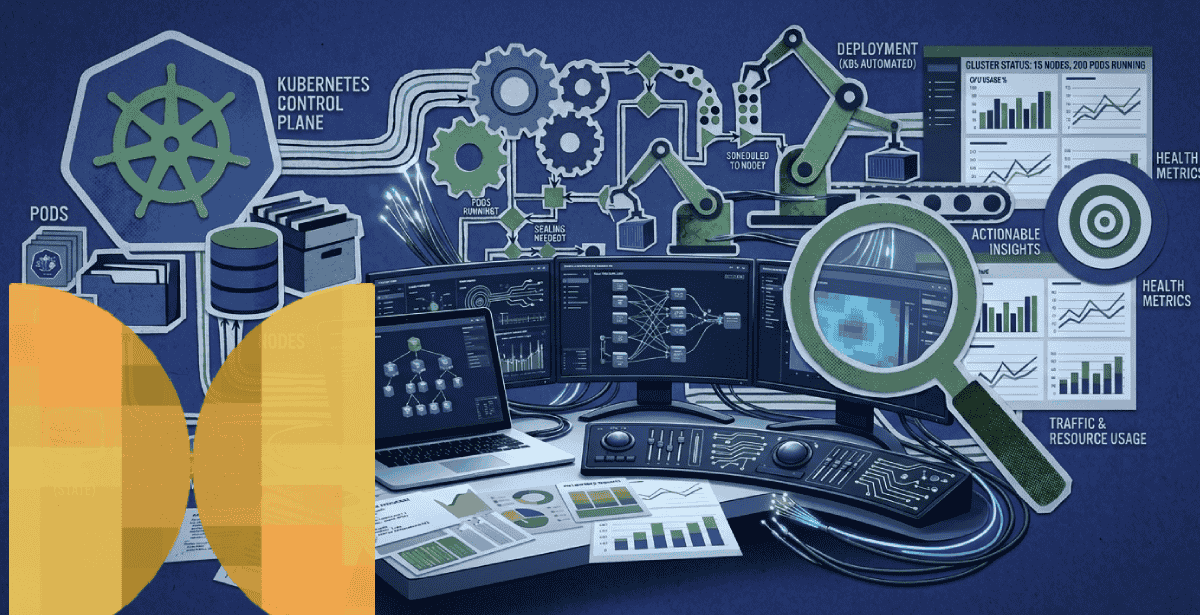
Running a handful of containers by hand is manageable. However, running thousands across dozens of nodes without help is not realistic for any team.
Kubernetes orchestration exists to close that gap. It automates scheduling, scaling, healing, and networking so engineers don’t manage every container by hand.
The following guide will help you further understand how that orchestration actually works once real production traffic arrives. It also covers where teams commonly misunderstand what Kubernetes does and doesn’t automate.
Kubernetes Cluster: The Building Block Orchestration Operates On
A K8s cluster is the set of machines, control plane and worker nodes together, that orchestration operates across. Every scheduling decision happens within this cluster boundary.
Node sizing shapes cluster efficiency more than most teams expect during initial planning. Too few large nodes waste capacity on partially filled machines; too many small nodes add overhead.
Finding the right balance takes real testing against actual workload patterns, not a generic sizing guide. A workload with bursty memory demands behaves very differently than one with steady, predictable usage.
Multi-zone cluster design protects against a single availability zone failure taking down an entire application. That resilience costs some added complexity in return for meaningfully better uptime guarantees.
Namespace strategy also deserves early attention, since it shapes how teams share a cluster without stepping on each other. A poorly planned namespace layout creates confusion as more teams onboard.
Resource quotas per namespace prevent one team’s workload from starving another team’s pods of capacity. Setting those quotas thoughtfully, rather than leaving them unset, avoids a very common and avoidable production incident.
💡 High availability needs to be designed before the first production workload reaches the cluster. Kubernetes cluster architecture should account for control-plane redundancy, workload distribution, persistent storage, automated health checks, and tested recovery procedures so individual failures do not become full-service outages. Regular recovery testing is equally important to verify that the architecture performs as expected when something goes wrong.
Kubernetes Management: What Day-Two Operations Actually Involve
Kubernetes management extends well beyond the initial cluster setup that most tutorials focus on. Upgrades, monitoring, cost control, and security patching all become ongoing responsibilities.
Version upgrades happen on a predictable cadence, and skipping too many puts a cluster at real security risk. Falling multiple versions behind eventually forces a difficult, high-risk jump instead of routine maintenance.
Staying current on a regular schedule turns upgrades into routine maintenance instead of a high-stakes, disruptive event. Most teams that fall behind do so gradually, not through a single decision.
Monitoring needs to cover both cluster health and application-level metrics, since either one failing alone can cause an outage. Prometheus and Grafana remain the most common open-source combination for this purpose.
Cost control is a genuine, ongoing management challenge once a cluster grows past a handful of applications. Over-provisioned resource requests are one of the most common sources of quiet, compounding waste.
Right-sizing those requests based on actual observed usage, not a rough guess, recovers real budget over time. That recovered budget often funds other infrastructure priorities without requiring a larger overall spend.
Security patching cannot lag behind, since Kubernetes and its ecosystem move quickly, and known vulnerabilities get exploited fast. A dedicated patching cadence, reviewed monthly, keeps this from becoming a recurring emergency.
Kubernetes Architecture: Control Plane Decisions That Shape Everything Else
K8s architecture decisions at the control plane level ripple through every workload the cluster ever runs. The API server, scheduler, and etcd all need deliberate, careful design attention.
Choosing a managed control plane versus running one yourself is often the first major architecture decision teams face. Managed options remove operational burden; self-managed options offer more control over configuration.
Etcd performance deserves particular attention, since it’s the single source of truth backing the entire cluster’s state. A slow or unreliable etcd cluster degrades everything running on top of it.
That degradation often shows up as mysterious, hard-to-diagnose slowness elsewhere in the cluster before the real cause is found. Monitoring etcd latency directly catches this problem before it cascades further.
Air-gapped and highly regulated environments add real architectural constraints most public documentation doesn’t address well. No internet-based image pulls, no cloud-managed control plane, and strict change control all apply.
💡 The Kubernetes distribution you choose should reflect how much control, security, and operational complexity your environment can support. Kubernetes architecture decisions are influenced by the tradeoffs between RKE2 and Vanilla Kubernetes around security hardening, customization, operational overhead, and support for constrained environments such as air-gapped deployments. Evaluating these factors against your workload and operational requirements can prevent costly architecture changes later.
DPL Example: Air-Gapped Kubernetes Orchestration for the Pakistan Air Force
The Pakistan Air Force needed container orchestration running with zero external connectivity across a demanding operational environment. Public cloud-managed Kubernetes services were not an option under these constraints.
DPL built an air-gapped Kubernetes environment using RKE2 and Rancher, secured with Istio, Vault, and Falco. The system now orchestrates more than 100 microservices entirely offline.
The results demonstrate what disciplined Kubernetes architecture delivers under a genuinely hard constraint. Deployment frequency rose from monthly to multiple times daily, with mean time to recovery under five minutes.
That combination of speed and reliability shows orchestration discipline matters more than raw infrastructure access. A well-designed air-gapped cluster can outperform a poorly managed cloud-connected one on every meaningful metric.
Why Kubernetes is Perfect for Container Orchestration
Container orchestration existed before Kubernetes, but Kubernetes became the dominant standard because its declarative model and extensible API automated tasks that once required extensive manual configuration.
Earlier tools relied heavily on custom scripting for rolling updates, service discovery, and deployment management. Kubernetes replaced much of that work with declarative configuration, lowering the barrier for mid-sized teams without dedicated infrastructure specialists.
The Kubernetes market is projected to grow from USD 3.13 billion in 2026 to USD 8.41 billion by 2031, representing a 21.85 percent compound annual growth rate. Its adoption has also accelerated as AI workloads introduce new scheduling and resource-allocation demands, particularly around GPU management.
An estimated 82% of container users now run Kubernetes in production, up from 66% in 2023.
Kubernetes’ extensibility through custom resources and operators lets teams adapt the platform to specific requirements. Its ecosystem, including tools such as Helm and Argo CD, further expands what teams can automate without building custom solutions from scratch.
At the foundation of this orchestration is the pod. Kubernetes pods are the smallest deployable units in Kubernetes, grouping containers that need to run together. Understanding how pods are scheduled, managed, and scaled helps explain how Kubernetes handles complex workloads efficiently.
Docker vs Kubernetes: Two Tools Solving Different Problems
Docker vs Kubernetes is a common but slightly misleading framing, since the two tools solve genuinely different problems. Docker packages and runs individual containers; Kubernetes orchestrates many containers across many machines at once.
Confusing the two leads teams to expect Kubernetes to replace Docker outright, which misunderstands what each tool actually does. Most production Kubernetes clusters still run containers built with Docker-compatible tooling underneath, even years into a full, mature migration.
That underlying compatibility is exactly why the “versus” framing confuses so many teams evaluating the two together. They aren’t competing options; they operate at completely different layers of the same stack. Each one solves a genuinely separate problem well, without overlapping much at all.
Teams sometimes delay adopting Kubernetes because they assume it means abandoning tools they already know well. That assumption is usually wrong, since most container-building workflows carry over largely unchanged into a Kubernetes environment.
The real shift Kubernetes introduces is operational, not in how containers get built in the first place. Deployment, scaling, and recovery all change considerably once orchestration enters the picture at real scale.
That operational shift is where most of the learning curve actually lives for teams adopting Kubernetes for the first time. Budgeting time for that learning curve upfront avoids frustration once a team is already mid-migration.
💡 The key is understanding how the two technologies fit into the broader container workflow before making an architecture decision. A clear understanding of Kubernetes vs Docker helps teams identify where containerization ends and orchestration begins, while also preparing them for the operational changes that come with running workloads at scale. Reviewing the differences, use cases, and relationship between the two can make adoption decisions much easier.
Wish to Benefit from Kubernetes Orchestration That Holds Up at Scale?
Getting those early decisions right matters more than most teams initially realize during the first Kubernetes rollout. A weak foundation tends to surface as recurring incidents well after the initial launch celebration ends. Real production traffic patterns tend to expose it eventually.
So, why not get it right from the start?
DPL’s cloud & DevOps services have the experience and expertise to handle even the trickiest projects. Let us help you get the most from your initiatives while preventing costly redesign once a cluster reaches real production scale.
Contact us via the form below with your requirements right away.

Topics
Related Articles
-

Hiring App Modernization Services to Effectively Break Monoliths into Microservices
22-Sep-2026 Waleed Riaz
-

How DevOps Engineering Services Help You Scale Without Full-Time Hiring
21-Sep-2026 Nauman Faridi
-

How the Right Managed Cloud Solutions Turn Infrastructure into a Competitive Edge
20-Sep-2026 Waqas Sharif