How Terraform IaC Eliminates Configuration Drift for Good

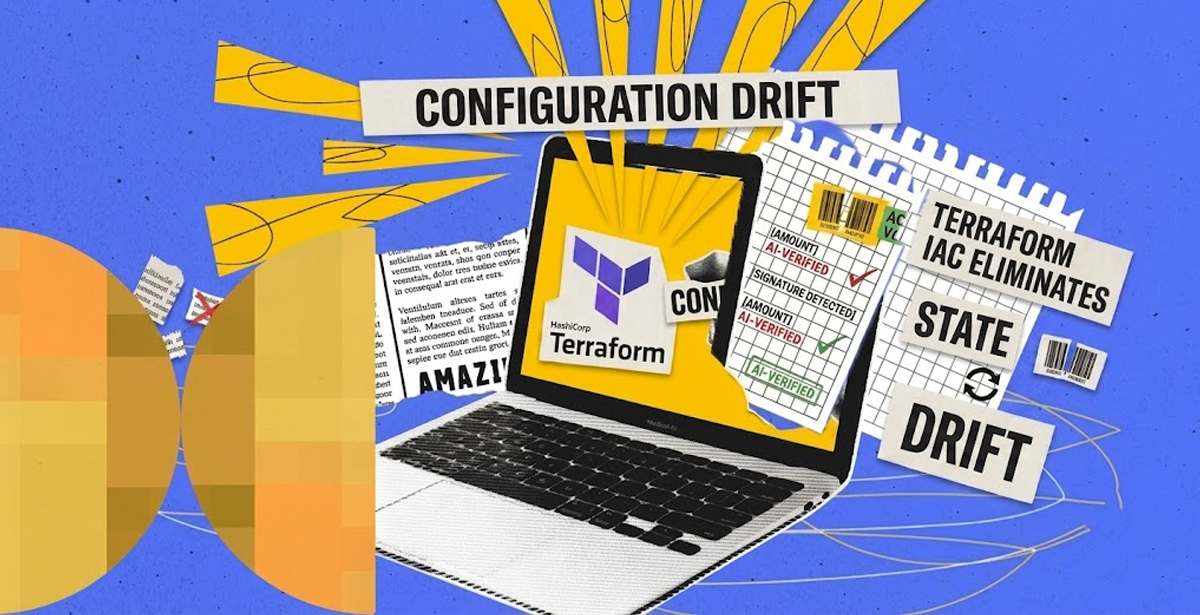
Configuration drift is the quiet failure mode of modern cloud infrastructure. An engineer makes a manual fix in the console. A script runs outside the pipeline. Weeks later, nobody can explain why staging and production behave differently.
Terraform IaC was built to solve exactly this problem. By treating infrastructure as versioned, declarative code, Terraform gives teams a single source of truth that catches drift before it causes an outage.
What Is Configuration Drift Exactly?
Configuration drift happens when the actual state of your infrastructure no longer matches what your code says it should be. It is usually caused by manual changes, emergency hotfixes, or forgotten one-off scripts.
Drift isn’t just an annoyance. Cloud misconfigurations tie for the most frequent cause of breaches from malicious attacks, accounting for 19% of incidents, according to IBM’s analysis of data breach cost factors. Every undocumented change is a gap between what your team believes is running and what is actually running.
That gap compounds. One manual tweak leads to another. Eventually, nobody trusts the infrastructure code at all, and every deployment becomes a gamble.
What is Terraform?
Terraform is an open-source Infrastructure as Code (IaC) tool that enables organizations to provision, configure, and manage infrastructure using declarative configuration files instead of manual processes.
It allows developers and DevOps teams to define cloud resources such as virtual machines, databases, and Kubernetes clusters in code. That way, infrastructure is consistent, repeatable, and version-controlled.
During deployment, Terraform compares the desired state defined in code with the actual infrastructure, creates an execution plan, and applies only the necessary changes. This approach eliminates configuration drift, reduces manual errors, and simplifies infrastructure management.
One of Terraform’s biggest advantages is its cloud-agnostic architecture. Through a rich ecosystem of providers, it can manage resources across AWS, Microsoft Azure, Google Cloud Platform (GCP), Kubernetes, VMware, SaaS platforms, and on-premises environments from a single codebase.
By treating infrastructure as software, Terraform enables organizations to deploy environments faster, improve collaboration between development and operations teams, and maintain reliable, scalable cloud infrastructure throughout its lifecycle.
Why Terraform Leads Modern Infrastructure as Code Tools
The market offers several mature IaC tools, including AWS CloudFormation, Azure Bicep, Pulumi, and Terraform. While all of them automate infrastructure provisioning, they differ in how they manage state, support multiple cloud providers, and detect configuration drift.
Terraform has emerged as the industry standard because of its cloud-agnostic architecture and declarative approach. Using HashiCorp Configuration Language (HCL), teams define the desired state of infrastructure in code, allowing environments to be provisioned consistently across AWS, Azure, Google Cloud, Kubernetes, VMware, and hundreds of other platforms through a single workflow.
Beyond provisioning, Terraform excels at maintaining infrastructure integrity. Its state management system continuously compares the desired configuration with the actual environment.
This makes unexpected changes immediately visible during the planning phase. Instead of relying on manual audits, teams can identify and remediate configuration drift before it impacts production.
Terraform also promotes software engineering best practices for infrastructure. Configurations can be version-controlled, peer-reviewed, tested through CI/CD pipelines, and organized into reusable modules that standardize deployments across environments.
This not only reduces manual errors but also improves collaboration between development, operations, and security teams.
For organizations managing hybrid or multi-cloud environments, Terraform provides a consistent operational model that minimizes complexity while improving governance, repeatability, and scalability.
Terraform plays a critical role in cloud migration by provisioning and managing the target infrastructure through code. As one of the top cloud migration tools, it enables teams to automate networks, compute, storage, and security resources using reusable Terraform modules, ensuring consistent, repeatable deployments while reducing configuration drift and migration risk across AWS, Azure, GCP, and hybrid cloud environments.
How Terraform IaC Prevents Drift by Design
Terraform treats your infrastructure definition as the only source of truth. Every resource, from a Terraform AWS security group to a load balancer, is described in configuration files rather than clicked into existence.
Here is the core mechanism, in plain terms:
- Terraform maintains a state file that records what it last provisioned.
- Running terraform plan compares that state against real infrastructure.
- Any mismatch is surfaced immediately, before it spreads.
According to HashiCorp’s own documentation, drift occurs when “manual changes are made to resources controlled by Terraform outside of the standard Terraform workflow.” The -refresh-only plan flag lets teams inspect exactly what changed without silently overwriting the state file.
This is the definition-style answer worth remembering: Terraform IaC eliminates drift by making every infrastructure change visible, reviewable, and reversible through code, rather than invisible and manual.
Integrating Terraform with a CI/CD pipeline transforms infrastructure changes into controlled, repeatable deployments. Understanding the trade-offs in GitLab CI/CD vs. AWS CodePipeline helps teams choose the right platform for automating terraform plan, policy validation, peer approvals, and terraform apply, ensuring every infrastructure change is tested, reviewed, and deployed before it reaches production.
Why Terraform AWS Workflows Benefit Most
Terraform AWS environments are especially prone to configuration drift because the AWS Management Console makes manual changes incredibly easy.
A single “quick fix” to a security group, IAM policy, route table, or EC2 configuration can bypass Infrastructure as Code entirely, leaving production environments out of sync with the source code.
These undocumented changes often go unnoticed until they cause deployment failures, security vulnerabilities, or compliance issues.
Terraform addresses this by maintaining a state file that represents the desired state of every managed AWS resource. Whenever terraform plan is executed, Terraform compares the infrastructure defined in code against the current state of resources in AWS.
If someone has modified a security group rule, changed an Auto Scaling configuration, or updated an S3 bucket policy directly through the console, Terraform immediately flags the drift and generates an execution plan showing exactly what changed and how it can be reconciled.
This becomes even more valuable in enterprise AWS environments spanning multiple accounts, regions, and teams.
By treating infrastructure as version-controlled code, organizations can enforce standardized deployments, peer reviews, and automated CI/CD workflows instead of relying on undocumented console changes.
The result is greater infrastructure consistency, faster troubleshooting, stronger security governance, and significantly lower operational risk across the AWS estate.
Terraform Cloud and Automated Drift Detection
Manually running terraform plan on a schedule works for small teams. It doesn’t scale. This is where Terraform Cloud becomes essential.
Terraform Cloud can run scheduled drift detection automatically, alerting teams the moment infrastructure diverges from code. No engineer has to remember to check.
This kind of automation matters more than ever. HashiCorp’s own State of Cloud Strategy Survey found that 64% of organizations report a shortage of cloud skills in-house. Automated drift detection removes the burden of manual, expertise-heavy audits from already stretched teams.
Continuous drift detection also builds trust in the pipeline itself. When Terraform Cloud catches an issue automatically, teams stop treating infrastructure changes as something to double-check by hand.
Infrastructure consistency is only half the battle. A robust multi-cloud security strategy extends Terraform’s Infrastructure as Code capabilities by enforcing consistent IAM policies, network configurations, compliance controls, and security guardrails across AWS, Azure, and GCP, reducing configuration drift while strengthening governance in hybrid and multi-cloud environments.
CloudFormation vs Terraform: Why Drift Handling Differs
Every infrastructure as code discussion eventually raises the CloudFormation vs Terraform IaC question. Both tools are declarative, but their drift handling diverges in an important way.
CloudFormation detects drift only within its own stack boundaries, and only on demand. Terraform’s plan-and-apply cycle is built into the everyday workflow, so drift checks happen as a natural byproduct of normal operations, not a separate audit step.
Terraform is also cloud-agnostic. A team managing AWS, Azure, and GCP resources gets one consistent drift-detection workflow instead of three separate tools with three different mental models.
The Takeaway
Configuration drift isn’t a rare edge case. It is the default outcome of any environment where infrastructure can be changed outside its code.
Terraform IaC closes that gap by making state, plan, and apply part of the everyday workflow. Whether you are managing a single Terraform AWS account or a sprawling multi-cloud footprint through Terraform Cloud, the same principle holds: if it is not in the code, it shouldn’t be in production.
Start by auditing your current state file against real infrastructure this week. The first drift you catch is usually the easiest one to fix.
Bonus: Frequently Asked Questions
Does Terraform IaC eliminate configuration drift completely?
Terraform IaC can’t stop someone from making a manual change. What it does is guarantee that change gets detected on the next plan or refresh, closing the gap fast instead of letting it linger unnoticed.
How often should teams run drift detection?
Daily, at minimum, for production environments. Teams using Terraform Cloud typically automate this on a schedule so no one has to remember.
Is Terraform better than CloudFormation for drift management?
For multi-cloud teams, yes. Terraform’s built-in plan cycle and cloud-agnostic state model make drift visible earlier and more consistently than CloudFormation’s on-demand stack checks.