
AI for Government – Building Responsible AI for Public Sector Organizations

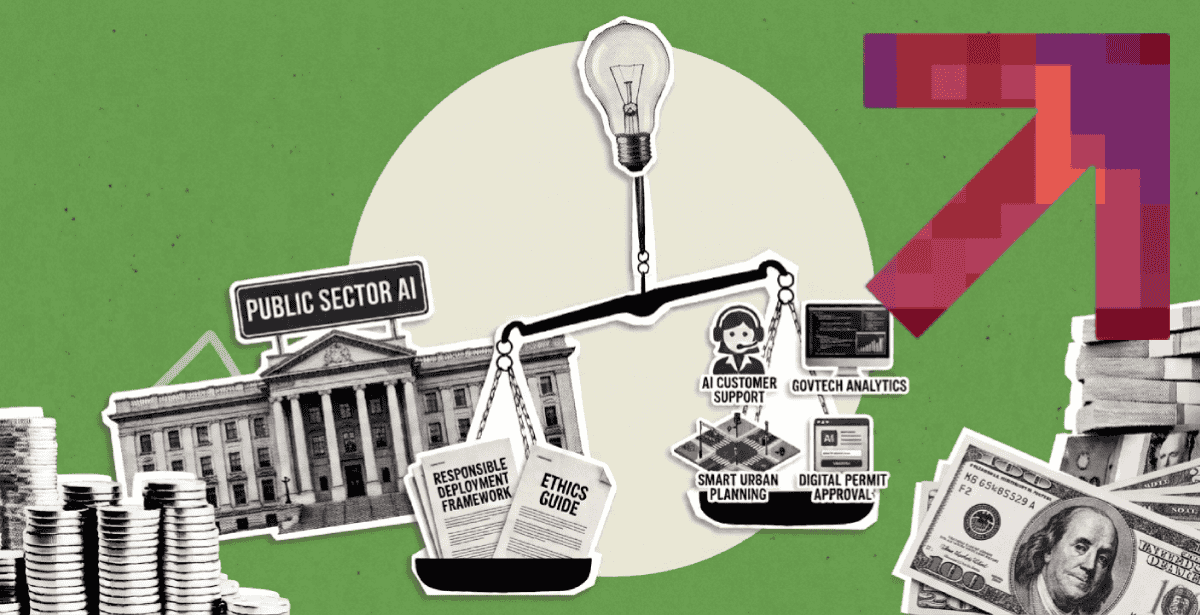
AI for government still delivers real value when deployed carefully – from processing citizen requests and detecting fraud to analyzing vast amounts of public data.
However, when AI is used to make or influence decisions that affect people’s lives, simply asking whether it can be deployed isn’t enough.
Governments also need to ask whether it can be trusted.
That makes responsible AI more than a technology initiative for public sector organizations. It’s about building systems that are transparent, secure, accountable, and designed around the people they serve.
This guide covers how public sector organizations are approaching that deployment responsibly today. It also covers where rushed AI adoption tends to create real problems later.
Government AI Solutions: Where Responsible Deployment Actually Starts
Government AI solutions succeed or fail based on decisions made long before any code gets written. Scoping, oversight, and stakeholder buy-in all come first.
Starting with a narrow, well-defined use case beats attempting a sweeping transformation on day one. A single complaint-handling workflow is easier to govern than an entire agency’s operations.
That narrow starting point also makes it easier to measure real results before expanding further. A pilot that succeeds on a small scale earns the trust needed to scale up responsibly.
Legal and compliance review needs to happen early, not as a final gate before launch. Public sector procurement and data-handling rules are stricter than most private-sector equivalents by design.
Skipping that early review is one of the most common causes of a stalled government AI project. A system built without compliance in mind rarely survives its first serious audit.
Stakeholder alignment across departments matters just as much as the technical build itself does. A system that IT loves but frontline staff distrust rarely survives contact with real daily use.
That upfront coordination pays off most visibly during a project’s first difficult tradeoff decision. Teams that already trust each other resolve those moments far faster than teams meeting for the first time under pressure.
💡 Successful government AI projects require strategic decisions before development begins. AI consulting services can help public sector teams assess use cases, data readiness, compliance requirements, stakeholder needs, and technical feasibility before committing resources. This early guidance can reduce project risk and create a clearer path from pilot to responsible deployment.
Public Sector AI for Balancing Efficiency With Accountability
According to the Public Sector AI Adoption Index 2026, over 70 percent of public servants worldwide now use AI. However, only 18 percent believe their governments deploy it effectively.
AI for the public sector has to deliver efficiency gains without compromising the accountability citizens expect from government systems. Those two goals pull in different directions more often than vendors admit.
Automating a decision entirely removes a layer of human judgment that many public processes were built around deliberately. That tradeoff needs an explicit decision, not a default outcome of a technical rollout.
Keeping a human reviewer in the loop for higher-stakes decisions is one common way to preserve that judgment. It costs some of the speed gains AI promises. It protects accountability where it matters most, especially for decisions with real consequences for citizens.
That tradeoff between speed and oversight should be made openly, with input from legal and program staff. A decision made quietly by an engineering team alone rarely holds up to later scrutiny.
Closing that gap takes clear rules, visible leadership support, and genuine investment in staff training. Technology alone rarely closes a trust gap that wide on its own.
Explainability deserves particular attention in any public sector deployment handling consequential decisions. A citizen denied a benefit deserves a clear, human-understandable reason, not an opaque algorithmic output.
Building that explainability into a system from the outset costs more upfront than bolting it on later. It’s a cost worth accepting given what public accountability actually requires of these systems.
Audit trails matter equally, since a government decision needs to be defensible months or years after it’s made. A system without clear logging makes that defense significantly harder to mount.
GovTech AI Vendors Behind Modern Government Systems
AI for government vendors range enormously in maturity, and picking the wrong one creates real downstream risk for an agency. Not every AI vendor understands public sector constraints equally well.
Vendors with genuine public sector experience tend to ask about compliance and accessibility requirements early in scoping conversations. Vendors without that experience often treat those requirements as an afterthought.
That difference shows up clearly during procurement conversations, well before any code gets written. Asking the right early questions filters out a poor fit before real money changes hands.
Security certifications matter more in this vendor selection than in most private sector procurement decisions. A breach involving citizen data carries reputational and legal consequences well beyond typical vendor risk.
DPL Example: Cutting Complaint Resolution Time by 65%
The Sindh Ombudsman office needed to modernize a complaint management process that was taking up to three weeks per case. Manual triage could not keep pace with growing complaint volume.
DPL built an AI-powered complaint management system using Amazon Bedrock and natural language processing for classification. The system now handles more than 1,000 complaints per day.
The results demonstrate what responsible AI deployment delivers inside a genuine public sector constraint. Resolution time dropped 65 percent, and classification accuracy reached 92 percent in production.
You can read the full Sindh Ombudsman case study to learn how citizen satisfaction rose 42 percent, and infrastructure cost dropped 40 percent.
AI in Public Administration: Where Technology Delivers the Clearest Wins
AI in public administration delivers its clearest wins in high-volume, rules-based processes rather than open-ended discretionary decisions. Document processing and case triage fit this pattern especially well.
Document-heavy workflows, like permit applications or benefits processing, benefit enormously from automated extraction and classification. Staff time gets freed up for the judgment calls that genuinely need a human.
That reallocation of staff time is often the more meaningful outcome than raw cost savings alone. Employees doing more meaningful work tends to improve retention across an entire department.
Predictive workload forecasting is another strong fit, helping agencies staff appropriately for seasonal demand spikes. A tax agency, for example, can anticipate filing-season volume well ahead of time.
Chatbots and virtual assistants handle a meaningful share of routine citizen inquiries without full case automation. That deflection frees staff for the complex inquiries that actually need their expertise and judgment.
Sequencing matters considerably here too, since tackling every process at once overwhelms both staff and IT capacity. A phased rollout, prioritized by volume and risk, tends to succeed where a big-bang launch does not. It’s also far easier to course-correct along the way.
Integration with legacy systems remains one of the hardest practical obstacles agencies encounter during rollout. Many government systems predate modern APIs by decades, and that gap doesn’t close easily.
That legacy gap often surprises teams who scoped a project assuming modern, well-documented interfaces on both sides. Budgeting extra time for integration discovery work avoids an unpleasant midproject surprise later on.
That surprise tends to land right when schedules are already tight and stakeholders are watching closely. It makes an already stressful moment considerably worse for the whole team.
AI for Government: Building Programs That Earn Public Trust
AI programs in government earn lasting public trust when efficiency, accountability, and transparency receive equal weight. Optimizing for one at the expense of the others can create governance gaps that become harder and more costly to fix later.
The NIST AI Risk Management Framework provides a useful, vendor-neutral starting point for structuring responsible AI governance. Establishing clear policies early helps agencies avoid retrofitting governance after systems are already deployed.
Transparency is equally important. Plain-language explanations of how AI systems work and influence decisions can help agencies build public understanding and accountability from the outset.
Agencies can also start small by targeting high-volume, rules-based processes where automation can deliver measurable value. AI automation services can streamline repetitive workflows, reduce manual workloads, and free staff capacity for broader modernization priorities.
A well-governed pilot can provide the evidence needed to build internal support for wider adoption. Documenting its objectives, safeguards, performance, and outcomes gives stakeholders a clear basis for evaluating the next phase.
For public sector organizations, the goal isn’t simply to deploy AI faster. It’s to build programs that deliver measurable improvements while maintaining the transparency, oversight, and accountability citizens expect.
Need the Best AI Experts a Government Office Can Hire?
DPL helps government organizations move from AI strategy to deployment with AI-first engineering, automation, data, and cloud expertise.
From modernizing workflows to building production-ready AI solutions, we bring the technical depth and governance mindset needed to turn AI initiatives into measurable outcomes.
Get in touch with our AI engineering via the form below, and discover how we meet the compliance and accountability demands unique to this sector.

Topics
Related Articles
-

Custom Neural Network Development for Vision, NLP, and Time-Series Data
22-Sep-2026 Hazar Hayat
-

AI Strategy Consulting – How to Build an AI Roadmap That Works in Practice
21-Sep-2026 Waleed Riaz
-

Generative AI for Retail – Smarter Personalization, Product Discovery, and Marketing
20-Sep-2026 Shahrukh Satti