
Architecture Decisions That Determine Long-Term Cost and Scale in Application Development for Cloud

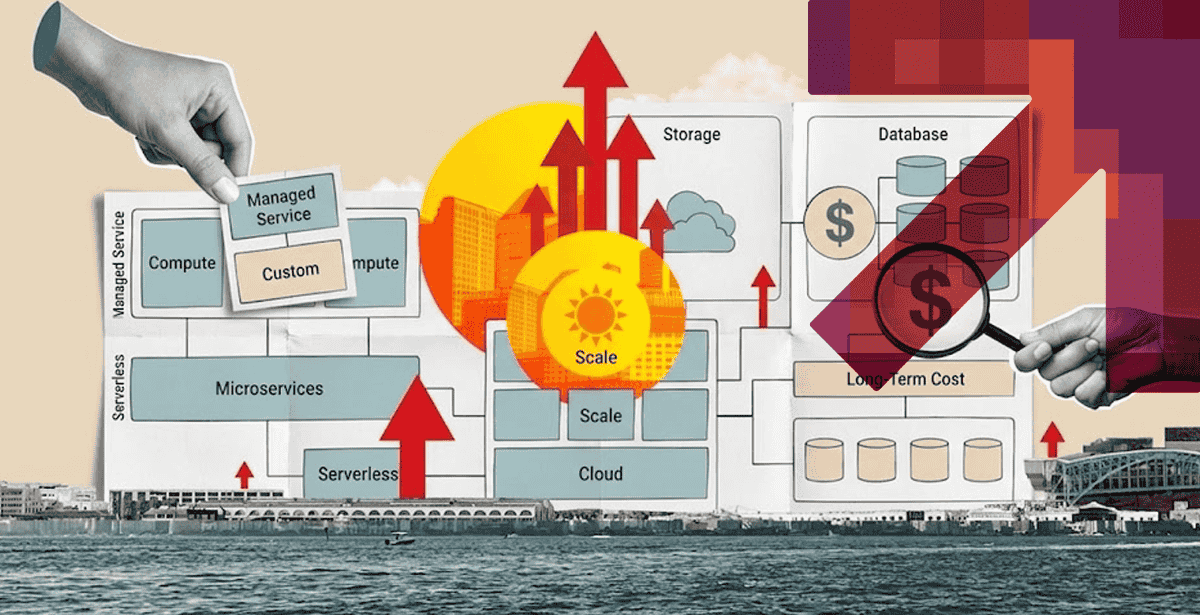
Most cost problems in application development for cloud trace back to one decision made too early. A team picks an architecture pattern before understanding its real workload. That choice compounds for years afterward.
Flexera’s 2026 State of the Cloud Report found something worth noting. Cloud waste climbed to 29% this year. That is the first increase in five years, and rising AI workloads are a major driver.
Why Early Architecture Decisions Shape Application Development for Cloud
Application development for cloud is not just about picking a provider. The deeper decisions involve compute model, data architecture, and how services communicate with each other.
Those choices are hard to reverse later. A monolith built for a single server rarely scales cleanly once traffic grows tenfold. Retrofitting elasticity into rigid architecture costs far more than designing for it upfront.
DPL’s work on the MENA Assistance roadside platform shows what getting this right looks like. The system now handles ten times normal traffic during emergencies. It does that without a full rebuild of the underlying platform.
Cloud App Development Starts With Compute and Data Choices
Cloud app development decisions begin with how workloads actually run. Serverless, containers, and virtual machines each fit different situations. Picking the wrong one early gets expensive fast.
Choosing Between Serverless, Containers, and Virtual Machines
Serverless functions suit bursty, event-driven workloads well. You pay only for actual execution time. Idle capacity sitting unused never shows up on the bill.
Containers fit steady, predictable workloads better than serverless does. They give more control over runtime behavior too. Container orchestration services handle this layer for workloads that need that consistency.
Virtual machines still make sense for legacy dependencies. Not every workload is ready to containerize immediately. Forcing a bad fit here often costs more than it saves later.
Data architecture decisions matter just as much as compute choices do. A database that cannot scale horizontally becomes the ceiling for the whole application. That ceiling shows up exactly when growth matters most.
Cloud Native Application Development: Designing for Elasticity From Day One
Cloud native application development means building for elasticity from the start. Teams that add it later pay a steep retrofitting cost. That distinction shapes nearly every downstream scaling decision.
Statelessness, Service Boundaries, and Failure Isolation
Stateless services scale horizontally without complex coordination logic. Adding a new instance requires no special handling of in-memory state. This single design choice removes an entire category of scaling headaches.
Service boundaries matter just as much as statelessness does. Poorly drawn boundaries create tight coupling between components that should scale independently. That coupling forces the whole system to scale together, driving costs up unnecessarily.
Failure isolation rounds out the picture here. One failing component should not take down unrelated services elsewhere. Container orchestration platforms enforce this kind of isolation by default, unlike a shared monolith.
CNCF’s 2026 survey found that 82% of container users now run Kubernetes in production. That adoption reflects exactly this kind of design discipline.
DPL’s nGAGE serverless SaaS platform demonstrates this pattern well. Tenant isolation runs at the row level. Infrastructure costs dropped 68% after the serverless rearchitecture.
When Application Modernization Services Make More Sense Than a Rebuild
Application modernization services exist because full rebuilds are not always the right call. Sometimes an existing system just needs its architecture updated, not replaced entirely.
A rebuild makes sense when the core business logic itself has changed. Modernization makes more sense when the logic still works fine. The infrastructure around it is usually the actual problem.
DPL’s application modernization work for NJS illustrates this well. The client’s cloud ERP now processes 500,000-plus work orders every year. That happened without a ground-up rewrite of existing business logic.
That project cut infrastructure costs by 35% through containerization alone. It also achieved SOC2 Type II compliance during the same modernization effort. Neither result required starting from zero.
What a Modernization Assessment Should Cover
A real modernization assessment looks at more than code age alone. It examines data access patterns, deployment frequency, and where manual intervention still happens too often.
That assessment should also flag dependencies on infrastructure the team no longer controls well. A legacy database version, for example, can quietly block every other modernization step downstream.
Cloud Modernization Is a Cost Decision, Not Just a Technical One
Cloud modernization gets framed as a technical exercise more often than it should. In practice, it is fundamentally a cost decision. Technical implementation details sit underneath that decision, not above it.
💡Modernize for outcomes, not just location. Moving an application to the cloud doesn’t automatically make it modern. Effective cloud modernization should improve scalability, resilience, performance, security, or operational efficiency—not simply relocate existing infrastructure. Before migrating, identify the limitations of the current architecture and determine whether rehosting, replatforming, refactoring, or rebuilding will deliver the strongest long-term value.
The Flexera waste figures back this up directly. Waste climbs when architecture does not match actual usage patterns. That mismatch gets worse, not better, as an application scales further.
Right-sizing compute is one part of the fix. Matching data storage tiers to access patterns is another. Neither happens automatically without a deliberate modernization decision driving it.
The Role of Cloud Engineering Services in Avoiding Costly Rearchitecture
Cloud engineering services exist to make these architecture decisions correctly the first time. That upfront investment is almost always cheaper than a costly rearchitecture later on.
AWS’s own Well-Architected Framework treats cost optimization as one of its core pillars. It sits alongside reliability and performance, not below them. Cost is not an afterthought bolted onto a working system.
Reliable cloud consulting services apply this thinking during architecture design itself, not after launch. Getting the review done early is far cheaper than fixing a live production system under load.
A dedicated proof of concept is often the fastest way to validate an architecture choice. It tests real assumptions against real workload data. That happens before a team commits budget to a full build.
How Cloud Provider Choice Interacts with Architecture Decisions
Provider choice is not neutral background noise in these decisions. AWS, Azure, and Google Cloud each push architecture in slightly different directions through their native tooling.
Google Cloud’s managed Kubernetes service, for instance, makes container-first architecture the path of least resistance. AWS leans harder toward serverless through Lambda and Step Functions integration.
Neither direction is inherently right or wrong on its own. Problems start when a team picks a provider for one reason. Then it fights that provider’s defaults for an unrelated architecture goal.
DPL works across AWS, Azure, and Google Cloud specifically because provider fit matters this much. The right platform depends on workload shape, not brand preference alone.
Common Architecture Mistakes That Cost Teams Later
A few architecture mistakes show up again and again in application development for cloud. Watch for these early, since they get more expensive to fix the longer they go unaddressed.
Choosing a database that cannot scale horizontally is one common mistake. It works fine at launch. Then it becomes the bottleneck exactly when growth accelerates.
Ignoring statelessness in service design is another frequent mistake. It seems harmless early on. It blocks horizontal scaling once traffic actually grows, though.
Skipping a proof of concept before committing to a full architecture is a third mistake. Assumptions about workload behavior often turn out wrong at real scale.
Treating cost optimization as a later cleanup task rounds out the list. By the time teams revisit it, the architecture is already locked in around the wrong assumptions.
Frequently Asked Questions
When should a team choose serverless over containers?
Serverless fits bursty, unpredictable workloads with idle periods between requests. Containers fit steady, high-throughput workloads better. The right choice depends on your actual traffic pattern.
Is application modernization always cheaper than a full rebuild?
Usually, yes, when the core business logic still works. A rebuild only makes sense when the logic itself needs to change, not just the infrastructure underneath it.
How early should cost optimization enter the architecture process?
As early as possible, ideally during initial design. Retrofitting cost efficiency into a live production system costs far more than designing for it upfront.
Does cloud native mean the same thing as cloud hosted?
No. Cloud hosted just means an application runs on cloud infrastructure. Cloud native means the application is architected specifically to exploit elasticity, containers, and managed services.
How do we know if our current architecture needs modernizing?
Rising infrastructure costs relative to usage are a clear signal. Frequent manual intervention during deployments or scaling events is another sign worth taking seriously.
Get the Best Team on the Job Today
Architecture decisions made early in application development for cloud determine cost and scale for years afterward. Compute choices, data architecture, and service boundaries all compound over time.
Modernizing an existing system often beats a full rebuild, when the underlying business logic still holds up. The infrastructure around it is usually the actual problem worth solving.
DPL’s cloud and DevOps services cover this full architecture lifecycle. That spans initial design through modernization and ongoing cost optimization work.
Talk to us about the architecture decision you are weighing right now. We will help you think through the cost and scale tradeoffs before you commit.

Topics
Related Articles
-
7 Processes Your Team Should Automate First with DevOps Automation Services
31-Aug-2026 Hazar Hayat
-
Kubernetes Pods Explained – How They Work and Why They Matter for Microservices
28-Aug-2026 Hazar Hayat
-
Kubernetes vs Docker – Choosing the Right Tool for Containerized Applications
21-Aug-2026 Hazar Hayat