Building Intelligent Visual AI with Custom Computer Vision Development

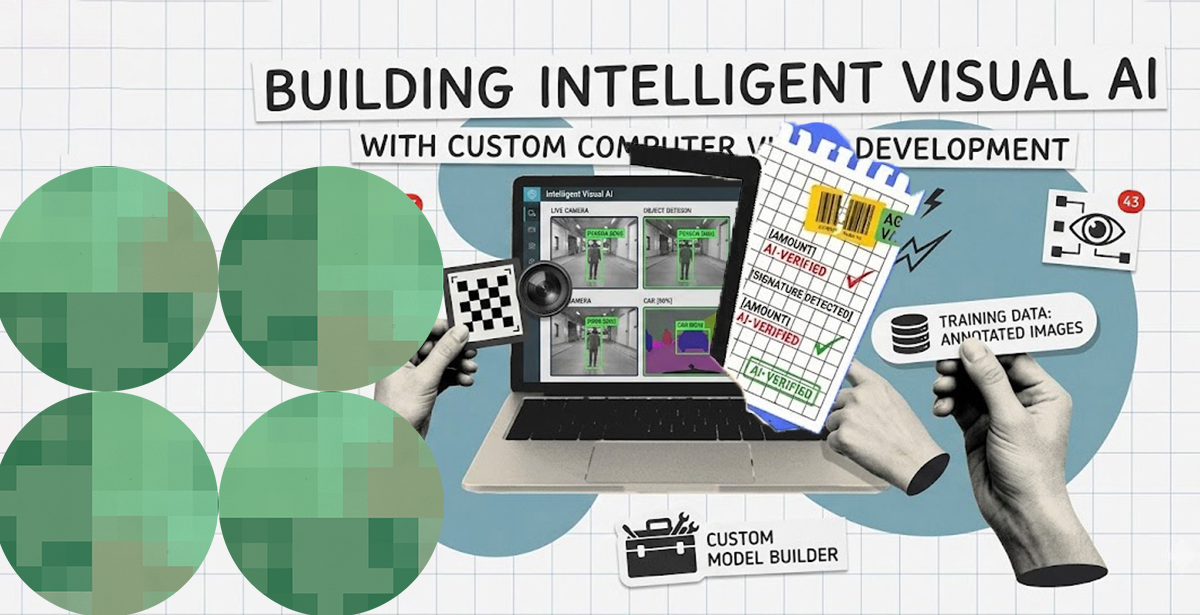
Every business now generates more visual data than it can manually review: security footage, product photos, medical scans, warehouse cameras. Turning that data into decisions is exactly what computer vision development services are built for.
Off-the-shelf tools are available and can get companies started, but real competitive advantage comes from custom visual AI trained on your data, your environment, and your risk tolerance.
Why Visual AI Is Transforming Modern Businesses
Visual AI is rapidly becoming a core enterprise capability, enabling organizations to extract real-time insights from images and video at scale.
Powered by computer vision, these systems use deep learning models to identify objects, detect anomalies, classify images, and automate decisions that once relied on manual inspection.
Unlike traditional image processing, modern computer vision learns from data, allowing it to perform accurately across dynamic environments and continuously improve over time.
When combined with edge computing and cloud infrastructure, Visual AI delivers low-latency inference for applications such as quality inspection, medical imaging, inventory management, and security monitoring.
The global computer vision market is projected to reach approximately $32.88 billion in 2026, driven by enterprise demand for intelligent automation.
As visual data becomes a critical operational asset, organizations are increasingly investing in custom computer vision solutions that deliver higher accuracy, faster decision-making, and measurable business outcomes.
Why Off-the-Shelf Vision Models Aren’t Always Enough
There are many reasons why businesses choose computer vision development services over what’s readily available.
Pretrained models are a strong starting point, but they weren’t built for your exact problem. Several gaps show up quickly once businesses move past pilots.
Domain-Specific Accuracy Challenges
Pre-trained computer vision models are designed to perform well across general datasets, but they often struggle in specialized business environments.
A model trained to recognize everyday objects may fail to identify manufacturing defects, interpret medical scans, or distinguish between visually similar industrial components. Factors such as unique product designs, inconsistent lighting, camera angles, and environmental conditions further reduce accuracy.
For organizations where even minor errors can result in production losses or safety risks, generic models simply aren’t sufficient.
Industry-Specific Data Requirements
Every industry generates visual data with distinct characteristics, making a one-size-fits-all approach ineffective. Healthcare relies on DICOM images and annotated diagnostic scans, while retail focuses on product catalogs, shelf images, and customer interactions.
These datasets often vary in quality, format, labeling standards, and volume, requiring specialized data engineering pipelines before model training can begin.
Building effective Visual AI systems therefore depends on collecting, cleaning, annotating, and managing high-quality datasets that accurately represent real-world operating conditions.
Without industry-specific data, even the most advanced AI models will produce inconsistent and unreliable results.
Privacy, Security, and Compliance
Many computer vision applications process sensitive visual information, including customer identities, medical records, and surveillance footage.
Organizations must ensure these systems comply with regulations such as GDPR, HIPAA, and other regional data protection standards while maintaining robust cybersecurity practices.
This requires secure data storage, encrypted transmission, access controls, audit logging, and privacy-preserving techniques such as anonymization or edge processing.
Beyond regulatory compliance, businesses must also address governance concerns around model transparency, bias, and responsible AI use. All of this is possible with computer vision development services.
Need for Custom Training and Optimization
Deploying a pre-trained model is only the starting point of a successful Visual AI initiative. To achieve production-level accuracy, models typically require fine-tuning using proprietary datasets that reflect an organization’s products, processes, and operating environments.
Continuous optimization further improves performance by incorporating new data, retraining models to adapt to changing conditions, and monitoring for model drift over time. This iterative process is supported by MLOps practices that automate data versioning, testing, deployment, and performance monitoring.
Custom training and optimization enable organizations to build computer vision systems that remain accurate, scalable, and reliable as business requirements evolve.
MLOps are essential for maintaining production-grade computer vision systems. Beyond initial deployment, MLOps services automate model versioning, CI/CD pipelines, drift detection, performance monitoring, and retraining workflows, ensuring Visual AI models remain accurate, reliable, and scalable as data distributions and operating environments change.
Real-Time Performance Considerations
Many Visual AI applications operate in environments where decisions must be made within milliseconds. Autonomous inspection systems, warehouse automation, traffic monitoring, and industrial robotics cannot afford high inference latency or unreliable model performance.
Achieving real-time computer vision requires optimizing models for speed, selecting appropriate hardware accelerators such as GPUs or edge AI devices, and balancing computational efficiency with prediction accuracy.
Organizations must also consider network bandwidth, cloud versus edge deployment, and system scalability as workloads increase.
Designing for production-grade performance ensures Visual AI systems remain responsive even when processing thousands of images or video streams simultaneously.
Custom ML models enable organizations to build proprietary computer vision models optimized for their unique datasets and operational requirements. By fine-tuning foundation models with domain-specific data, businesses can improve feature extraction, reduce false positives, and achieve the accuracy, latency, and robustness that generic models cannot consistently deliver. Therefore, do not skimp on custom ML model development and choose the right partner for the job.
Industries Relying on CV Software Development
Custom computer vision now touches nearly every sector. If you’re interested in computer vision development services but aren’t sure where to start, here are some common use cases from the verticals using this tech the most.
- Manufacturing quality inspection: AI-powered visual inspection detects defects, assembly errors, and product inconsistencies with up to 90% greater accuracy than manual reviews, reducing waste, improving quality, and enabling real-time quality control on production lines.
- Retail inventory and customer analytics: Computer vision monitors shelf inventory, identifies out-of-stock products, and analyzes customer movement, foot traffic, and shopping behavior to optimize merchandising, staffing, and store operations.
- Healthcare diagnostics: Visual AI assists clinicians by analyzing medical images such as X-rays, CT scans, and MRIs, helping prioritize cases, detect abnormalities earlier, and improve diagnostic accuracy.
- Logistics and warehouse automation: AI-powered vision systems identify, track, and sort packages while guiding robotic picking and automated warehouse operations to improve efficiency, accuracy, and order fulfillment.
- Smart cities and surveillance: Computer vision analyzes live video feeds to optimize traffic flow, detect incidents, enhance public safety, and support intelligent infrastructure management in real time.
- Agriculture and crop monitoring: Drone and satellite imagery combined with Visual AI detect crop diseases, nutrient deficiencies, pest infestations, and irrigation issues, enabling precision agriculture and higher yields.
- Financial document verification: Computer vision automates ID verification, document validation, and fraud detection during customer onboarding, accelerating approvals while improving compliance and security.
How to Build Custom Computer Vision Solutions for Your Business
Building custom computer vision solutions follows a repeatable path, regardless of industry. Before contacting a service provider though, you should consider a few steps.
- Identifying Business Problems Suitable for Visual AI – Successful computer vision projects begin with clearly defined use cases where visual data can drive measurable outcomes. Common applications include defect detection, object recognition, identity verification, document processing, and safety monitoring. Prioritizing high-value, data-rich problems ensures faster ROI and smoother implementation.
- Data Collection and Annotation – High-quality datasets are the foundation of accurate computer vision models. Images and videos must be collected from real operating environments, cleaned, and precisely annotated with labels, bounding boxes, segmentation masks, or keypoints to train models that perform reliably in production.
- Model Selection and Fine-tuning – Choosing the right architecture depends on the use case, latency requirements, and deployment environment. Pre-trained models are typically fine-tuned on domain-specific datasets to improve accuracy, reduce false positives, and adapt to unique business conditions.
- Deployment at Cloud or Edge – Computer vision models can be deployed in the cloud for centralized processing or at the edge for low-latency inference. The optimal approach depends on bandwidth, scalability, security, and real-time performance requirements, with many enterprises adopting hybrid architectures.
- Continuous Monitoring and Improvement – Production models require ongoing monitoring to track accuracy, latency, and model drift. MLOps practices enable continuous retraining, performance optimization, and automated deployments, ensuring Visual AI systems remain accurate as data, environments, and business needs evolve.
You can also never go wrong with AI proof of concept development. A successful PoC benchmarks model accuracy, inference latency, infrastructure requirements, data quality, and integration complexity using representative production data. As a result, it provides measurable KPIs before committing to enterprise-scale deployment.
What to Expect From Professional CV Development Services
A capable partner delivering computer vision development services should offer a full lifecycle, not just a model. Few things to look out for are:
- AI Strategy and Feasibility Assessment Before Any Code Is Written – This ensures the proposed solution addresses the right problem, aligns with operational goals, and delivers measurable business value before development starts.
- Dataset Preparation and Labeling Using Domain Experts Where Needed – High-quality training data is critical for model accuracy. Images and videos are collected, cleaned, and annotated, with domain experts validating labels to ensure the model learns from accurate data.
- Custom Model Development Tuned To Your Accuracy and Speed Targets – Developers fine-tune or build computer vision models optimized for specific use cases. This balances detection accuracy, inference speed, and resource consumption based on business and deployment requirements.
- MLOps and Model Lifecycle Management for Versioning, Monitoring, and Retraining – This enables organizations to detect model drift, maintain accuracy, and continuously improve Visual AI systems as new data becomes available.
- Integration with Existing Business Systems – Computer vision solutions deliver the most value when integrated with enterprise applications such as ERP, CRM, or industrial controllers. This enables automated workflows, real-time decision-making, and seamless data exchange across business operations.
- Performance Optimization and Ongoing Support After Go-live – Production environments evolve over time, requiring continuous optimization to maintain speed, accuracy, and reliability. Ongoing support includes monitoring system performance, refining models, updating infrastructure, and implementing enhancements as business requirements change.
Choosing the Right Computer Vision Development Partner
Not every AI vendor can execute custom visual AI well. If you’re looking for the highest quality computer vision development services, you should be assessing according to the following:
- Technical expertise across model architectures, not just one framework
- Experience across industries, since domain nuance changes everything
- AI engineering and MLOps capabilities for production-grade reliability
- Cloud and edge deployment experience matched to your latency needs
- Long-term model maintenance, since vision models degrade as real-world conditions shift
Ideally, you should ask prospective vendors to demonstrate production deployments rather than just proof-of-concepts.
Request details on model accuracy, latency, MLOps workflows, monitoring, and how they manage model drift over time. A provider’s ability to maintain and optimize Visual AI in production is often a better indicator of long-term success than an impressive demo.
AI consulting helps organizations design scalable Visual AI solutions before development begins. Experienced consultants evaluate data readiness, deployment architecture, governance, infrastructure, and MLOps requirements to create implementation roadmaps that minimize technical risk while maximizing long-term business value.
Don’t Miss the Chance to Start a Custom Computer Vision Project
Custom visual AI is no longer a luxury reserved for tech giants. With the right computer vision development services, mid-market and enterprise businesses alike can turn cameras and sensors into a genuine competitive advantage.
The companies that start now, with a clear-eyed assessment of data, infrastructure, and use case, will be the ones setting the pace in their industry over the next several years.