A Technical Guide to Internet of Things Development – From Sensor to Cloud to Dashboard

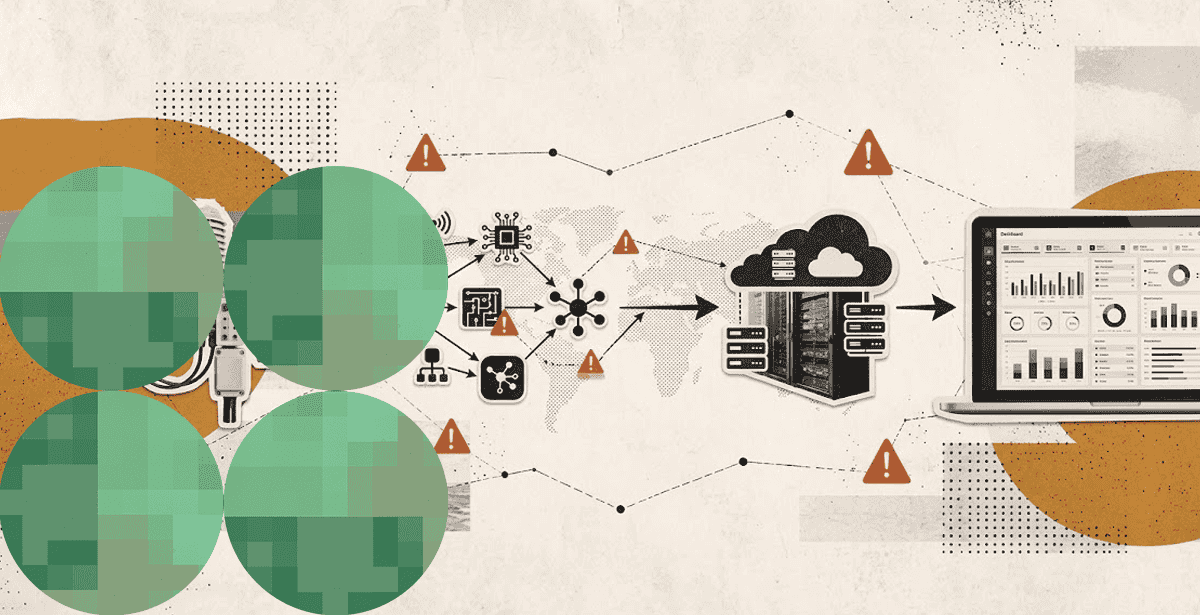
Every internet of things development project touches four distinct layers, whether the team building it realizes that upfront or not. Sensor, connectivity, cloud, and dashboard each demand different expertise entirely.
Most project delays trace back to one of these layers being treated as an afterthought. This guide walks through each layer using real, shipped deployments as proof of what actually works. By the end of it, you’ll know exactly which questions to ask before your next connected device project starts.
What Sensors and Firmware Actually Have to Get Right
Every internet of things deployment starts at the sensor layer, and that’s where the physics constraints live. Battery life, signal range, and environmental durability all get decided here first.
Firmware development at this layer runs under real constraints most application developers never face. Memory is often measured in kilobytes. Every processing cycle affects battery life directly.
Getting sensor calibration wrong here cascades through every layer above it. A drifting temperature reading doesn’t just look wrong on a dashboard. It can trigger false alarms or mask a real equipment failure.
Environmental durability adds another layer of difficulty most software teams underestimate. A sensor rated for indoor use will fail fast outdoors. Solid firmware can’t compensate for the wrong hardware rating.
Reliable firmware development experts tend to treat this layer as its own discipline. It’s kept separate from the cloud and application work built on top of it.
Getting device behavior right the first time matters enormously at this layer. A bug shipped to ten thousand deployed sensors is expensive to fix after the fact. Physical access is often required, unlike a cloud bug a team can patch remotely overnight.
IoT Development Company Considerations for Connectivity
An IoT development company has to make a real connectivity tradeoff before writing a line of cloud code. LoRaWAN, cellular, WiFi, and Bluetooth each solve different range and power problems.
LoRaWAN wins on battery life and range for low-bandwidth sensor data spread across a large physical area. It’s a poor fit for anything that needs to stream continuous data or video.
Cellular connectivity works well when devices move around and WiFi coverage can’t be guaranteed. It costs more per device monthly, so the tradeoff only makes sense for the right use case.
WiFi remains the default choice for fixed indoor deployments with reliable power. Bandwidth is plentiful, and most facilities already have the infrastructure in place before a project even starts.
Choosing wrong here is expensive to reverse later. Swapping connectivity technology after thousands of units ship usually means a full hardware redesign. A firmware update pushed out remotely can’t fix a radio problem.
Security has to enter this conversation early too, not after devices are already in the field. NIST’s IoT device cybersecurity guidance recommends baking device identity and secure communication into the connectivity layer from the start.
IoT Software Development: Where the Cloud Layer Actually Lives
IoT software development at the cloud layer is where raw sensor data becomes something an application can actually use. This layer handles ingestion, device management, and the business logic connecting devices to outcomes.
AWS IoT Core, Azure IoT Hub, and similar platforms handle the device connection and message routing piece. They’re not the whole solution. They’re the ingestion and device-shadow layer underneath everything else.
Device shadows deserve special attention at this layer specifically. They let an application check or set a device’s expected state. That works even when the device itself is offline or asleep to save power.
Fleet-scale software also needs to handle firmware updates safely across thousands of devices at once. A single bad push without proper staging can brick an entire fleet in one afternoon.
Message volume planning belongs here too, well before launch day arrives. A fleet of ten thousand devices reporting every second generates a very different load profile. Reporting hourly instead changes the cost picture entirely.
Case Study: Cloud Software Managing 200,000+ Connected Devices
DPL has been iApartments’ core technology partner since 2019, scaling the platform from MVP through Series A funding. The system now manages more than 200,000 connected IoT devices across the property portfolio.
Locks, lights, thermostats, and sensors all report into a single AWS IoT Core platform built for this scale. Fleet-wide firmware updates roll out in staged batches, never all at once across the fleet.
The results reflect what disciplined cloud-layer software makes possible at real scale. The platform saves an estimated 552,000 manhours annually, with sub-$1 monthly operating cost per connected device.
None of those numbers work without cloud software built specifically for fleet-scale device management from day one.
You can get more details by reading the full iApartments case study.
IoT App Development: Turning Device Data into a Usable Dashboard
IoT app development is the layer most users actually see, and it’s what they judge the entire product by. A dashboard showing raw sensor values isn’t useful. One showing trends and clear next actions is.
Real-time versus historical data presentation is a real design decision, not a technical afterthought. Some users need live status. Others need trend lines across weeks to spot a slow degradation pattern early.
Alert fatigue is the most common IoT app development mistake teams make in practice. A dashboard that flags every minor fluctuation trains users to ignore all alerts, including the ones that actually matter.
Thoughtful threshold design prevents that outcome from the start. An alert should represent a genuine decision point. It shouldn’t just be a data point crossing an arbitrary line drawn early in development.
Role-based views matter just as much as alert design once a platform serves different kinds of users. A facilities manager and a maintenance technician rarely need the same screen or the same level of detail.
IoT Product Development: Managing the Full Stack as One System
IoT product development succeeds or fails on how well these four layers integrate as a single system. That’s the core challenge behind internet of things development work in general, not a niche concern.
Treating the four layers as disconnected projects run by different teams is a common, costly mistake.
A common failure pattern is treating firmware, connectivity, cloud, and app as separate procurement decisions handled by different vendors. Integration problems surface late, usually right before a planned launch date.
A single team, or at minimum a single architect, needs visibility across all four layers from the start. That’s what catches a connectivity choice straining the cloud layer’s expected message volume months before launch.
Budget planning suffers from the same fragmentation when layers are sourced separately. A vendor quoting only the hardware piece rarely flags the cloud infrastructure costs that scale with device count later.
Case Study: Terminal Operating System Across Distributed Border Sites
NLC needed a first-of-its-kind terminal operating system for Pakistani border crossings. It had to work across multiple physical sites with unreliable connectivity between them.
DPL built the system with RFID for vehicle monitoring and gate-out management. Offline-first software keeps the system working even when connectivity to central systems drops entirely.
The system is deployed at Kharlachi Border Terminal, with rollout continuing across all NLC terminals. Dwell time dropped and cargo transparency improved measurably across every deployed site.
If this piques your interest, check out the comprehensive case study for the NLC Terminal Operating System. That result depended on treating hardware, connectivity, and software as one integrated system.
None of the four layers got outsourced separately here. One team owned the RFID hardware choice, the offline-first software design, and the sync logic back to central systems.
That kind of ownership is what let the system keep working through connectivity drops most fragmented projects wouldn’t survive. Nobody had to coordinate an emergency fix across three different vendors mid-deployment.
Cross-border logistics adds regulatory complexity on top of the technical challenge too. Customs data has to stay consistent even during a connection drop. Nothing about that requirement is optional or negotiable.
Vehicle counts, cargo manifests, and gate timestamps all need to reconcile automatically once connectivity returns. A system that just drops records during an outage creates a compliance gap nobody can afford at a border crossing.
Industry data reinforces why that discipline matters more every year as fleets keep growing. IoT Analytics reports connected IoT devices grew 14% to 21.1 billion in 2025. Steady growth is forecast through the rest of the decade.
That scale means integration mistakes get expensive fast. A design flaw costing little across ten pilot devices costs enormously more once it’s replicated across an entire fleet.
Firmware Development: The Layer Everything Above It Depends On
Firmware development deserves one more direct callout because it’s the layer most new IoT teams underestimate going in. Every layer above it depends on firmware working correctly first, without exception.
Over-the-air updates need redundancy designed in specifically to avoid bricking devices during a failed push. A/B partitioning keeps a known-good firmware image available while a new one installs safely in the background.
Security has to start here too, not get bolted on at the cloud layer later. Signed firmware images that reject unsigned updates close off an entire category of supply-chain attack before it can even start.
Our bespoke software for IoT approach treats firmware, embedded software, and cloud logic as connected layers of one system. They’re never separate, disconnected deliverables handed off between teams.
Want an Internet of Things Development Project That Actually Ships?
Internet of things development only works when all four layers get planned together from day one. Bolting them together after each ships on its own separate timeline rarely goes well.
Start with the connectivity decision, since it constrains everything built on top of it. Then design firmware and cloud architecture together, since fleet management assumptions shape both layers simultaneously.
Budget review meetings should include someone who understands all four layers, not just the one their department happens to own. That’s usually the cheapest insurance a project can buy against late-stage surprises.
A dashboard redesign six months in is a minor inconvenience. A connectivity redesign six months in, after thousands of units have shipped, is a far more expensive conversation entirely.
DPL has shipped internet of things systems across proptech, logistics, and government deployments spanning hardware, firmware, cloud, and dashboard work. Our IoT development services can help scope which layer your next connected product needs the most attention on first.
Tell us how we can help you by sharing your requirements in the form below. We’ll get back to you soon.