
Choosing an Internet of Things Platform: AWS IoT Core vs. Azure IoT Hub

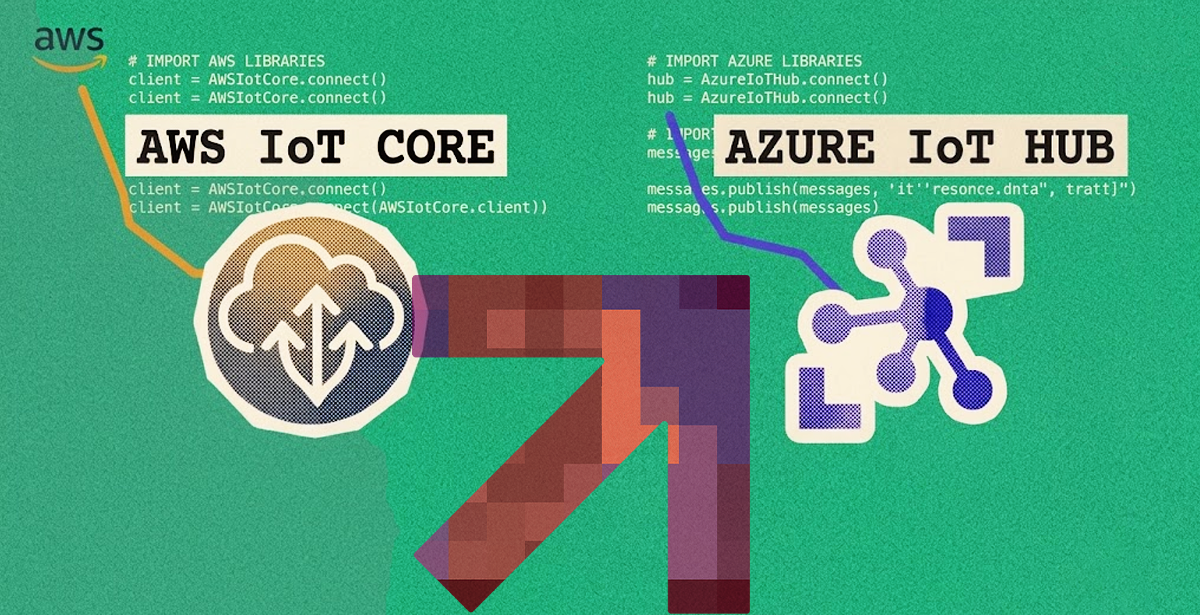
Choosing an internet of things platform is no longer just a cloud infrastructure decision. It determines how easily you can onboard devices, secure communications, process data in real time, and scale operations without driving up costs or operational complexity.
For small pilots, the choice between AWS IoT Core and Azure IoT Hub may seem insignificant. At enterprise scale, however, the differences become impossible to ignore. Aspects such as identity management, edge capabilities, and ecosystem integrations can influence the long-term success of an IoT deployment.
If you wanted to compare AWS IoT Core and Azure IoT Hub across the factors that matter most in production, you’re on the right page.
AWS IoT Core: Strengths and Tradeoffs
AWS IoT Core is built around a rules engine. It routes device messages to other AWS services with very little custom code.
Teams already running workloads on AWS gain a natural advantage here. Data can flow straight into Lambda, S3, or Kinesis without extra glue code.
Where AWS IoT Core pulls ahead is fleet operations. AWS IoT Device Management handles bulk provisioning, remote actions, and fleet indexing at a scale few competitors match.
That scale claim isn’t theoretical. DPL has been iApartments’ core technology partner since 2019. Together they built an AWS IoT Core platform that now manages 200,000-plus connected devices — locks, lights, thermostats, and sensors — across residential units.
The platform processes 2+ million datapoints from 30,000+ apartments today. It runs at a sub-$1 monthly operating cost per device, and it’s on a path to 80,000-plus connected apartments by 2027.
Here’s what this client had to say about working with us.
While all the above sounds great, there’s one tradeoff you’ll need to factor in while selecting AWS IoT Core as an internet of things platform: complexity.
Configuring the rules engine, device shadows, and IAM policies correctly takes real AWS expertise. Mistakes here are a common source of production incidents.
Azure IoT Hub: Strengths and Tradeoffs as an IoT Cloud Platform
Azure IoT Hub takes a more opinionated approach to device-to-cloud messaging. It’s built around device twins that mirror each device’s reported and desired state.
For teams managing configuration drift across large fleets, that model is easier to reason about than raw message routing. Azure IoT Hub also integrates tightly with Azure Digital Twins and Azure Active Directory.
That integration matters for enterprises already standardized on Microsoft identity and compliance tooling. Microsoft’s own guidance covers how to scale an IoT Hub deployment. It spans multiple hubs and regions as device counts grow.
The learning curve is gentler for teams with a .NET or enterprise IT background. Flexibility narrows, though, once a workload moves outside the Azure ecosystem.
What Actually Matters When You Choose an Internet of Things Platform at Scale
Feature checklists matter less than four operational realities:
- Device provisioning
- Security posture
- Cost predictability
- Interoperability
Get any of these wrong, and the platform choice becomes expensive to reverse.
IoT Gateway Design and Device Provisioning at Scale
At 10,000 devices, manual provisioning is impossible. The platform needs automated bulk enrollment, certificate rotation, and remote firmware updates built in, not bolted on.
An IoT gateway layer often sits between edge devices and the cloud platform. It handles protocol translation and local buffering during connectivity gaps.
DPL’s LoRaWAN-based deployments use this same pattern for vehicle monitoring and asset tracking in the field.
Check how cleanly each platform’s SDKs integrate with the gateway hardware already deployed. That fit matters more than raw throughput numbers on a spec sheet.
Security and Compliance at Scale
NIST’s IoT device cybersecurity guidance recommends baseline controls for identification, configuration, data protection, and secure updates. Every additional device is another potential entry point.
Both AWS IoT Core and Azure IoT Hub support per-device X.509 certificates and mutual TLS. The real question is how each platform handles certificate lifecycle management once device counts reach six figures.
As IoT deployments scale, manual credential and certificate rotation quickly becomes unmanageable. A strong IoT application security strategy automates identity management, key rotation, device authentication, and policy enforcement, reducing security risks while ensuring connected devices remain protected throughout their lifecycle.
Cost Predictability for IoT Solutions at Scale
Message-based pricing looks affordable in a demo. It gets unpredictable fast once production traffic kicks in.
A fleet that spikes telemetry frequency during an incident can trigger a cost spike, too. That tends to hit right when budgets are already tightest. Model pricing against your actual message pattern, not the vendor’s default assumptions.
Include reconnection storms, firmware update bursts, and seasonal usage spikes in that model. Do this before signing anything, and model the real ROI of an IoT investment before the contract stage.
Cutting costs with connected devices isn’t just about deploying sensors; it’s about building scalable systems. Well-architected IoT development services reduce infrastructure waste, minimize maintenance costs through remote device management, and prevent expensive downtime, delivering measurable ROI over the entire lifecycle of an IoT deployment.
Interoperability and IoT Middleware for Multi-Cloud Flexibility
Few organizations run a single IoT cloud platform forever. Mergers, acquisitions, and multi-vendor hardware make it likely that some IoT middleware will eventually need to bridge platforms.
Favor platforms that speak standard protocols like MQTT and AMQP over proprietary SDKs, wherever the workload allows it. That choice keeps a future migration measured in weeks, not quarters. It also holds up as the technologies reshaping Internet of Things application development keep shifting underneath the stack.
The Real Decision
The right internet of things platform matches your team’s existing cloud expertise. It also fits your compliance requirements and device provisioning volume, not the vendor with the longer feature list.
Start by mapping your fleet’s growth curve for the next 18 months. Then stress-test both platforms’ pricing and provisioning tools against that number. Do it through a proof-of-concept IoT build before signing a multi-year contract.
That exercise, done early, heads off most of the expensive re-platforming decisions. Those tend to surface two years into a deployment, not two months.
DPL’s IoT and embedded development team has run this exercise for real estate, logistics, and industrial clients. It’s worth a conversation before you lock in a platform.
Bonus: Frequently Asked Questions
Is AWS IoT Core or Azure IoT Hub better for large fleets?
Neither wins universally. AWS IoT Core tends to suit teams already deep in the AWS ecosystem with complex event-routing needs. Azure IoT Hub suits teams standardized on Microsoft identity and device-twin state management.
Do I need a dedicated IoT platform instead of building custom infrastructure?
Past a few hundred devices, yes. The provisioning, patching, and scaling work a managed platform handles becomes a full-time engineering burden otherwise.
How many devices can these platforms actually support?
Both are architected for millions of concurrent connections. Real-world throughput depends heavily on message size, frequency, and how well the account is partitioned across hubs or endpoints.