
IoT Services Company – What a Real IoT Partner Actually Delivers

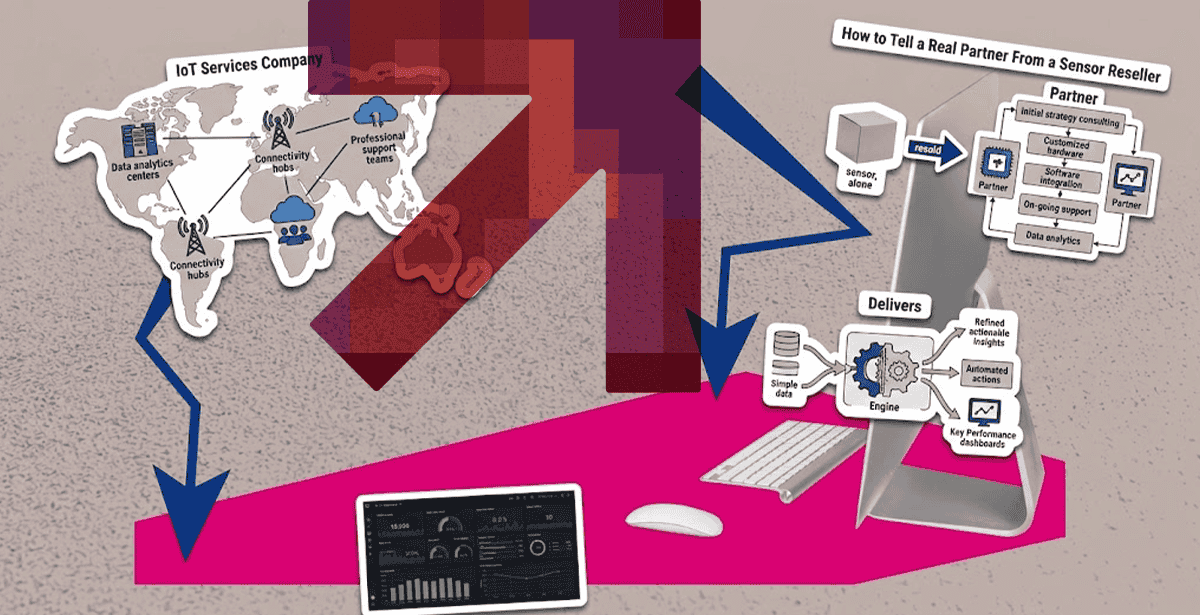
The enterprise IoT market reached $324 billion in 2025, growing 14% into 2026. That growth has pulled in a lot of vendors who sell hardware but cannot deliver anything around it.
Picking the wrong IoT services company is expensive. A sensor reseller can get devices talking to a dashboard. It usually cannot get that data working for your actual business.
What an IoT Services Company Actually Delivers
An IoT services company should cover four connected layers, not just one. That means device firmware, cloud infrastructure, data pipelines, and the business logic tying it together.
A reseller typically stops at layer one. They ship a sensor, hand you an app, and disappear once the invoice clears. Nobody stays around when that sensor stops reporting correctly.
DPL’s own IoT development services span firmware, cloud architecture, and predictive maintenance together. That range is the difference between a device and a working system.
Why a Single Vendor Beats a Patchwork of Specialists
Splitting firmware, cloud, and app development across three vendors creates coordination gaps. Each vendor optimizes their own layer, without full visibility into the others.
Those gaps show up months later, usually during a production incident. A single accountable partner catches integration problems earlier, before they reach a customer.
Accountability also gets clearer with one vendor involved. When something breaks across a multi-vendor stack, each vendor can point to another as the likely cause. That finger-pointing costs real time during an actual outage.
IoT Consulting Services: Strategy Before You Buy Hardware
IoT consulting services should come before any hardware gets selected, not after. Strategy decisions made early determine what hardware actually makes sense to buy.
Why IoT Consulting Comes First, Not Last
A reseller sells you their catalog. Real IoT consulting starts with your actual problem instead, then works backward to the right technology stack.
That distinction matters enormously. Cisco’s Connected Futures research found that only 26% of IoT projects were considered a complete success. Most failures trace back to unclear goals set before any hardware was chosen.
Good consulting also scopes a pilot before a full rollout happens. A narrow proof of concept tests real assumptions against real conditions. That happens before a company commits real budget to a full deployment.
Connectivity choice is one of the first strategic decisions a good consulting engagement resolves. LoRaWAN, cellular, and WiFi each fit different device density and power requirements.
💡 Choose connectivity based on the workload. If you’re asking what is LoRaWAN, the key is understanding where it fits in the connectivity stack. LoRaWAN is well suited to low-power devices that transmit small amounts of data over long distances, making it useful for applications such as smart buildings, asset tracking, environmental monitoring, and industrial sensing. It is less suitable for high-bandwidth applications that require continuous data transmission.
IoT Development Services: Firmware, Cloud, and Everything Between
IoT development services cover far more ground than most buyers expect going in. Firmware, connectivity, cloud infrastructure, and user-facing software all need real expertise.
Why Full-Stack Capability Actually Matters
A team that only writes firmware will struggle with cloud scaling later on. A team that only builds cloud dashboards may not understand device power constraints at all.
DPL’s firmware development work sits alongside cloud and data engineering under one roof. That structure avoids the handoff gaps that show up when two separate vendors split the work.
Security sits inside this layer too, not bolted on afterward. NIST’s NISTIR 8259 series defines baseline cybersecurity practices IoT device makers should follow from day one.
A vendor unfamiliar with that baseline is not equipped to build production IoT hardware responsibly. Device authentication and encrypted communication should never be treated as optional extras.
IoT Solutions Built Around Your Actual Use Case
Good IoT solutions get shaped by the problem they solve. They should never be shaped by whatever hardware a vendor happens to have sitting in inventory already.
DPL’s bespoke software approach to IoT reflects this directly. Generic platforms work fine early on. They tend to hit a ceiling once requirements get specific.
A smart workforce tracking deployment illustrates this well. DPL built WiFi-based indoor location tracking for a facility management client. That system now spans 50,000-plus workers across 18,000 locations nationwide.
No off-the-shelf platform was designed for that exact scale and use case. Custom IoT solutions cost more to build initially than a generic platform does.
That upfront cost buys real headroom, though. Custom builds avoid the rigid limits generic platforms eventually hit once a deployment scales past a pilot.
Managed IoT Services: What Happens After Launch Day
Managed IoT services matter more than most buyers realize during the sales process. A device fleet does not run itself once it ships into the field.
Monitoring, Patching, and Fleet Management at Scale
Devices fail, firmware needs updates, and security patches cannot wait indefinitely. Someone has to own that ongoing responsibility once a deployment goes live in production.
A reseller has typically moved on to the next sale by this point. Real managed IoT services include monitoring, remote diagnostics, and scheduled firmware updates as standard, ongoing work.
This is where the real cost of a cheap sensor reseller shows up later. A device without ongoing management becomes a security liability within months, not years, of deployment.
Fleet-wide visibility is the other piece buyers underestimate. Knowing which devices are online, updated, and healthy across thousands of units requires real tooling, not a spreadsheet.
DPL’s use of AWS IoT Device Defender and CloudWatch monitoring illustrates what real fleet management looks like at scale. Alerts fire automatically the moment a device drifts out of expected behavior. That happens well before a customer ever notices anything wrong on their end.
How Pricing Structure Reveals What You Are Actually Buying
Pricing structure often tells you more than a sales pitch does. A one-time hardware invoice with no ongoing line item is a strong signal. It usually means you are buying devices, not a service relationship.
A real IoT partner typically prices in phases. Discovery and consulting come first. Development and integration follow, and managed operations continue as a recurring cost after launch.
That recurring cost is not padding. It reflects real, ongoing work. Someone monitors dashboards, patches firmware, and responds when a device in the field starts misbehaving unexpectedly.
Buyers should be skeptical of any vendor who cannot explain what that ongoing fee actually covers. Vague answers here usually mean there is no real team behind the number.
Contract length is worth scrutinizing too. A vendor unwilling to commit to a genuine multi-year support relationship is telling you something important. They may not expect their own hardware to last that long once it is out in the field.
Red Flags That Signal a Sensor Reseller, Not a Real Partner
A few warning signs repeat across sensor resellers pretending to be full IoT partners. Watch for these during vendor evaluation, before signing anything.
Vague answers about firmware update processes are one clear red flag. A real partner can explain exactly how updates get tested and pushed to devices already in the field.
No mention of device security standards is another warning sign. A vendor unfamiliar with frameworks like NISTIR 8259 likely has not implemented real IoT security before.
Inability to name a comparable deployment at real scale rounds out the list. Portfolio slides are easy to produce. A specific reference client, with a real device count, is not.
Ask for a reference call directly, and insist on a named contact. A vendor who hesitates here is telling you something worth paying close attention to before signing anything at all.
The Bottom Line
An IoT services company should deliver a working system, not just a shipped device. Firmware, cloud infrastructure, and ongoing management all matter equally to that outcome.
A sensor reseller can get you started. It rarely sticks around for the parts of a deployment that actually determine long-term success.
DPL’s IoT and embedded development services cover consulting, development, and managed operations under one roof. Our portfolio spans deployments across facility management, logistics, and real estate.
Talk to us about the project you are evaluating vendors for right now. We will help you tell a real partner from a reseller before you sign anything.

Topics
Related Articles
-
The Most Common IoT Security Risks — and the Architecture Decisions That Eliminate Them
28-Aug-2026 Waleed Riaz
-

IoT Integration – Connecting Devices, Data, and Enterprise Applications
21-Aug-2026 Bilal Sattar
-

How to Vet an IoT Development Company Before Betting Your Product on Them
20-Aug-2026 Bilal Sattar