How to Customize Open-Source Models for Production Accuracy Using LLM Fine-Tuning Services

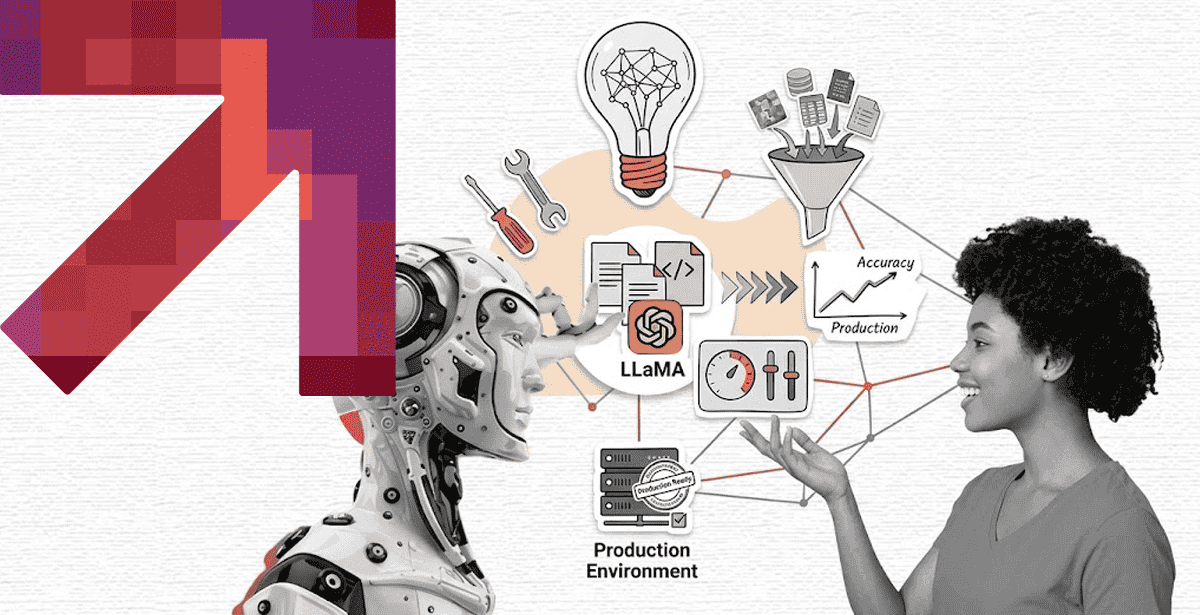
Most open-source models perform well in a demo and disappoint in production. The gap usually isn’t the model. It’s how little of your own data it has actually seen.
LLM fine tuning services exist to close exactly that gap. They take a general-purpose model and adapt it to the language, edge cases, and formats specific to your business.
What LLM Fine-Tuning Services Actually Do
LLM fine tuning services take a pre-trained model and continue training it on a narrower, task-specific dataset. The base model already understands language. Fine-tuning teaches it your business.
That distinction matters because most teams reach for prompting first, and prompting has real limits. A clever prompt can’t teach a model vocabulary it has never encountered in training.
Fine-tuning works differently. It adjusts the model’s internal weights using labeled examples drawn directly from your own documents, tickets, or transcripts.
The result is a model that performs consistently on your specific data, not just on generic benchmarks. That consistency is what production systems actually need to stay reliable.
Not every use case justifies this investment, and a good partner says so upfront. Simple, well-defined tasks often perform fine with prompting or retrieval alone.
Cost is part of that honest conversation too. Training runs, evaluation cycles, and ongoing monitoring all add up. A partner should walk through that math before any contract gets signed.
The teams that get real value from LLM fine tuning services usually share one trait. They know exactly what accuracy problem they’re solving before training ever starts.
When Fine-Tune LLM Beats Prompting and RAG
Deciding to fine-tune an LLM instead of relying on prompting or retrieval comes down to a few concrete signals. Volume is one of the clearest.
High-volume, repetitive tasks where the same document types and formats appear constantly are strong candidates. A model trained specifically on that pattern outperforms one guessing from a prompt each time.
Domain-specific vocabulary is another strong signal worth watching for. Legal, medical, and technical fields all use terminology a general-purpose model was never trained to recognize precisely.
Latency and cost also factor into this decision more than most teams initially expect. A fine-tuned model can often run smaller and cheaper than a large general-purpose model wrapped in a long prompt.
Retrieval augmented generation solves a different problem, and the two approaches aren’t mutually exclusive. RAG grounds answers in current documents; fine-tuning changes how the model reasons and writes.
Many production systems combine both approaches for the best result. Fine-tuning shapes tone and domain reasoning, while retrieval keeps facts current.
Teams that treat this as an either-or choice usually end up disappointed. The strongest systems layer these techniques together rather than picking one upfront.
What the Custom LLM Training Process Actually Looks Like
Custom LLM training starts with data, not with model selection. A dataset of a few thousand clean, representative examples often outperforms a much larger, messier one.
Data quality matters more than volume at nearly every stage of this work. Inconsistent labeling teaches the model wrong patterns just as effectively as good data teaches the right ones.
Evaluation design deserves as much attention as the training data itself. Teams need a clear, measurable definition of success before training begins, not after results start coming back.
Iteration is normal, and teams that expect a single training run to nail production accuracy usually end up disappointed. Most successful projects run several rounds before results stabilize.
Version control matters here just as much as it does in regular software development. Every training run should be reproducible, with a clear record of which dataset and parameters produced which model.
Holdout data that the model never sees during training is what makes evaluation meaningful. Testing against training data only tells you the model memorized examples, not that it generalizes.
Case Study: Automating 50,000+ Daily Work Orders with a Customized LLM
National Janitorial Solutions is a facility management company with 18,000 US locations. This client was processing more than 50,000 work orders daily. Each of these arrived as unstructured, inconsistent paperwork.
Manual classification consumed massive amounts of staff time and introduced errors at scale. Nobody could keep pace with the volume using manual review alone.
DPL integrated Google Document AI with GPT-3.5 Turbo, customized to the company’s specific document formats and terminology. The system automatically classifies PDFs and extracts purchase order and invoice numbers.
The results speak to what disciplined model customization delivers in practice. The company now saves 400 hours of manual labor every week across its entire operation.
None of that accuracy happened on the first attempt either. The team iterated on document samples and extraction rules repeatedly. Error rates only dropped to a reliable level after several rounds.
LLM Model Customization: Techniques Beyond Full Fine-Tuning
LLM model customization covers a wider range of techniques than full fine-tuning alone. Parameter-efficient methods like LoRA adjust a small fraction of a model’s weights.
That efficiency matters enormously for cost and iteration speed. A LoRA adapter can be trained in hours on modest hardware, compared to days for a full fine-tuning run.
Multiple adapters can also be swapped in and out of the same base model for different tasks. That flexibility avoids maintaining a separate full model copy for every single use case.
A single base model can effectively serve several departments this way. Each team gets behavior tuned to its own workflow without the infrastructure cost of running separate large models.
Prompt-tuning and instruction-tuning sit further along this same spectrum, requiring even less compute than LoRA. They work best for narrower behavioral adjustments rather than deep domain knowledge.
Choosing among these techniques depends heavily on available data volume and budget. Teams with limited labeled examples often get more reliable results from a lighter-weight technique than from full fine-tuning.
Stanford HAI notes that fine-tuning requires far less data and compute than training a model from scratch. That efficiency is exactly why these lighter techniques exist in the first place.
What to Ask Before Signing On an LLM Fine-Tuning Company
An LLM fine-tuning company worth hiring should start with your data, not a generic playbook. Ask how they handle data cleaning, labeling, and privacy before any training begins.
Evaluation methodology is where a lot of vendors get vague fast. A capable partner defines success metrics tied to your actual business outcomes, not just generic benchmark scores.
Ask specifically how they prevent catastrophic forgetting, where a model loses general capabilities while learning narrow ones. That failure mode is common and often goes unmentioned in sales conversations.
Team continuity is worth probing too, the same way it matters in any technical vendor relationship. Ask who actually runs the training pipeline versus who shows up only for the sales pitch.
Our generative AI services can build fine-tuning pipelines around exactly these safeguards. Evaluation happens continuously, not just once before launch.
Pricing transparency matters here as well. A vendor should walk through compute cost, data prep effort, and retraining cadence. That math should come before any number gets attached to a proposal.
Reference customers in your specific industry are worth asking for directly. A partner who has only fine-tuned models for one narrow use case may not transfer well to your particular data.
Team continuity questions apply here too, the same way they matter in any long-term vendor relationship. Ask whether the same engineers who scope the project actually stay on through deployment.
Ongoing monitoring after deployment matters just as much as the initial training run. Models drift as real-world data shifts, and nobody notices until output quality visibly degrades weeks or months later.
That drift is often invisible until a customer or auditor flags it directly. Waiting for that signal is far more expensive than catching it through routine monitoring.
💡 Proprietary models become valuable when they capture patterns that generic models can’t. Custom ML model development should start with high-quality proprietary data, clear business objectives, rigorous evaluation, and a plan for monitoring and retraining as that data changes. The goal is not simply to build a model your competitors cannot access, but one that delivers measurable value from knowledge unique to your business.
AI Model Development Services: Where Fine-Tuning Fits the Bigger Picture
AI model development services span far more than fine-tuning alone, and framing matters here. Fine-tuning is one tool among several for adapting a model to your business.
Data pipelines, evaluation infrastructure, and deployment tooling all belong in the same conversation as the model itself. A great fine-tuned model with no monitoring around it degrades quietly and expensively.
A model development program that only ever produces one model rarely justifies its own overhead. The real return comes from reusable pipelines that make the second and third model faster to ship.
That reuse is where the economics of custom model work actually improve over time. The first model is always the most expensive one to build.
Retrieval-grounded systems often pair naturally with a fine-tuned model underneath. So, before hiring RAG Implementation services, discuss how they can make these two approaches complement each other in production.
Choosing the right combination depends on how often your underlying knowledge changes. Fast-changing information favors retrieval. Stable, structural knowledge favors baking it directly into the model through fine-tuning.
Most real deployments end up needing both layers working together. Treating them as competing options rather than complementary ones is a common early mistake that costs teams months.
Governance has to scale alongside any custom model program, especially at enterprise size. Every automated decision built on a customized model needs a clear audit trail explaining why it happened.
That documentation burden grows with regulatory scrutiny, particularly in finance, healthcare, and government work. Skipping it early almost always means retrofitting it later, at much higher cost.
Auditors and regulators alike will eventually ask why a customized model made a specific call. “The model was trained that way” is never an acceptable answer on its own.
Vendor lock-in is worth watching closely too, especially with proprietary fine-tuning platforms. Choosing open, portable formats keeps future options open as the underlying models keep improving.
Open-weight models have narrowed the performance gap with closed alternatives considerably over the past two years. That shift gives buyers real leverage they didn’t have before.
Cost predictability improves with that leverage as well. A team that isn’t locked into one vendor’s pricing can renegotiate or migrate when a better option appears.
Model selection itself deserves the same scrutiny as any other architecture decision. Newer open-weight releases regularly close the gap with proprietary alternatives on narrow, well-defined tasks.
The pace of change in this space rewards that kind of caution more than most teams expect going in. Gartner predicts organizations will use small, task-specific models three times more than general-purpose LLMs by 2027. Lower cost and better accuracy on narrow tasks are driving that shift.
That shift toward smaller, purpose-built models is exactly what good fine-tuning work enables. Betting entirely on one giant general-purpose model looks increasingly short-sighted for most business use cases.
Getting Production Accuracy from LLM Fine-Tuning Services
LLM fine tuning services earn their cost when a model performs reliably on your data, not just in a demo. That’s a narrower, more valuable bar.
Start with a clear evaluation plan, invest in clean training data, and expect iteration before results stabilize. Teams that skip any of these steps rarely get the accuracy they were promised.
None of this requires betting the entire roadmap on one giant training run. Small, well-scoped projects build the internal muscle for bigger ones later, with far less risk attached.
DPL’s AI engineering team has customized models for government, facility management, and enterprise clients running in production today. And we’re ready to replicate our successes in your upcoming project. Let us know what we can do in the form below.

Topics
Related Articles
-
Building Autonomous Agents for Real-World Workflows with an AI Agent Development Company
17-Sep-2026 Nauman Faridi
-
How to Make Digital Transformation AI the Engine of Your Modernization Strategy
15-Sep-2026 Waleed Riaz
-

Medical Image Analysis – The Role of AI in Modern Medical Diagnostics
14-Sep-2026 Saad