Building With Llama, Mistral, and DeepSeek in Production – A Guide to Open Source LLM Development


Open source LLM development used to mean a tradeoff. Pick a weaker model, or pick a cheaper one. That tradeoff doesn’t hold the way it used to.
Llama, Mistral, and DeepSeek have all closed the capability gap considerably over the last two years. What hasn’t changed is the engineering work required to run any of them well.
Open weights give you a starting point. Not a finished system. Production reliability, fine-tuning, and ongoing operations still have to be built around the model itself.
Why Enterprises are Rethinking Open Source LLM Development
Enterprise adoption of open-source models is smaller than the hype suggests, at least so far. The topic comes up constantly in planning conversations anyway. Open-source models made up just 11% of enterprise LLM API usage in 2025. That’s down from 19% the year before.
That’s according to Menlo Ventures’ State of Generative AI in the Enterprise report, based on a survey of enterprise decisionmakers. The same report found enterprises “remain cautious, preferring closed-source models” for now, at least on average.
Llama remains the leading open-weight model in enterprise use. That’s true even as its growth has slowed since its last major release hit the market. The same report points to that stagnation as one driver of the broader open-source pullback in spend.
Mistral and DeepSeek split most of the remaining open weight share between them. Both sit well behind Llama in enterprise spend. Both still show up in real production deployments today, often chosen for the specific tradeoffs covered later in this guide.
What the Performance Numbers Actually Show
The performance picture tells a different story than the spending numbers, though. Stanford’s 2026 AI Index tracked the capability gap on a major public leaderboard. That gap sat between the top closed model and the top open-weight model.
It had narrowed to roughly 3.4%, down from over 15% in 2023 as per the Stanford AI Index Report 2026.
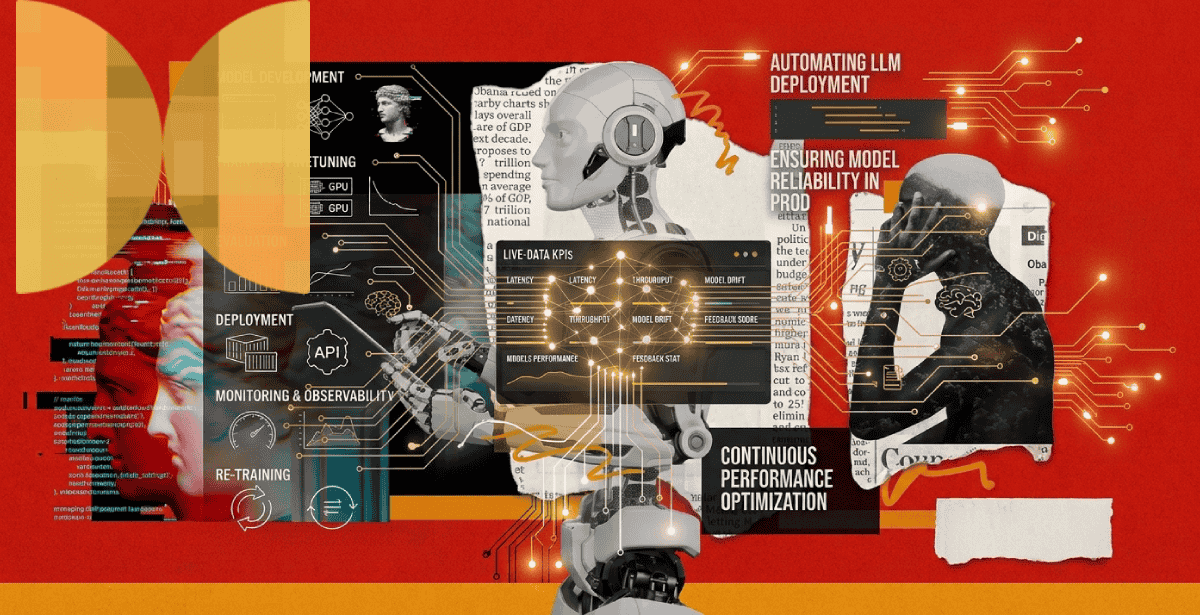
None of this means open source LLM development is a dead end. It means the teams succeeding with it treat deployment as seriously as model selection itself. The gap isn’t really in the models. It’s in the production engineering wrapped around them.
Llama Development Services: Where Open Source Starts for Most Teams
Llama remains the default starting point for most enterprise open-source LLM development. The ecosystem around it is the most mature of the three. Tooling, fine-tuning frameworks, and deployment guides all exist in greater depth than for newer alternatives.
That maturity doesn’t eliminate the engineering lift required to ship it. Running Llama in production still means choosing a hosting strategy. It means picking a serving framework too, and a monitoring approach suited to your real traffic pattern.
Generic deployment guides rarely account for any of that nuance. Teams that get Llama development services right treat the model as one component in a larger system. Not the whole system by itself.
Retrieval, guardrails, and evaluation pipelines all matter as much as the model weights themselves. A strong base model wrapped in a weak system still produces weak results downstream.
Mistral Integration: Built for a Different Kind of Workload
Mistral’s models are smaller and faster than many Llama variants at comparable quality. That efficiency makes Mistral integration attractive for latency-sensitive applications specifically. Real-time chat and search ranking both benefit directly from that speed advantage.
Where this gets complicated is retrieval. A fast model paired with a slow pipeline still produces a slow application. That holds true no matter how quickly the model itself responds once called.
Why Retrieval Quality Matters More Than Model Speed
Latency budgets get eaten up fast once retrieval, re-ranking, and generation all run in sequence for one query. Teams often tune the model first, since it’s the visible piece. The retrieval layer underneath is usually the slower half of the pipeline.
Mistral’s speed advantage only shows up end to end if the surrounding system keeps pace with it. A fast model bolted onto a slow retrieval layer still feels sluggish to the person waiting on an answer.
For more complex knowledge bases, a simple vector lookup isn’t always enough on its own. Relationships between documents and entities often carry meaning that matters just as much as the words themselves. A flat similarity search misses that meaning entirely, especially across long, interconnected knowledge bases spanning many teams.
GraphRAG implementation extends that retrieval layer with exactly those structured relationships. It’s a deeper investment, but one that pays off clearly on complex, interconnected content.
DeepSeek Customization: Cost-Efficient Reasoning at Scale
DeepSeek has carved out a specific niche in this space. Strong reasoning performance, at meaningfully lower compute cost than many comparable closed models on the market today.
That cost advantage is exactly why DeepSeek customization work has grown among cost-conscious engineering teams this year. Reasoning-heavy workloads benefit most directly from that cost profile, especially at real production volume.
Customizing a reasoning-focused model differs from customizing a general chat model in one key way. The fine-tuning data needs to preserve reasoning structure, not just tone and vocabulary choices.
Get that wrong and you can quietly degrade the exact capability you chose the model for in the first place. Reasoning quality erodes slowly, often before anyone on the team notices the regression.
LLM fine-tuning services work across different model families applies directly here. The fine-tuning mechanics differ by model. But the discipline around data quality and evaluation stays consistent, regardless of which logo sits on the model card.
What Production Customization Actually Requires
DPL saw this discipline play out directly while customizing a document processing system for National Janitorial Services. The original build used Google Document AI and GPT-3.5 Turbo. Both were tuned to that client’s own document formats and edge cases, not a generic template.
The lesson generalizes well beyond that specific model pairing. Getting any model, proprietary or open source, to perform reliably on a client’s actual documents takes rigorous evaluation. It takes iteration against real failure cases pulled from production, not synthetic benchmarks pulled from a leaderboard somewhere online.
Document formats vary wildly between clients, even within the same industry and the same general category of paperwork. A model that performs well on one client’s invoices can stumble on another’s. The cause is usually formatting quirks nobody anticipated during the initial build.
That discipline resulted in 400 hours saved weekly and more than 50,000 work orders automated daily for that client. The specific model mattered less than the evaluation rigor wrapped around it.
The same rigor applies directly to validating Llama, Mistral, or DeepSeek on your own data. Trusting a model in production without that validation step is how quiet failures start.
Choosing Between an Open-Source Language Model and a Proprietary One
The honest answer depends on what you’re optimizing for. An open-source language model gives you control over hosting, fine-tuning depth, and data residency. A closed API simply can’t match that level of control.
A closed model trades that control for less operational overhead day to day. Someone else runs the infrastructure, patches the model, and handles the scaling question for you entirely.
Cost sometimes favors open source at scale, once hosting and engineering time are accounted for honestly. It doesn’t always, though, and that caveat matters more than most vendors mention upfront.
A closed model billed per token can beat a self-hosted model running on underutilized GPU capacity. It depends heavily on your actual traffic volume and how efficiently your infrastructure runs day to day.
Generative AI consulting services often start from this point. Teams need help modeling the real cost and risk tradeoffs before committing to either path for a given use case.
LLMOps for Open Source: Keeping Self-Hosted Models Reliable
Self-hosting an open-source language model shifts real operational weight onto your own team directly. Model updates, prompt drift, and latency monitoring all become your responsibility. A vendor no longer owns any of that for you, quietly, behind an API you never see.
That tradeoff only pays off with the right operational discipline behind it from day one. Without it, savings from self-hosting get eaten up fast. Incident response eats the budget nobody set aside for it, on a team already stretched thin.
A model that performed well at launch can drift within a few months. Usage patterns shift, and the production data it sees diverges from what it was tuned on. Nobody notices until quality complaints start showing up from real users.
LLMOps services cover exactly this gap directly. Versioning, rollback plans, and cost monitoring. All built for models running in your own infrastructure, not someone else’s managed endpoint.
Why Prompt Engineering Still Matters After Deployment
That operational layer catches drift before it reaches a customer-facing failure. It also gives a team confidence to update a model whenever the data warrants it. Nobody has to re-litigate the entire deployment every single time a change comes up for discussion internally.
Prompt engineering matters quite a bit here too. Teams often underestimate it going into a self-hosted deployment of this kind. Small wording changes alone can shift output quality more than a full model upgrade would.
That shift comes at a fraction of the engineering time a full retraining cycle requires. The risk of trying it first is minimal by comparison. The upside can be substantial when it works out well on real production traffic.
Prompt engineering services frequently reveal something teams don’t expect going in. A well-tuned prompt closes more of the quality gap than switching models entirely would have.
Getting Open-Source LLM Development Right
Llama, Mistral, and DeepSeek all represent real, production-viable paths today. None of them are experiments anymore. The differentiator between teams that succeed and teams that stall isn’t model choice at all.
It’s the engineering discipline wrapped around deployment, fine-tuning, and ongoing operations over time. That discipline is learned, not downloaded along with the model weights.
Need more guidance? DPL offers custom LLM application development as part of its AI engineering services. Our work spans both open source and proprietary model families. Each build is centered on whichever foundation actually fits the use case and the budget at hand.
Let us know how our team can help you. Contact us via the form below.