
The Smart Building Technology Stack – Sensors, Gateways, IoT, and Cloud

Walk into a modern office tower and you rarely see the technology that runs it. Smart building technology works quietly in the background. Thermostats adjust themselves. Lights follow occupancy. Alerts fire before a chiller fails.
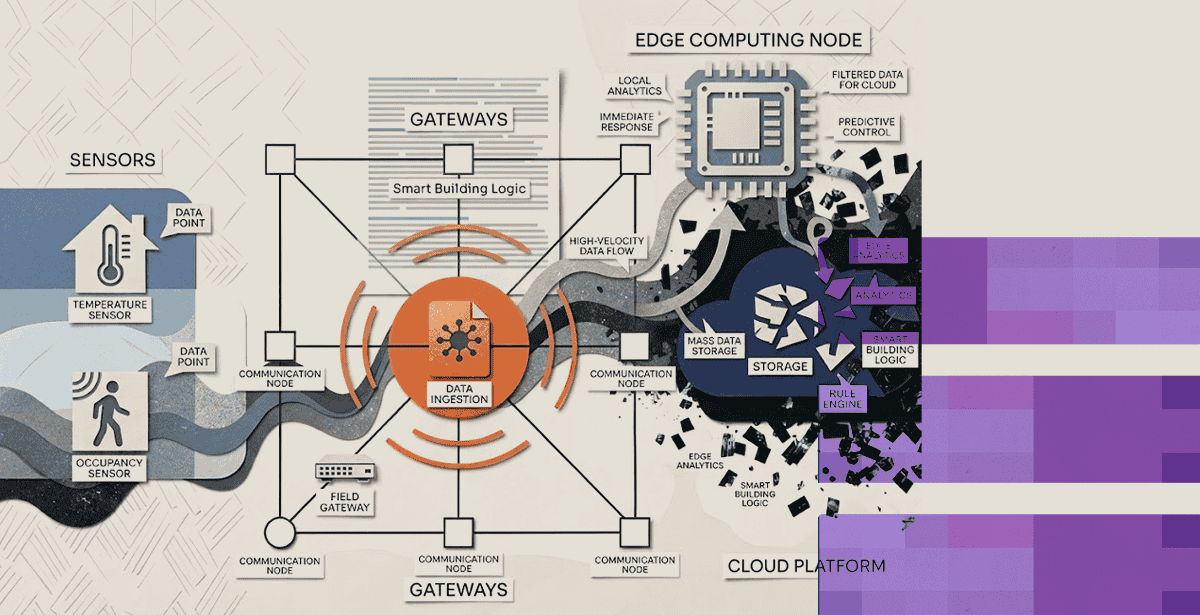
None of that happens by magic. It happens because three layers work together. Sensors capture raw data. Gateways move it. Cloud platforms turn it into decisions.
Buildings account for roughly 30% of global energy demand, according to the International Energy Agency. That single fact explains a lot.
It explains why the smart building market is projected to grow from $121.57 billion in 2026 to over $204 billion by 2032, per MarketsandMarkets research. This piece breaks down the tech stack behind that growth, layer by layer. It also covers what separates a solid deployment from a fragile one.
Inside a Smart Building: The Sensor, Gateway, and Cloud Stack
Every smart building runs on the same basic architecture, regardless of size or industry. Sensors sit at the edge. Gateways sit in the middle. Cloud platforms sit at the top.
Sensors measure temperature, occupancy, humidity, energy draw, and equipment vibration. Gateways aggregate that data locally and forward it over a network protocol. Cloud platforms store it, analyze it, and trigger automated responses.
DPL’s IoT development work follows this same three-layer model across every deployment. That holds whether it’s a single office or a portfolio of 30,000 apartments. The layers change in scale, not in structure.
Sensors: The Data Layer
Sensor selection depends entirely on what the building needs to measure. A parking garage needs vehicle detection. A residential unit needs HVAC runtime and door-lock status. A warehouse needs vibration and temperature sensors on critical equipment.
Connectivity choices matter as much as the sensors themselves. LoRaWAN suits low-power, long-range use cases, like vehicle monitoring across a large corporate lot. WiFi and Bluetooth work better for dense indoor deployments, where range matters less than data volume.
Gateways: The Bridge Between Field and Cloud
Gateways do more than relay data. They buffer readings during connectivity gaps. They apply basic filtering. They reduce the raw volume before it reaches the cloud.
A well-designed gateway layer often makes the difference between a system that survives a network outage and one that quietly loses data. DPL’s firmware development team builds this edge logic directly into embedded hardware. That keeps gateways working even when connectivity is unreliable.
Building Automation: Turning Data into Action
Building automation is what happens after the data arrives. Raw sensor readings are worthless without logic that decides what to do with them.
A basic rule might be simple: if occupancy drops to zero, dim the lights. A more advanced one draws on historical patterns. If HVAC runtime exceeds a unit’s normal baseline, it flags the anomaly before a tenant complains.
That second pattern is where automation earns its budget. DPL’s predictive maintenance and AI engineering work layers machine learning on top of automation rules. Simple thresholds become predictive alerts.
Automation also depends on reliable device management at scale. DPL’s cloud and DevOps infrastructure runs on AWS IoT Core. It handles device shadows, fleet indexing, and auto-scaling. Automation logic keeps running as a building portfolio grows from dozens of units to tens of thousands.
Smart Building Solutions Across Industries
Smart building solutions look different depending on the building type. The underlying stack rarely changes. Three real deployments show the range.
Smart Communities and Proptech
DPL has been the core technology partner for iApartments since 2019, from MVP through Series A funding. The platform now manages more than 200,000 connected devices. That includes locks, lights, thermostats, and sensors across residential units on a single AWS IoT Core architecture.
The results speak for themselves. The platform saves an estimated 552,000 labor hours a year. It also runs at a sub-$1 monthly operating cost per connected device.
🔥 Hot tip! Think beyond individual devices. Smart building technology works best when sensors, gateways, connectivity, and cloud platforms operate as one connected architecture. Check out our smart building solutions to learn how these layers work together to create scalable, intelligent building environments.
Facility Management at National Scale
Smart building technology extends beyond a single structure. DPL built a WiFi-based indoor location tracking system for a nationwide janitorial services company. It runs across more than 50,000 workers at 18,000-plus locations in all 50 US states.
The same sensor-gateway-cloud model that tracks a thermostat also tracks a workforce badge. Only the data source changes.
Government and Border Infrastructure
Not every smart building is commercial. DPL built Pakistan’s first Terminal Operating System for a border crossing point. It combines RFID, vehicle monitoring, and gate management into one platform.
The system now handles real-time cargo tracking across National Logistics Cell terminals. It has cut dwell time and improved transparency at scale.
Smart Energy Management: Where the ROI Shows Up
Smart energy management is usually the fastest-justified line item in a smart building budget. The savings are easy to measure. Every degree of unnecessary heating or cooling has a dollar figure attached.
Predictive Maintenance and HVAC Optimization
The clearest energy wins come from predictive maintenance. Instead of servicing HVAC equipment on a fixed schedule, sensors track real usage and flag anomalies early.
An occupied apartment unit typically runs its HVAC cycle for one to seven hours. A malfunctioning unit can run over 200 hours in the same period. It burns energy the whole time and heads toward a costly failure.
Catching that gap early is smart energy management in its most direct form.
Choosing the Right IoT Solutions for Your Building Stack
Not every building needs the same IoT solutions. A ten-story office and a 30,000-unit apartment portfolio face different constraints. Both still run on sensors, gateways, and cloud.
Security and Connectivity Considerations
When it comes to securing IoT, you should treat this matter as a priority rather than an afterthought. Always cover the controls that matter most for building systems. These include X.509 certificate-based device authentication, TLS 1.3 encryption, and continuous monitoring through tools like AWS IoT Device Defender.
Connectivity choices also compound over time. A building that starts with WiFi-only sensors may need LoRaWAN later, for outdoor assets like parking or perimeter monitoring. Idealy, you should know how these protocols fit together rather than compete.
Message protocol matters too, though it gets less attention than sensors or security. MQTT keeps bandwidth low for high-frequency readings, which suits large sensor fleets on constrained networks.
HTTPS is simpler to implement and works well for lower-frequency data, like daily energy reports. Most mature IoT solutions end up running both, matched to what each device actually needs to send.
Planning for Growth Before You Build
The biggest mistake in early-stage deployments is designing for the current building count, not the next one. A stack built for ten units rarely survives the jump to a thousand without a redesign.
DPL’s IoT consulting work starts by mapping expected scale against connectivity choice, cloud architecture, and device management tooling. Getting that sequence right up front avoids a costly rebuild eighteen months into a rollout.
Frequently Asked Questions
What is smart building technology, in simple terms?
Smart building technology is the combination of sensors, gateways, and cloud software that lets a building monitor and adjust itself automatically. It covers everything from lighting and HVAC to security and workforce tracking.
What’s the difference between smart building technology and building automation?
Smart building technology is the full stack: sensors, gateways, and cloud. Building automation is the logic layer that acts on the data those sensors and gateways produce.
How fast does smart energy management pay for itself?
Timelines vary by building type. Predictive maintenance use cases often show measurable savings within the first year, since they catch equipment failures before they turn into emergency repairs.
Do smart building solutions require replacing existing infrastructure?
Not usually. Most gateways integrate with existing HVAC, lighting, and access-control systems. That keeps rollout costs and timelines manageable, rather than requiring a full hardware replacement.
Start With the Layer That Matters Most
Smart building technology is not one product. It is three layers working together. Most failed deployments trace back to weakness in just one of them: sensors that don’t fit the use case, gateways that lose data during outages, or cloud platforms that can’t scale past the pilot.
If you’re evaluating where to start, DPL’s IoT consulting and PoC development team can help validate your stack on a narrow slice of real building data before you commit to a full rollout.

Topics
Related Articles
-

IoT Integration – Connecting Devices, Data, and Enterprise Applications
22-Aug-2026 Bilal Sattar
-

How to Vet an IoT Development Company Before Betting Your Product on Them
21-Aug-2026 Maha Yaser
-
Building a Smart Factory – The IoT, Automation, and Data Infrastructure Required to Get There
19-Aug-2026 Bilal Azhar