
Top Traits of High-Impact DevOps Consulting Companies (and Red Flags to Avoid)

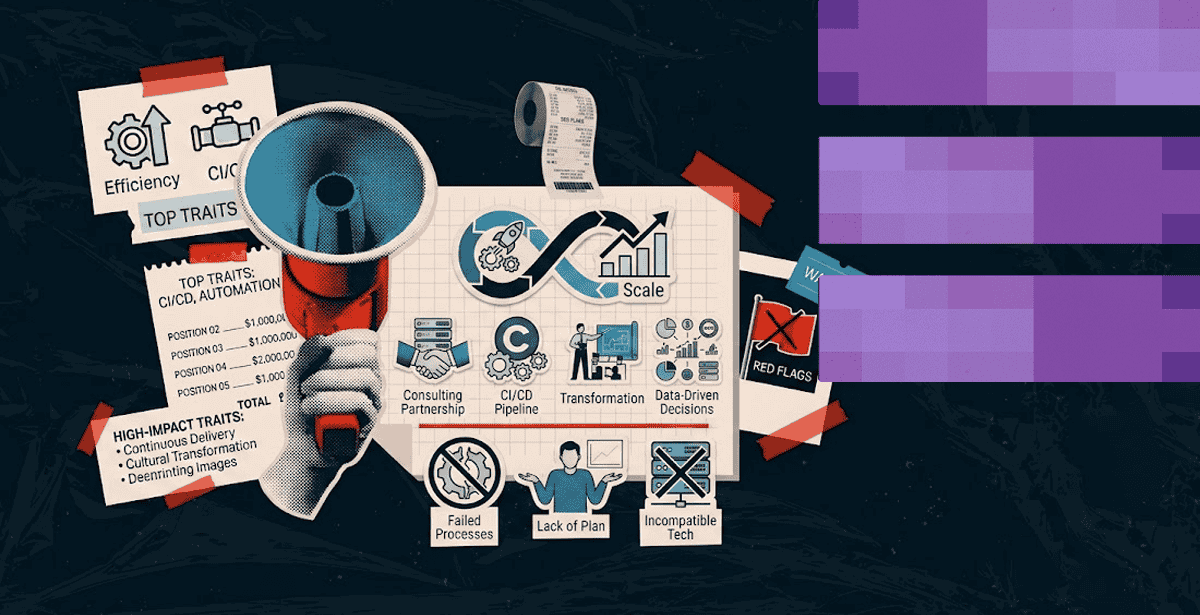
Every DevOps consulting pitch sounds the same: faster deployments, fewer outages, happier engineers. Most can’t back it up. The 2025 DORA State of DevOps report found that only about 40% of teams industry-wide actually hit elite or high-performing status, proving that speed and stability rarely come from a slide deck alone.
Choosing among DevOps consulting companies is one of the highest-leverage decisions an engineering leader makes. Get it right and deployment frequency, uptime, and cost all move in the right direction within months. Get it wrong and you’ve paid consultants to leave your pipeline exactly where they found it.
This post breaks down what separates the DevOps consulting companies that actually move the needle from the ones that just bill hours, plus the red flags that predict which one you’re hiring.
What the Best DevOps Consulting Companies Actually Do Differently
High-impact firms don’t sell DevOps as a product. They treat it as an operating model change: culture, tooling, and architecture shifting together. That’s a harder sell than “we’ll set up your pipeline,” which is exactly why so few firms commit to it.
The market backs up why this matters right now. Global spending on DevOps tooling and services is projected to climb from $24.30 billion in 2026 to over $125 billion by 2034. As budgets grow, so does the number of firms claiming expertise they don’t have.
The best DevOps consulting companies share a few concrete traits, not vague promises. Here’s what to actually look for.
Trait #1: Real DevOps Consulting Experience, Not Just Certifications
Certifications prove someone passed a test. They don’t prove a team can decompose a legacy monolith into microservices under a hard deadline, or debug a failed deployment at 2 a.m. without paging the client.
Real DevOps consulting experience shows up in specifics: which orchestration tool they chose and why, what broke during a migration, how they measured the fix. If a firm can’t name the actual tools and tradeoffs behind a past engagement, they probably didn’t do the work themselves.
💡Look for evidence, not just credentials. When evaluating DevOps consulting services, ask for specifics about past engagements: the tools selected, architectural tradeoffs, migration challenges, deployment failures, and measurable outcomes. Certifications can demonstrate knowledge, but real consulting expertise shows in how a team handles complex problems under real-world delivery pressure.
Trait #2: They Operate Like a DevOps Consulting Firm, Not a Staffing Agency
A staffing agency hands you contractors and a timesheet. A genuine DevOps consulting firm owns outcomes: deployment frequency, mean time to recovery, infrastructure cost, and security posture, with numbers attached.
This distinction showed up clearly in one of our own engagements. When DPL modernized a Pakistani government agency’s complaint platform, the goal wasn’t “add engineers” — it was a 65% reduction in complaint processing time and a 42% increase in deployment frequency, achieved through GitLab CI/CD and containerized microservices on AWS.
That’s the accountability gap. A staffing model can’t promise a number like that because nobody owns the architecture end to end — which is the whole premise behind any reliable DevOps solutions and service provider company.
Trait #3: Depth in Cloud DevOps Consulting Across Multiple Providers
Most connected products don’t live on a single cloud forever. A firm that only knows one provider’s dashboard will steer every client toward that provider, regardless of fit.
Strong cloud DevOps consulting means fluency across AWS, Azure, and Google Cloud, plus the judgment to know when a workload actually needs multi-cloud versus when that just adds complexity.
We saw this firsthand building CarPal’s roadside assistance platform on Google Kubernetes Engine, where GKE’s auto-scaling handled 10x burst traffic during regional emergencies without a rearchitecture.
AWS DevOps Consulting Chops That Go Beyond the Basics
AWS DevOps consulting is its own specialty, given how deep the AWS toolchain runs: CodePipeline, CodeBuild, CodeDeploy, Lambda, ECS, and increasingly Bedrock for AI-driven features. A firm that only knows how to wire together a basic pipeline is leaving most of AWS’s value on the table.
Our work re-architecting iApartments’ IoT cloud platform is a case in point. Rebuilding around ECS, auto-scaling, and cost-optimized storage tiers brought operating cost per connected device under $1 a month across 200,000-plus devices, while keeping message latency under 200 milliseconds.
💡Look beyond the pipeline. Effective AWS DevOps consulting should go beyond setting up a basic CI/CD workflow. Look for expertise across services such as CodePipeline, CodeBuild, CodeDeploy, ECS, Lambda, and Bedrock, with the ability to architect around your workload’s scalability, performance, and cost requirements. The right AWS strategy should optimize the entire delivery and infrastructure stack—not just automate deployments.
Red Flags: Signs a DevOps Consulting Company Is All Talk
Some warning signs show up before a contract is even signed. Watch for a DevOps consulting company that:
- Leads with Tools, Not Outcomes – If the pitch is a list of logos (Kubernetes, Terraform, Jenkins) with no numbers attached to past results, that’s a checklist, not a track record.
- Won’t Commit to Metrics – Deployment frequency, lead time, change failure rate, and mean time to recovery are the four DORA metrics that actually matter. A firm that dodges committing to any of them is hedging against underperformance.
- Has Never Worked Under Real Constraints – Air-gapped environments, strict compliance regimes, or legacy on-prem systems all reveal whether a team can adapt, or only knows the greenfield cloud-native path.
- Treats Security as a Phase Two – Bolting on security after the pipeline is built is how breaches happen. It should be embedded from the first sprint.
- Can’t Explain Platform Engineering – The line between DevOps and platform engineering has blurred, and a firm that hasn’t kept up is behind, not ahead. Make sure to brush up on platform engineering vs. DevOps to better learn how the two now overlap.
If two or more of these show up during evaluation, treat it as a signal to keep looking.
Questions to Ask Before You Sign
A short, direct list works better than a long RFP. Ask prospective partners:
- What were your last three clients’ deployment frequency and MTTR before and after the engagement?
- Which cloud provider fits our workload best, and why not the others?
- How do you handle compliance requirements like SOC 2 or HIPAA inside the pipeline itself, not as an afterthought?
- What happens to our infrastructure knowledge when the engagement ends?
- Can you point to a deployment you’ve supported under real production pressure, not a demo environment?
The Takeaway
The DevOps consulting companies worth hiring can point to specific numbers from specific engagements: deployment frequency that went from monthly to daily, infrastructure costs cut by double digits, incident response measured in minutes instead of hours. Everything short of that is a sales pitch.
If you’re evaluating DevOps consulting companies for an upcoming initiative, DPL’s cloud and DevOps team has run this playbook for government agencies, defense organizations, and high-growth startups alike, and can walk you through what a serious engagement should look like before you commit budget.

Topics
Related Articles
-

7 Processes Your Team Should Automate First with DevOps Automation Services
31-Aug-2026 Hazar Hayat
-
Kubernetes Pods Explained – How They Work and Why They Matter for Microservices
28-Aug-2026 Hazar Hayat
-

Architecture Decisions That Determine Long-Term Cost and Scale in Application Development for Cloud
27-Aug-2026 Hazar Hayat