Why Embedded Software Quality Determines Whether Your Connected Device Succeeds or Fails

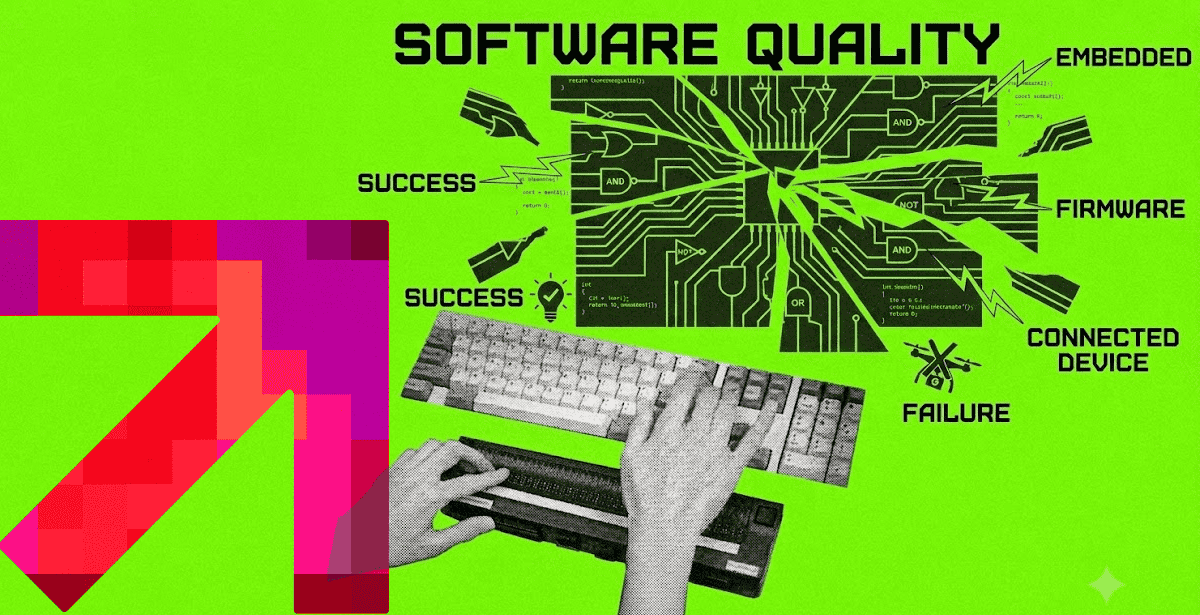
A connected device rarely fails because of the hardware. It fails because the firmware running on it wasn’t ready for the real world.
Embedded software quality is the difference between two outcomes. One product runs for years in the field. The other generates support tickets from day one. Hardware gets the attention in a pitch deck. Firmware is what actually keeps the device working after it ships.
This guide covers what embedded software quality really requires. That’s coding discipline, real-world testing, and a clear view of what failure costs at scale.
What “Embedded Software Quality” Actually Means for a Connected Device
Embedded software quality isn’t the same bar as typical app development. A phone app that crashes gets restarted. A thermostat controller that crashes might get abandoned by an angry tenant, or fail unsafe.
Firmware runs on constrained hardware, often for years, without a reboot button anyone can reach. That changes what quality means. A memory leak that goes unnoticed in a web app can become fatal after months of uptime.
Firmware Development Practices That Prevent Field Failures
Firmware development for connected devices needs guardrails a typical software team doesn’t think about. Every byte of memory matters. Every millisecond of latency matters, too, when the hardware is cheap and the deployment is remote. That’s also why firmware is rarely a good fit for off-the-shelf software.
Coding Standards: Why MISRA C Still Matters
MISRA C has guided safety-critical embedded software for decades. It still shapes how disciplined teams write C today. The guidelines exist to eliminate undefined behavior. That kind of bug is easy to write and brutal to debug once a device is in the field.
For safety-critical deployments, that discipline extends further, into IEC’s Functional Safety Framework for electronic systems where failure could cause harm.
Teams that skip these guidelines often get away with it in early prototypes. The bugs tend to surface later, once real devices sit in conditions nobody tested for in the lab.
IoT Device Testing Before Anything Ships
IoT device testing has to go further than a bench test in a controlled office. Power brownouts, weak signal, temperature swings, and years of continuous uptime all belong in the test plan.
Firmware that’s only tested against ideal conditions will eventually meet the conditions it wasn’t tested against. Build failure injection into the plan. Simulate the network dropping mid-update. Simulate power cutting out mid-write.
The Real Cost of Connected Device Failure at Scale
Connected device failure doesn’t stay small once a fleet grows. A bug affecting one unit is a support ticket. The same bug at 50,000 units is a recall, or a brand that stops shipping.
Firmware bugs are expensive to fix after deployment, too. A remote update helps, but only if the update mechanism was built with the same rigor as the firmware it patches. A broken update pipeline can brick a fleet instead of fixing it. Model the true ROI of an IoT investment before assuming firmware quality is a corner worth cutting.
Measure IoT by business outcomes, not device count. The ROI of IoT development services should be tied to measurable outcomes such as reduced downtime, lower maintenance costs, improved asset utilization, and greater operational efficiency. Define these metrics before deployment so you can quantify whether your IoT Development Services investment is delivering real business value.
Case Study: Embedded Systems Reliability Across 200,000-Plus Devices
DPL has been iApartments’ core technology partner since 2019. The work spans embedded firmware and the cloud platform behind locks, lights, thermostats, and sensors across residential units. The fleet now runs 200,000-plus connected devices on AWS IoT Core.
Embedded systems reliability at that scale isn’t optional. A firmware bug in a smart lock doesn’t just annoy a resident. It can lock them out of their own home.
The platform runs at a sub-$1 monthly operating cost per device. That only holds up if failure rates stay low enough that support costs don’t erase the margin. Full case study details are in DPL’s project portfolio.
That same reliability bar applies outside residential IoT, too. DPL built a Terminal Operating System for Pakistan’s National Logistics Corporation. It runs RFID and embedded systems across remote border terminals with unreliable connectivity. The software there has to work correctly with no engineer nearby to fix it.
Frequently Asked Questions
What’s the biggest embedded software quality mistake teams make?
Skipping real-world testing conditions. Firmware that only sees a lab bench before shipping will meet conditions it was never tested against, once it’s in the field.
Does embedded software quality matter more than hardware quality?
They matter together. Hardware defects get caught earlier and cost more to fix upfront. Firmware defects surface later and get treated as an afterthought, even though the cost of failure is often just as real.
How does IoT device testing differ from typical software QA?
It has to account for power loss, weak connectivity, and physical environment, not just logic bugs. A clean lab test suite misses the failure modes that actually show up in the field.
Where to Start
Don’t wait until a field failure to take firmware quality seriously. Build testing for real-world conditions into the plan from the first prototype, not after the first support ticket.
A scoped proof of concept is the fastest way to validate firmware decisions early. Test the update mechanism and the failure recovery path before scaling to thousands of units.
DPL’s embedded and IoT development team has built firmware and cloud platforms for real estate, logistics, and facility management clients. Some of that work runs well past 200,000 connected devices. A conversation before the first prototype ships is usually the cheapest insurance against an expensive failure later.