Firmware vs Software – What’s the Difference and How Do They Work Together?

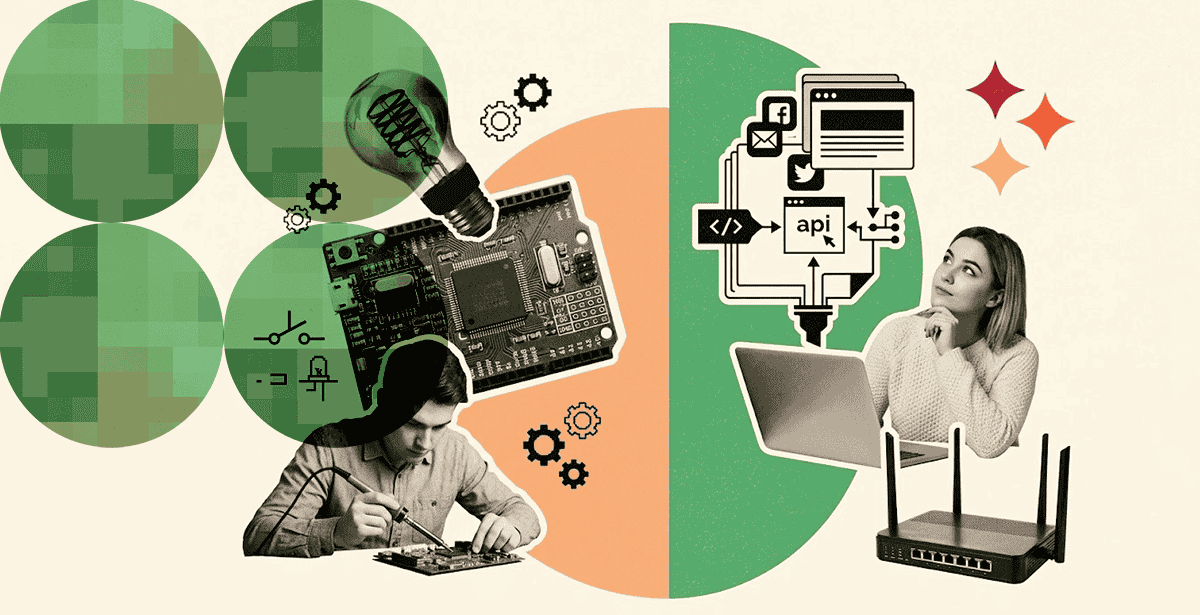
Ask five engineers to explain firmware vs software and you’ll likely get five different answers. That confusion isn’t harmless. It shapes update strategy, security posture, and even who gets hired to build what.
The distinction matters more as more products ship with a chip inside them. A thermostat, a smart lock, and a fleet tracker all run both firmware and software.
What Is Firmware?
Understanding firmware vs software starts with firmware itself, the layer everything else depends on.
Firmware is the low-level code that runs directly on a device’s hardware. It’s usually stored in read-only or flash memory. The National Institute of Standards and Technology defines it precisely. It’s programs and data stored in hardware such that they cannot be dynamically modified during execution.
That permanence is the defining trait. Firmware initializes hardware at power-on. It manages sensors and actuators directly. It provides the thin layer everything else runs on top of. Without it, a device’s processor is just silicon with no instructions to follow.
Firmware typically runs close to the metal, often with no operating system at all. It talks directly to registers, interrupts, and memory addresses. Application-level code never has to think about any of that.
Every layer above firmware depends on it working correctly first. A bug at this level doesn’t just crash an app. It can take the entire device down with it, since nothing above firmware can run without it.
What Is Software?
Software is the broader category covering any set of instructions a computer executes. That includes everything from a mobile app to an operating system. Technically, it even includes the firmware itself.
In everyday usage, though, “software” usually means the higher-level applications running on top of an operating system. A weather app, a dashboard, a cloud service: these are software in the way most people mean the word.
The practical difference is abstraction level. Software developers work with frameworks, libraries, and operating system services. Those tools hide most hardware detail from view. That’s a fundamentally different job than firmware development.
Portability also separates the two in practice. Software written for one operating system often runs on very different hardware underneath it. Firmware, by contrast, is usually tied tightly to one specific chip or board revision.
How Firmware Development Differs from Application Development
Firmware development happens under constraints most application developers never face. Memory might be measured in kilobytes, not gigabytes. Processing power is limited, and every cycle counts toward battery life.
Debugging tools look different too. A firmware engineer often works with an oscilloscope and a logic analyzer. A JTAG debugger replaces the standard IDE breakpoint system most software developers rely on. Reproducing a bug can mean physically probing hardware pins.
Testing is harder to automate as well. Application software can run its test suite in a cloud CI pipeline within seconds. Firmware often needs the actual target hardware first. A carefully built simulator sometimes substitutes, but not always convincingly.
DPL’s firmware development builds this discipline into every embedded engagement. Getting device behavior right the first time matters more here. A bug shipped to ten thousand devices in the field is expensive to fix after the fact.
Release cycles reflect these constraints too. A mobile app team might ship ten releases a week. A firmware team might ship one carefully validated release a quarter instead. The cost of a mistake is simply much higher once hardware is already in the field.
The Firmware Engineer’s Toolkit
A firmware engineer typically works in C or C++. Rust is gaining ground too, especially on newer safety-critical projects. These languages give the fine-grained memory control that higher-level languages deliberately hide away.
Real-time operating systems like FreeRTOS or Zephyr often sit underneath more complex firmware. They handle task scheduling without the overhead a full desktop OS would add. Bare-metal programming, with no OS at all, remains common on the simplest devices.
Hardware datasheets become required reading in this world. A firmware engineer needs to know a chip’s register map the way a web developer knows an API’s documentation. Sometimes better, since a wrong register value can damage the hardware itself.
Why is Firmware Update Riskier Than a Software Patch
A firmware update carries risks a typical software patch doesn’t. Push a broken app update, and a user can usually roll back or reinstall. Push broken firmware to a locked door or an industrial controller, and the device can become unresponsive entirely.
That failure mode has a name: bricking. A device that fails mid-update, especially without a fallback partition, can end up permanently unusable. Physical intervention, sometimes a full hardware replacement, becomes the only fix.
Over-the-air updates need redundancy built in specifically to prevent this outcome. A/B partitioning keeps a known-good firmware image available while the new one installs. A failed update then rolls back automatically instead of bricking the device outright.
Security adds another layer of urgency to getting firmware updates right. The Cybersecurity and Infrastructure Security Agency has pushed for faster, more disciplined patching of network-connected devices. Unpatched firmware remains one of the most common attack entry points across connected infrastructure.
Signed firmware images add another safeguard worth building in from the start. A device that verifies a cryptographic signature before accepting an update refuses anything unsigned. That single check closes off a whole category of supply-chain attack.
Version tracking matters just as much once a fleet grows past a handful of units. Knowing exactly which firmware version each device runs makes a staged rollout possible. Without it, every update becomes an all-or-nothing gamble.
Case Study: Firmware at Scale for a 200,000-Device Fleet
DPL has been iApartments’ core technology partner since 2019, scaling the platform from MVP through Series A funding. The system now manages more than 200,000 connected IoT devices, including locks, lights, thermostats, and sensors.
Every one of those devices runs firmware DPL had to design for remote update from day one. Manually touching 200,000 physical locks to push a fix was never an option worth considering.
The result speaks to what disciplined firmware architecture makes possible. The platform saves an estimated 552,000 manhours annually. Property onboarding time dropped from four weeks to three days as a direct result.
Read the full iApartments case study for the complete deployment breakdown. None of those outcomes work without firmware built to update safely at real-world scale.
That scale is exactly where firmware mistakes get expensive fast. A bug might cost one engineer an afternoon on a single prototype. The same bug can cost a company months once it’s shipped inside a quarter-million locks.
Embedded Firmware in the Real World
Embedded firmware shows up in places most people never think about. A car’s engine control unit runs it. So does a hospital infusion pump, and so does the smart thermostat on your wall.
The stakes scale with the device. A bug in a smart light bulb’s firmware is an annoyance at worst. A bug in an infusion pump’s firmware is a patient safety issue. That’s exactly why medical device firmware faces regulatory scrutiny application software rarely sees.
Certification requirements follow from that same logic. Automotive and medical embedded firmware often needs to meet standards like ISO 26262 or IEC 62304 before it ever ships. Consumer app software almost never faces that bar.
Power budget is another constraint that separates embedded firmware projects by device category. A battery-powered sensor expected to last five years on a coin cell faces real tradeoffs. A mains-powered gateway never has to consider them. Even how often it wakes up to check in becomes a design decision.
How Embedded Software Fits on Top
Embedded software sits one layer above firmware, still running on the device itself but with more structure. Think of the logic that decides when a thermostat should adjust. It’s built on top of the firmware that actually drives the heating element.
This layer often runs under a real-time operating system. That gives it task scheduling and memory protection firmware alone typically lacks. It’s still resource-constrained, just less brutally than the layer beneath it.
The line between embedded software and a device’s cloud-facing application is often where product teams disagree most. What logic runs on-device versus what gets pushed to a backend service shapes both cost and responsiveness.
Getting this layering right early saves real engineering time later. Teams that blur firmware and embedded software together tend to end up with code that’s hard to test. It also becomes harder to certify, and nearly impossible to port to a new chip down the line.
💡 Not every IoT product can rely on generic software architecture. Bespoke software can help define what belongs on the device, what belongs in the cloud, and how those layers communicate. This separation makes IoT systems easier to test, update, scale, and adapt as the product evolves.
Why the Distinction Matters for Security and Liability
Getting the firmware vs software boundary wrong creates real business risk, not just semantic confusion. Product liability frequently hinges on which layer failed. Firmware defects and application bugs can trigger very different legal and warranty obligations.
Security patching cadence differs sharply between the two layers as well. Application software often patches weekly. Firmware updates, given their higher risk profile, tend to ship quarterly, or only when a serious vulnerability forces the issue.
Hiring gets affected too. A team advertising for a “software engineer” when they actually need firmware expertise will interview the wrong candidates entirely. Weeks of recruiting effort get wasted chasing skills that don’t match the actual job.
💡 Security requirements should be defined separately for each device layer. Securing IoT means accounting for different patching cycles, update mechanisms, authentication methods, and failure risks across firmware and software. Treating both layers the same can leave vulnerabilities unaddressed or make updates unnecessarily risky, especially once devices are deployed at scale.
Making the Right Call When Scoping a Connected Device Project
Start by mapping which functions genuinely need to live in firmware. Others can move up into embedded software, or even further up into the cloud. Not every feature belongs at the lowest layer just because the device has a chip.
Budget for firmware development differently than application work too. Longer test cycles and physical hardware requirements both add cost. A smaller talent pool pushes firmware timelines higher than equivalent software features almost every time.
Plan the update mechanism before writing a single line of firmware. Retrofitting safe over-the-air updates onto a device already in the field is far harder. Designing for it from the first prototype is always the cheaper path.
Getting the Layers Right from the Start
The firmware vs software line isn’t just an academic distinction. It determines how a connected device gets built, tested, updated, and secured for the years it stays in the field.
DPL has shipped firmware and embedded software across smart-home, government, and industrial deployments. Each layer gets treated with the discipline it actually requires, not a one-size-fits-all process.
Our IoT development practice can help scope which layer your next connected product decision really belongs in. Let us know how we can help by sharing you requirements below. Our team will get back to you very soon.