
Legacy App Modernization – 5 Architecture Patterns That Work in Production

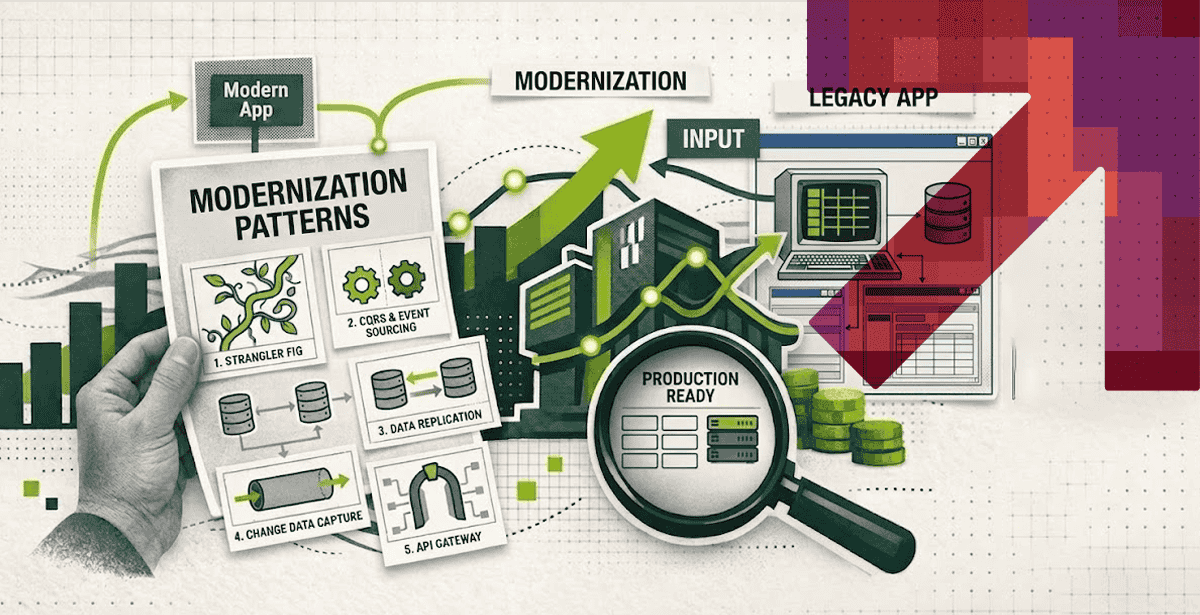
Legacy app modernization fails more often from architecture mistakes than from bad tooling. Federal agencies alone spend roughly 80% of their IT budgets just keeping legacy systems alive, according to the U.S. Government Accountability Office. That’s money not going toward anything new.
Accumulated technical debt in the US software industry has reached $1.52 trillion per CISQ’s 2022 cost-of-poor-quality report. Most of that debt sits inside monolithic systems nobody wants to touch.
Why Most Legacy Application Modernization Efforts Stall
The default instinct is a full rewrite: freeze the old system, build a new one from scratch, cut over on a single weekend. It almost never works. Requirements hide inside twenty-year-old code that nobody fully understands anymore.
Legacy application modernization succeeds when it’s incremental, not when it’s heroic. Every pattern below shares one property: it lets the old and new systems run side by side while traffic shifts gradually, with a rollback path at every stage.
Teams that skip straight to a rewrite usually discover the hard way that the legacy system encodes years of edge-case fixes nobody documented. A missing tax rule, a currency rounding quirk, a permission exception for one client.
Rebuilding from a spec instead of from the running system is how those quietly disappear and resurface as production incidents.
Pattern 1: Strangler Fig for Incremental Legacy Application Modernization
The strangler fig pattern routes traffic through a facade that gradually redirects specific functions to new services while the legacy system keeps running underneath. Over time, the new system “strangles” the old one until nothing depends on it anymore.
How Strangler Fig De-Risks App Modernization Services Engagements
This is the backbone of most credible app modernization services engagements because it never requires a full cutover date.
DPL used exactly this approach decomposing a monolithic defense platform into 100+ containerized microservices for the Pakistan Air Force’s air-gapped Kubernetes environment, moving function by function instead of attempting a single migration event.
Pattern 2: Anti-Corruption Layer for Application Refactoring for Cloud
An anti-corruption layer sits between old and new systems, translating data models and contracts so the new services never inherit the legacy system’s technical debt directly. It’s essential the moment application refactoring for cloud touches a system with decades of undocumented business logic baked into its data structures.
Keeping Legacy Contracts Intact During the Transition
Without this layer, teams end up importing the exact assumptions they were trying to escape. A clean anti-corruption layer means the legacy database can keep its quirks while new services get a clean, modern contract to build against, which is what makes application refactoring for cloud incremental instead of all-or-nothing.
In practice, this usually means a thin translation service: it receives calls in the new system’s clean format, converts them to whatever the legacy system expects, and converts the response back. It adds a small amount of latency in exchange for a much larger reduction in coupling.
Teams that skip it end up with new services quietly full of if-statements that only make sense in the context of a twenty-year-old schema.
Pattern 3: Database Decomposition Before Cloud Modernization
Cloud modernization efforts stall when the application layer gets modernized but the database stays a single monolithic instance everything still writes to. That shared database becomes the new bottleneck and the reason two “independent” services can’t actually deploy independently.
Why Cloud Modernization Fails When the Database Stays Monolithic
Decomposing the database, whether through read replicas, bounded-context schemas, or a move to purpose-built stores like Amazon Aurora or DynamoDB, has to happen in step with the application split.
DPL’s work modernizing a facility management client’s ERP platform onto Aurora MySQL processing 500,000+ work orders annually followed this exact sequencing, pairing database decomposition with a 35% infrastructure cost reduction through containerization.
Pattern 4: Event-Driven Backbone for Microservices Architecture
A microservices architecture that communicates entirely through synchronous calls just rebuilds the monolith’s tight coupling with extra network hops. An event-driven backbone, using something like EventBridge, Kafka, or Step Functions, decouples services so one team’s deployment doesn’t require coordinating with five others.
Choosing Sync vs. Async in a Microservices Architecture Migration
Not every interaction needs to be async. User-facing requests that need an immediate response stay synchronous; state changes that other services need to react to become events. Getting this split wrong is one of the most common reasons a microservices architecture ends up slower and more fragile than the monolith it replaced.
A useful rule of thumb: if a caller needs to know the result before it can proceed, keep it synchronous. If a caller just needs to know something happened, publish an event and let interested services react on their own schedule. Mixing these up is how teams end up with distributed systems that are somehow harder to debug than the monolith they started with.
Pattern 5: Sidecar and Service Mesh for Zero-Downtime Cutover
A service mesh, like Istio, handles traffic shifting, mutual TLS, and observability without changing application code. That makes it possible to run canary deployments and gradual traffic cutovers as a standard operating procedure rather than a rare, risky event.
Istio, mTLS, and Traffic Shifting in Production
DPL’s air-gapped Kubernetes work for a defense client relied on Istio service mesh and HashiCorp Vault to secure service-to-service traffic while cutting pipeline execution time to under 10 minutes and achieving 99.95% cluster availability.
That combination is what turns a modernization migration into routine, low-drama deployments instead of a nerve-wracking cutover night.
What App Modernization Services Should Actually Deliver
A modernization engagement that just produces a new codebase hasn’t delivered anything measurable yet. App modernization services should tie every architectural decision to a number: deployment frequency, mean time to recovery, cost per transaction, or resource utilization.
The real goal is to improve how the application performs, scales, and evolves after deployment. Faster release cycles, reduced infrastructure costs, improved reliability, stronger security, and better developer productivity are outcomes that matter more than the technology stack itself.
Every migration, refactor, or replatforming effort should have clearly defined success metrics. If a modernization project cannot demonstrate measurable business or operational improvements, it has simply replaced old technology with new technology.
Common Pitfalls When Combining These Patterns
None of these five patterns work in isolation forever. Strangler fig without an anti-corruption layer just moves the coupling problem to a new location. Database decomposition without an event-driven backbone to keep data eventually consistent creates silent data drift between services.
The teams that get this right treat the five patterns as a sequenced toolkit, not a checklist to apply all at once.
Start with the facade and translation layer, prove the routing works safely, then decompose data, then introduce async communication, and only then reach for a service mesh once there are enough services to justify the operational overhead.
Measuring Legacy App Modernization Success
Across DPL’s legacy app modernization engagements, the pattern holds: deployment frequency moves from monthly to multiple times daily, mean time to recovery drops from hours to under five minutes, and infrastructure costs fall 35-60% through right-sized containerization.
These aren’t aspirational targets. They’re outcomes from systems running in production today, some of them in air-gapped, zero-connectivity environments where failure isn’t an option.
Track these metrics from day one of the engagement, not after the first services ship. A baseline measured against the legacy system, before any pattern is applied, is the only way to prove the modernization effort produced a real result instead of just a different-looking system with the same underlying problems.
The pattern selection matters more than the migration tooling. A team with the right architecture decisions can modernize a legacy system incrementally, with rollback at every stage, and never need a high-risk cutover weekend at all.
Modernize Without Betting the Business on a Cutover Weekend
Legacy app modernization done well never looks dramatic. It looks like steady, measurable progress: services peeled off one at a time, traffic shifted gradually, and a rollback path that’s never actually needed. DPL has run this playbook in environments ranging from air-gapped defense infrastructure to high-volume commercial ERPs.
Explore DPL’s application modernization services or start with a scoped proof of concept to validate the architecture before committing to a full migration.

Topics
Related Articles
-
7 Processes Your Team Should Automate First with DevOps Automation Services
31-Aug-2026 Hazar Hayat
-
Kubernetes Pods Explained – How They Work and Why They Matter for Microservices
28-Aug-2026 Hazar Hayat
-
Architecture Decisions That Determine Long-Term Cost and Scale in Application Development for Cloud
27-Aug-2026 Hazar Hayat