Building a Smart Factory – The IoT, Automation, and Data Infrastructure Required to Get There

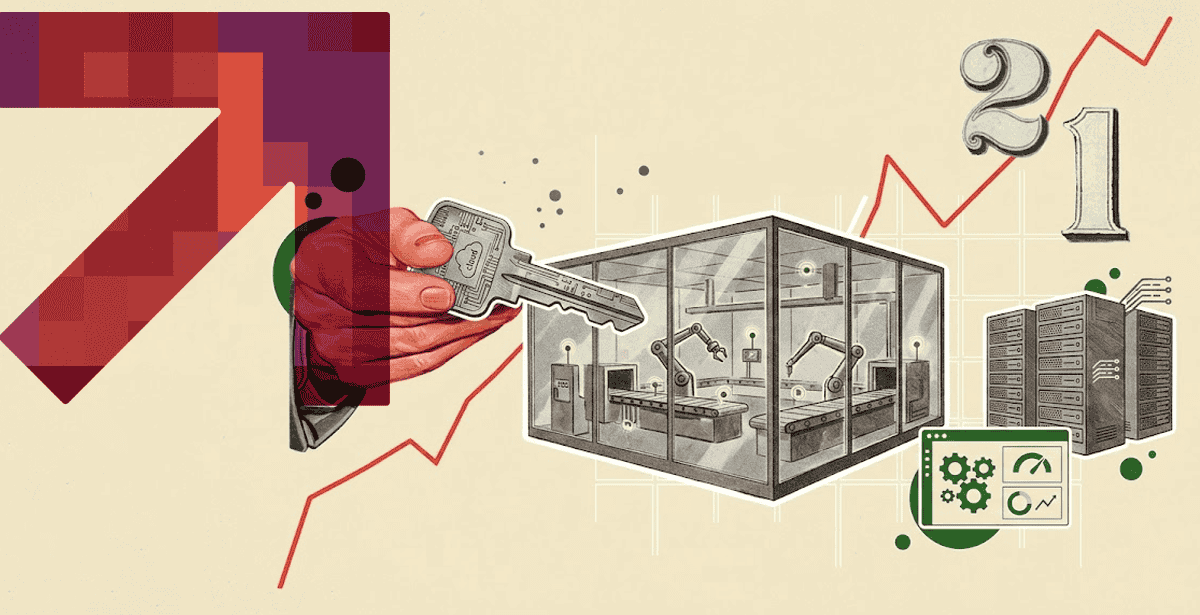
A smart factory isn’t a facility with a few sensors bolted onto old equipment. It’s a production environment where data flows continuously from the floor to a system that can act on it, whether that action is a maintenance alert, an automated adjustment, or a simulation run before a change ever touches a real machine.
The investment behind this shift is substantial. The smart manufacturing market is projected to reach $1,063.15 billion by 2033, growing at a 12.1% CAGR, as manufacturers replace isolated automation with connected, data-driven operations.
That growth isn’t driven by novelty. It’s driven by manufacturers who’ve run the numbers on unplanned downtime, scrap rates, and energy waste, and concluded that the cost of staying disconnected is higher than the cost of instrumenting the floor.
What Makes a Factory “Smart”? Industry 4.0 in Practice
Industry 4.0 is the umbrella term for this shift: the integration of sensors, connectivity, automation, and data analytics into manufacturing in a way that lets systems sense, communicate, and adjust with minimal manual intervention.
The Four Layers of Industry 4.0 Maturity
In practice, Industry 4.0 maturity builds in layers.
First, sensors capture data that used to go unmeasured.
Second, connectivity gets that data off the floor and into a system that can store and process it.
Third, automation acts on it in real time.
Fourth, simulation and modeling, through a digital twin, let teams test changes before committing capital to them.
Skipping a layer to jump straight to advanced automation is how smart factory projects stall.
Each layer depends entirely on the one below it working reliably. Automation built on inconsistent sensor data doesn’t just fail to add value, it actively erodes trust in the whole initiative the first time it acts on bad information.
That’s why maturity should be measured in reliability at each layer, not in how advanced the technology sounds on a roadmap slide.
Industrial IoT: The Sensor Layer Underneath Everything
Industrial IoT is the foundation every other layer depends on. Without reliable, accurate sensor data, automation has nothing trustworthy to act on and a digital twin has nothing real to simulate against.
What Industrial IoT Actually Measures on the Floor
Vibration, temperature, current draw, cycle time, and throughput are the usual starting points. The goal isn’t measuring everything possible. It’s measuring the handful of signals that correlate with the failures and inefficiencies that actually cost money, then expanding coverage deliberately from there.
Sensor placement matters as much as sensor selection. A vibration sensor mounted two inches from a bearing tells a very different story than one mounted on the housing a foot away. Getting this wrong doesn’t just add noise, it can mask the exact failure signature the sensor was installed to catch.
IoT in Manufacturing: From Isolated Sensors to a Connected Data Layer
IoT in manufacturing only creates value once sensor data leaves the machine it came from and reaches a system where it can be correlated across the whole production line. A single sensor reporting to a local screen is monitoring. A network of sensors reporting to a shared platform is the beginning of a smart factory.
Connectivity Choices That Hold Up on a Factory Floor
Factory floors are hostile environments for wireless signals: metal structures, electrical interference, and machinery that moves.
The right connectivity choice, whether MQTT over industrial Ethernet, WiFi, or a low-power protocol like LoRaWAN for remote or battery-powered sensors, depends on how far data has to travel and how much interference it has to travel through, not on whichever protocol is trendiest.
Retrofitted sensors on older equipment often can’t be wired at all without a costly line shutdown, which is exactly the scenario LoRaWAN and similar low-power protocols were built for: battery-powered sensors that report reliably for years without running new cable through a live production environment.
💡Start with the environment before choosing the protocol. If you’re asking what is LoRaWAN and whether it belongs in your deployment, consider the physical realities of the site first. LoRaWAN is designed for long-range, low-power communication where running cables is impractical and battery life matters more than bandwidth. In industrial facilities, warehouses, and large campuses, it can often connect sensors reliably without the infrastructure costs associated with wired networks or cellular connectivity.
Industrial Automation: Where Machines Act on the Data
Industrial automation is where sensing turns into action. A system that only reports a problem is a dashboard. A system that adjusts a process parameter, halts a line, or triggers a maintenance workflow automatically is automation doing its job.
Closing the Loop Between Sensing and Acting
The most valuable automation doesn’t just react to failures, it prevents them. Predictive maintenance models trained on vibration and temperature trends can flag a bearing headed for failure weeks before it happens, turning an unplanned shutdown into a scheduled maintenance window.
DPL’s predictive maintenance offering is built around exactly this principle: using IoT-powered monitoring to predict equipment health before downtime happens, a capability that applies directly to manufacturing floor equipment as much as it does to any other connected asset.
Not every automated response needs to be dramatic. Adjusting a conveyor speed, throttling a motor, or triggering a work order are all forms of industrial automation that reduce manual intervention without requiring a full robotic overhaul of the line.
Digital Twin: The Layer That Turns Data Into Foresight
A digital twin is a live, data-fed virtual model of a physical asset, process, or entire production line. It’s the layer that lets manufacturers ask “what happens if” without risking real equipment or real output.
What a Digital Twin Needs to Be Useful, Not Just Impressive
A digital twin is only as good as the data feeding it. A polished 3D visualization built on stale or incomplete sensor data is a demo, not a decision-support tool. The digital twin market is projected to grow from $49.5 billion in 2026 to $328.5 billion by 2033, a 31.1% CAGR, driven specifically by manufacturers using twins to simulate workflows, improve predictive planning, and reduce downtime.
The practical starting point isn’t a twin of the entire factory. It’s a twin of the single process or line with the clearest cost of failure, built on real-time industrial IoT data, expanded once it proves it can predict something correctly before it happens.
Building a Smart Factory Without a Blank-Slate Budget
Few manufacturers get to build a smart factory from scratch. Most are retrofitting sensors and connectivity onto equipment that’s been running for a decade or more, which changes the sequencing of the whole project.
DPL’s experience managing large fleets of connected devices, including a platform sustaining 200,000+ connected IoT devices at sub-$1 per device monthly operating cost, and asset-tracking systems built on RFID for real-time cargo and vehicle monitoring, translates directly to the device management and connectivity challenges manufacturers face when retrofitting older equipment.
The core problem, keeping thousands of distributed devices reporting reliably and cheaply, is the same whether the devices sit in an apartment building or on a factory floor.
The sequencing that works best starts small: instrument the highest-cost failure point first, prove the sensor data is reliable, add automation around that one process, and only then invest in a digital twin once there’s a track record of clean data to build it on.
This staged approach also makes budget approval easier. A single-process pilot with a clear cost baseline is a much easier investment case to make than a plant-wide transformation with returns that won’t show up for years.
Frequently Asked Questions
What’s the difference between industrial IoT and IoT in manufacturing?
Industrial IoT usually refers to the sensors and connectivity layer itself. IoT in manufacturing is the broader application of that layer across the full production environment, including how the data gets used for automation and planning.
Do we need a digital twin to start with Industry 4.0?
No. Digital twins are typically the last layer added, after sensing, connectivity, and automation are already producing reliable data. Starting with a twin before the underlying data is trustworthy produces a simulation nobody can rely on.
How long does building a smart factory typically take?
It depends heavily on how much retrofitting is required, but a phased approach, starting with one process or line, can show measurable results within months rather than requiring a multi-year, plant-wide rollout before anything pays off.
Is industrial automation only about robotics?
No. Industrial automation includes anything from automated shutoffs and process adjustments to predictive maintenance workflows. Robotics is one visible form of it, but far from the only one that matters.
What’s the biggest risk in a smart factory rollout?
Building automation or a digital twin on top of unreliable sensor data. It’s tempting to move fast to the more visible layers, but a smart factory built on shaky foundations produces confident-looking decisions based on bad information.
Start With the Sensor Layer, Build Up from There
A smart factory isn’t built top-down from an ambitious digital twin. It’s built bottom-up, starting with industrial IoT that produces trustworthy data, automation that acts on it reliably, and simulation that earns its place once the data underneath it can be trusted.
DPL brings device management, connectivity, and predictive maintenance expertise from large-scale IoT deployments to manufacturers starting that journey. Explore DPL’s IoT development services to scope where your factory’s smart factory journey should actually begin.