
What Is LoRaWAN? A Complete Guide to How It Works and When to Use It

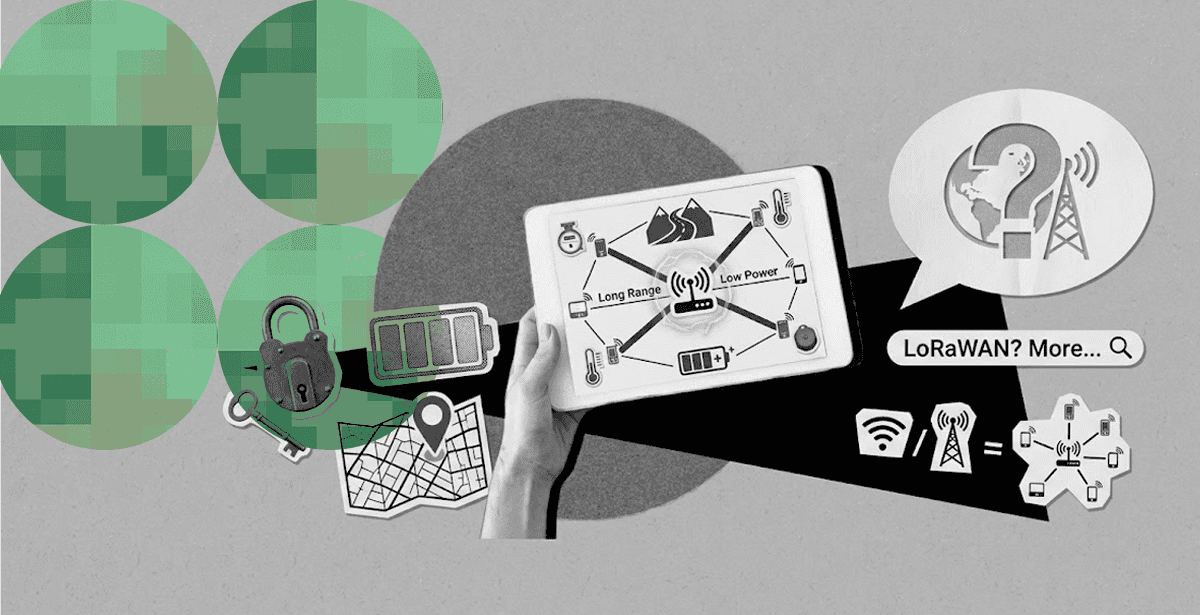
What is LoRaWAN? The short answer is that it’s a low-power, wide-area networking protocol that lets battery-powered sensors send small amounts of data across kilometers, not meters, without draining a battery in weeks.
It’s the networking layer behind everything from smart water meters to vehicle trackers that need to run for years on a single battery.
The technology has scaled fast. The LoRa Alliance reports 125 million LoRaWAN end devices deployed globally as of December 2025, growing at a 25% compound annual rate across the ecosystem, with 170+ major network operators now supporting the standard.
The broader LoRaWAN market is projected to grow from $6.70 billion in 2026 to $54.62 billion by 2033, a 34.9% CAGR, as smart metering, smart buildings, and smart cities scale up deployments.
What Is LoRaWAN? A Quick Definition
LoRaWAN (Long Range Wide Area Network) is a media access control protocol built on top of LoRa, a physical-layer radio modulation technique. LoRa handles the actual radio signal; LoRaWAN handles how devices join the network, communicate securely, and manage power.
Together, they form a Low-Power Wide-Area Network, or LPWAN, purpose-built for devices that send small, infrequent messages and need to run for years on minimal power.
How LoRaWAN Works: Gateways, Devices, and the Network Server
A LoRaWAN deployment has three core pieces: end devices, gateways, and a network server. Devices send small data packets over the air; gateways receive those packets and forward them over standard IP to a network server, which handles deduplication, security, and routing to the application.
Adaptive data rate is one of the quieter features that makes this work well at scale. The network server can instruct a device to adjust its spreading factor, trading data rate for range, based on how far it is from the nearest gateway and how noisy the radio environment is. Devices close to a gateway transmit faster and use less airtime; devices at the edge of coverage transmit slower but more reliably.
The Role of a LoRaWAN Gateway
A single LoRaWAN gateway can receive signals from thousands of devices across several kilometers, far beyond what a WiFi access point or Bluetooth beacon could cover from one location. This is the core economic advantage of the architecture: a handful of gateways can blanket a large area that would otherwise require hundreds of shorter-range access points.
What Makes LoRaWAN Devices Different From WiFi Devices
LoRaWAN devices trade bandwidth for range and battery life. A typical LoRaWAN sensor might send a few bytes every few minutes and run for 5-10 years on a coin cell battery. A WiFi device sending the same data would drain that same battery in days, because WiFi radios are built for throughput, not power efficiency.
That tradeoff shapes hardware design from the start. LoRaWAN devices typically spend the vast majority of their life in a deep sleep state, waking briefly to transmit and then returning to sleep immediately. Firmware built around this duty cycle, not just the radio chip itself, is what actually determines whether a device hits its multi-year battery life target in the field.
LoRaWAN and the Broader World of LPWAN
LoRaWAN is one of several LPWAN technologies, alongside options like NB-IoT and Sigfox. What sets it apart is that it runs on unlicensed spectrum, meaning organizations can deploy their own private networks without paying a carrier for airtime on every message.
Where LoRaWAN Fits Among IoT Protocols
Among IoT protocols, LoRaWAN occupies a specific niche: long range, low power, low bandwidth. It’s not competing with WiFi for streaming video or with cellular for real-time voice. It’s built for the enormous category of devices that just need to report a small reading occasionally, reliably, for years.
LoRaWAN vs. WiFi vs. Cellular: When Each One Wins
Choosing among IoT communication protocols comes down to three variables: how far the signal needs to travel, how much power the device can spare, and how much data actually needs to move.
Range, Power, and Bandwidth Tradeoffs
WiFi wins when devices have reliable power and need high bandwidth at short range, like a security camera streaming video indoors. Cellular wins when a device is mobile across a wide area and needs guaranteed carrier-grade connectivity, though at a higher cost per device and higher power draw.
LoRaWAN wins when the device is stationary or slow-moving, battery-powered, and only needs to send small amounts of data across a large area, like a soil moisture sensor in a field or a parking sensor in a garage.
None of these IoT communication protocols is universally “better.” Each is a different point in the same three-way tradeoff between range, power, and bandwidth, and the right choice depends entirely on what the device actually needs to do.
💡 Optimize for the constraint that matters most. Successful embedded systems design is rarely about maximizing range, bandwidth, or battery life simultaneously. Every connected product operates within tradeoffs. Define the most critical requirement—whether that’s years of battery life, real-time responsiveness, or low operating cost—and design the hardware, connectivity, and power management strategy around that priority.
Choosing the Right Protocol for Your Deployment
DPL’s vehicle theft prevention system for corporate parking facilities runs on LoRaWAN specifically because the use case demands years of battery life on a device attached to a parked vehicle, with alerts that only need to fire occasionally and travel across an entire parking structure or campus from a single gateway.
Smart waste management follows the same logic: bin fill-level sensors report infrequently, sit in fixed locations, and need to survive years without a battery change, making LoRaWAN a far better fit than WiFi or cellular for that specific job. The lesson generalizes: match the protocol to the device’s actual behavior, not to whichever network happens to already be installed.
💡Match connectivity to the device, not the entire home. A strong smart building technology stack often uses multiple connectivity options for different needs. While WiFi works well for high-bandwidth devices, LoRaWAN can support low-power sensors such as water leak detectors, environmental monitors, and utility meters that need long battery life and reliable coverage across larger properties. Choosing the right connectivity layer for each device can improve reliability, reduce maintenance, and lower operating costs over time.
Common Misconceptions About LoRaWAN
The most common misunderstanding is treating LoRaWAN as a WiFi replacement. It isn’t, and it was never meant to be.
WiFi still wins for anything needing sustained high throughput. LoRaWAN is a complementary protocol for the much larger category of devices that just need to report small amounts of data reliably over a wide area.
Another misconception is assuming LoRaWAN requires carrier infrastructure like cellular does. Because it runs on unlicensed spectrum, an organization can deploy a fully private LoRaWAN network on its own property, with its own gateways and network server, without ongoing carrier fees per device or per message.
Frequently Asked Questions
What is LoRaWAN used for in practice?
Smart metering, asset tracking, environmental sensing, smart agriculture, and any use case needing long battery life and wide coverage over small, infrequent data payloads.
Do I need a LoRaWAN gateway for every building or site?
Not necessarily. A single well-placed LoRaWAN gateway can often cover several kilometers, so one gateway may serve an entire campus or facility depending on terrain and obstructions.
Is LoRaWAN secure enough for enterprise deployments?
Yes, when implemented correctly. LoRaWAN specifies AES-128 encryption at both the network and application layers, and enterprise deployments should pair that with strong key management practices.
Can LoRaWAN devices send large amounts of data?
No, and that’s by design. LoRaWAN payloads are intentionally small, typically under 250 bytes per message, which is what makes the long range and multi-year battery life possible in the first place.
How is LoRaWAN different from Sigfox or NB-IoT?
All three are LPWAN technologies, but LoRaWAN runs on unlicensed spectrum and supports private network deployment, while NB-IoT typically runs on licensed cellular spectrum through a carrier. Sigfox uses a proprietary, carrier-operated network model similar to NB-IoT in that regard.
Pick the Protocol That Matches the Job
Now that you understand what is LoRaWAN, you should know what matters more is knowing when it’s the right tool. It excels at exactly one thing: long range, low power, low bandwidth communication for devices that need to last years in the field.
DPL has deployed LoRaWAN across vehicle monitoring and smart facility use cases where that tradeoff is exactly right. Explore DPL’s IoT development services to figure out which IoT communication protocol actually fits your next connected device deployment.

Topics
Related Articles
-

IoT Integration – Connecting Devices, Data, and Enterprise Applications
22-Aug-2026 Bilal Sattar
-

How to Vet an IoT Development Company Before Betting Your Product on Them
21-Aug-2026 Maha Yaser
-

Building a Smart Factory – The IoT, Automation, and Data Infrastructure Required to Get There
19-Aug-2026 Bilal Azhar