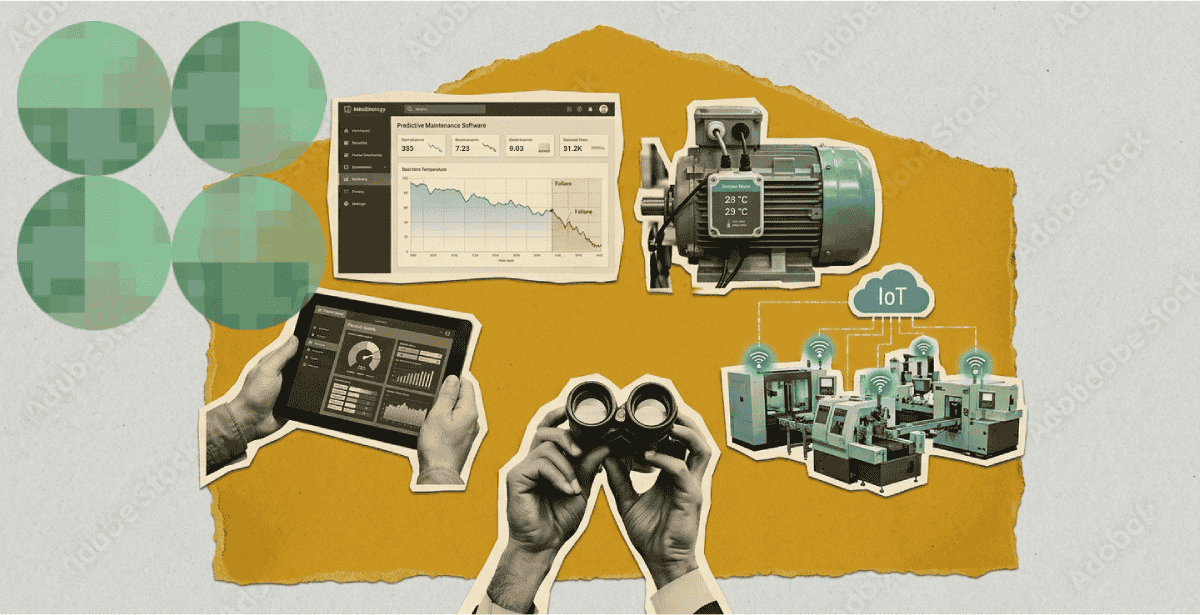
What Are Industrial IoT Applications? A Practical Guide for Operations Teams


Ask an operations manager what industrial IoT means. You’ll usually hear “sensors on machines.” That’s true. But it undersells the whole picture.
IIoT connects equipment, people, and processes into one system. Operations teams can actually see it and act on it. That’s the real shift.
The applications span more ground than most people expect. Predictive maintenance. Asset tracking. Quality control. Energy management. Supply chain visibility. Each one solves a different operational problem. All of them use the same underlying IIoT building blocks.
Why IIoT Means More Than Smart Factories
Bring up industrial IoT, and most people picture the same thing: a fully automated factory floor, robots at every turn, and humans playing a supporting role. It’s not an inaccurate picture, but it represents only one piece of a much bigger story.
Industrial IoT extends well beyond manufacturing. It powers applications across logistics, cold-chain storage, utilities, and infrastructure, helping businesses monitor assets, optimize operations, and make data-driven decisions.
We’ve previously explored what it takes to build a smart factory from the ground up, including the automation and data infrastructure behind it.
On the other hand, this guide takes a broader look at industrial IoT solutions and how they create value across different industries.
After all, you don’t need an entirely automated factory to benefit from connected operations. Many IIoT applications are smaller, more targeted, and far less expensive to implement.
This guide takes a wider lens instead. Industrial IoT solutions show up just as often in logistics yards and cold-storage warehouses. They show up in utility infrastructure too, not just on an assembly line.
If your mental model stops at “factory,” you’re missing most of what IIoT actually does across the economy right now. The applications are broader, and often cheaper to start, than a full factory build.
The Market Context Operations Teams Should Know
None of this is a niche trend anymore, even if it still feels unfamiliar inside some operations teams. Budgets are shifting toward it steadily, year after year.
That shift spans nearly every industrial sector worth naming, from heavy manufacturing to cold-chain logistics. The global industrial IoT market was valued at $514.39 billion in 2025. It’s projected to reach $602.87 billion in 2026 alone.
That’s according to Precedence Research, a market analysis firm tracking the sector closely. The trajectory continues toward $2.43 trillion by 2035. That works out to a 16.8% compound annual growth rate, sustained over an entire decade.
Manufacturing holds the largest share of that market today. But predictive maintenance, not factory automation broadly, is the single application driving the most adoption within it. That distinction matters a great deal for where operations teams should focus their efforts first.
Predictive Maintenance: The Leading IIoT Application
Predictive maintenance flips the traditional maintenance schedule on its head entirely. Instead of servicing equipment on a fixed calendar, sensors monitor vibration and temperature continuously. Maintenance happens when the data says it’s actually needed, not before.
This matters because scheduled maintenance wastes money on equipment that’s fine. It also misses failures that happen between scheduled checks entirely. Condition-based monitoring closes that gap directly, catching problems early as they develop in real time.
💡 Continuous monitoring becomes even more valuable when equipment data can reveal patterns that precede a breakdown. Predictive maintenance tools analyze historical sensor readings, operating conditions, and failure records to identify early warning signs and estimate when maintenance may be needed. This helps teams prioritize interventions, plan repairs around operational schedules, and reduce the risk of unexpected downtime.
Asset Tracking and Condition Monitoring on the Ground
Beyond maintenance, these systems also track where assets physically are, in real time. They track what condition those assets are in too. This spans vehicles, containers, and equipment moving through a busy facility floor.
Lost or misplaced inventory costs operations teams real money every quarter. Leadership often doesn’t realize how much until someone measures it directly. Asset tracking closes that visibility gap, turning a guess into a precise, searchable location on a map.
It also feeds the condition-monitoring side of the same deployment, combining both jobs into one piece of hardware.
Choosing the right sensor hardware for this kind of tracking depends heavily on the environment. Temperature extremes, vibration, and humidity all affect sensor reliability differently. Each deployment site brings its own mix of these stresses.
💡 Sensor selection should account for the conditions a device will encounter throughout its operational life, not just its initial deployment environment. Choosing an IoT sensor requires evaluating measurement accuracy, operating range, power consumption, environmental resistance, and maintenance requirements before committing to hardware. Getting these factors right upfront reduces compatibility issues, replacement costs, and disruptions as the deployment scales.
A real deployment makes these tradeoffs concrete fast. Theory only goes so far once hundreds of sensors are running in the field. Weather and wear expose things a lab test never accounted for.
DPL Case Study: A Logistics Terminal Running on IIoT
DPL built exactly this kind of system for National Logistics Corporation. The client manages terminals along a major border crossing route. The deployment combined RFID tracking, vehicle monitoring, and warehouse management into one connected operation.
Cargo transparency improved immediately. Trucks, containers, and inventory could all be tracked through the same system in real time. Dwell times at the terminal dropped too. Staff no longer needed manual checks to know where a shipment actually stood.
The system now runs across multiple terminals. It handles vehicle gate-ins, warehouse inventory, and cargo monitoring together, all through one platform.
That’s IIoT solving three separate operational problems at once. Not three disconnected tools bolted together after the fact, each with its own login and its own dashboard.
Making Sense of the Data IIoT Generates
Every sensor and tracker in an industrial deployment generates data constantly. It never takes a break, day or night. At scale, that adds up to billions of data points from a single site.
Operations teams need a way to actually use that data. Not just store it somewhere and forget about it. A lot of early IIoT pilots quietly end up doing exactly that.
Raw sensor data without context is just noise. The real value comes from turning that stream into dashboards and alerts that someone actually watches. Trend analysis matters too, giving operations staff something they can act on quickly.
Anomaly detection models add another layer on top of that same trend data, flagging drift before it becomes downtime.
None of this works well without somewhere reliable to put the data first. That storage layer is easy to overlook while the dashboards still feel fast.
💡 Storing industrial data is only useful if teams can retrieve and analyze it efficiently as deployments grow. Effective IoT data management requires choosing storage solutions that support high-volume ingestion, time-series queries, data retention policies, and integration with analytics platforms. Planning these capabilities early prevents storage bottlenecks and keeps historical data accessible for trend analysis, anomaly detection, and operational decisions.
Choosing an Industrial IoT Platform
An IIoT platform connects devices, collects their data, and makes it usable across every team that needs it. That includes maintenance crews and finance teams reporting on asset utilization.
Picking one is less about brand names. It’s more about whether it scales past your first few hundred connected devices cleanly. A frantic re-architecture six months in is the alternative outcome nobody wants to live through.
That scaling question matters more than most procurement checklists suggest. A platform chosen for a 50-device pilot often buckles quietly once it reaches a few thousand devices in production. The gap between a pilot-ready platform and a production-ready one is usually the first thing teams underestimate.
Pilots always run smoothly because they’re small. Not because the platform underneath them is actually ready for real production traffic at full scale.
IoT in Manufacturing Beyond the Factory Floor
IoT in manufacturing doesn’t stop at the production line itself. Energy management systems track power consumption across a facility. They flag waste that would otherwise hide inside a monthly utility bill nobody reads closely.
Quality control benefits too. Sensors catch defects earlier in a production run than a human inspector working a visual check ever could. They simply never blink or lose focus during a long shift.
Supply chain visibility extends the same tracking principles outward. It connects what happens on the floor to what happens with suppliers and shipments well beyond it.
Each of these counts as its own IIoT application. None of them require a full smart factory build to deliver value on their own merits.
Frequently Asked Questions
What’s the difference between consumer IoT and IIoT?
Consumer IoT connects everyday devices like thermostats and doorbells. IIoT connects equipment and infrastructure where uptime and safety carry real financial stakes.
Do we need a smart factory to benefit from IIoT?
No. Predictive maintenance, asset tracking, and energy monitoring all deliver standalone value on their own. A full smart factory build is one possible destination, not a prerequisite for starting anything.
How fast can an operations team see results?
Asset tracking and basic condition monitoring often show value within weeks. Predictive maintenance models typically need a few months of data before predictions become reliable enough to trust.
Those numbers track with broader industry research. Deloitte’s analysis of predictive technologies finds a similar pattern. Typical gains run 10% to 20% in equipment uptime. Maintenance costs usually drop 5% to 10% as well.
That’s exactly why operations leaders increasingly treat predictive maintenance as the first IIoT investment worth making. It’s usually the one that pays for itself before a full platform rollout even begins.
Where to Start with IIoT
Operations teams don’t need to tackle every application at once. Most start with the single problem costing them the most right now. That might be unplanned downtime, lost assets, or inventory nobody can locate quickly.
These applications compound once the first one proves out. A predictive maintenance pilot often reveals data infrastructure gaps. Those same gaps affect an asset-tracking rollout later on, and the reverse holds true as well.
DPL has built IIoT systems for a variety of clients across different industry verticals. Each one needed exactly this kind of practical starting point, not a theoretical roadmap.
DPL’s IoT and embedded development services team can help figure out which application solves your most expensive problem first. Let us know how we can help you via the form below.