7 Signs You Need Bespoke Software Development NOW


Modern organizations no longer compete on products alone. They compete at operational speed, with system intelligence, and with the ability to adapt without friction.
Yet most companies are still running on software built for the “average” businesses.
The truth is, generic tools were never designed around your workflows, your data, or your growth; they’re meant to give a general solution.
On the other hand, bespoke software development changes the rules entirely. It lets you design technology around how your business actually works. Moreover, it turns compromise into precision and replaces friction with alignment.
If this piques your interest, read on to find out everything there is to bespoke apps.
🔥 Choosing between off-the-shelf software and custom development isn’t always straightforward. What works for one business may limit another, especially when workflows, integrations, and long-term scalability come into play. Taking the time to understand the trade-offs can prevent costly technology decisions later. If you’re weighing your options, make sure you understand the distinction between off the shelf software vs custom software to determine which type best aligns with your business needs and growth plans.
What is Bespoke Software?
Bespoke software, also known as custom or business-specific software, is a technologysolution developed to meet the unique requirements of a specific business or organization.
Unlike generic, off-the-shelf software, it’s purpose-built from the ground up to align with a company’s workflows, preferences, and operational strategies. It’s meant to solve certain problems, perform unique tasks, and facilitate specific activities that generic software usually doesn’t.
To sum up what bespoke software development entails, here are the main characteristics of this type of apps.
- Custom Design – Bespoke apps are created according to the client’s exact specifications.
- Unique Functionality – These apps include features that aren’t readily available in off-the-shelf software.
- Scalable and Flexible – Bespoke software evolves with the business as requirements change.
- Integration-Friendly – The software easily connects with existing systems and databases.
- Ownership and Control – The client typically owns the software and its source code.
The Benefits of Bespoke Software Application Development
Custom-built software isn’t just another system; it’s the backbone of smarter, faster, and more adaptable business operations. Backing this statement are the following benefits.
1) Full Ownership and Intellectual Property Control
Bespoke software gives your organization complete ownership of both the source code and the intellectual property (IP) behind the system.
Owning source code outright allows your team to adapt, enhance, and scale functionality freely, without external restrictions. Full IP ownership also enables your organization to commercialize, license, or patent unique features developed for your processes. This transforms the software into a strategic asset, providing long-term leverage and potential revenue opportunities.
As the owner of the bespoke software development process and output, you control compliance, security, and internal standards. You can enforce custom data handling, reporting rules, and audit processes that align precisely with your regulatory obligations.
This is what DPL achieved while creating Arro Money, a bespoke neo-banking platform for Marq Millions.
Built from the ground up, it integrated government and industry data, complied with UK financial regulations, and included a secure backend. These capabilities ensured a smooth, safe, and efficient banking experience. The platform also gained recognition as a finalist in the 2019 Emerging Payments Awards.
2) No Vendor Lock-In or Dependency
Commercial Software-as-a-Service (SaaS) tools often come with vendor lock-in, limiting flexibility and increasing risk.
Vendors can change pricing, discontinue features, or sunset entire products at their discretion. These changes can disrupt continuity of workflow and budget planning.
In contrast, bespoke software eliminates dependency on third-party roadmaps or contractual terms. So, you control feature prioritization, pricing impact, and product direction.
You also get to optimize your IT spending. Studies show many companies waste large portions of their software budgets on unused applications and licenses because they can’t easily switch or consolidate.
This independence reduces exposure to sudden subscription hikes, forced migrations, or costly retooling. It also means your system can evolve based on your organization’s pace, not a vendor’s quarterly release cycle.
3) Dedicated, Context-Aware Support
With off-the-shelf tools, support teams often lack context. This leads to generic responses and slower resolutions. Moreover, engineers may not understand your unique workflows, integrations, or data flows without a detailed briefing.
In contrast, bespoke software development teams intimately understand your software’s architecture. They built the system, know its dependencies, and can troubleshoot or upgrade with precision. This context-aware support reduces downtime and accelerates improvements tied directly to your operations.
For example, Amazon’s internal logistics systems are maintained by in-house engineers who constantly optimize and evolve them. This internal ownership helps Amazon keep its fulfilment networks highly reliable and responsive to demand changes.
Quick, informed support also fosters innovation. Instead of waiting for generic support queues, your team moves faster on enhancements and performance tuning.
4) Optimized User Experience and Workflow Alignment
Custom software is designed around real user behavior inside your organization. Interfaces reflect familiar terminology, existing workflows, and internal reporting structures. This alignment reduces cognitive friction and shortens the learning curve for employees.
Research from McKinsey shows that improving user experience can increase productivity by up to 25 percent. When systems match how teams actually work, adoption improves, and resistance decreases. Employees spend less time navigating irrelevant features and more time executing meaningful tasks.
5) Lean Architecture Without Feature Bloat
Off-the-shelf platforms often include extensive modules designed for broad market appeal.
Many organizations use only a fraction of available functionality yet pay for the full suite.
This feature bloat can slow system performance and complicate maintenance processes.
Bespoke software focuses strictly on the functionality your organization actually requires.
This lean architecture reduces processing overhead and simplifies future upgrades.
Cleaner systems are easier to test, secure, and maintain over time.
Building only essential components ensures higher utilization and clearer return on investment. Performance improvements often follow because unnecessary background processes are eliminated.
6) Modular and Evolvable Technical Architecture
Long-term adaptability is essential in rapidly changing digital environments.
Bespoke software development helps by designing systems with modular architecture principles.
This means the software is divided into self-contained components (modules) that operate independently while remaining fully integrated within the larger system. As a result, changes to one module don’t disrupt the entire system, improving resilience and maintainability.
Such a structure allows components to be enhanced, replaced, or scaled without requiring a full system rebuild. Therefore, organizations can modernize specific layers like analytics without interrupting core business operations.
This flexibility, in turn, reduces technical debt, lowers long-term maintenance costs, and extends the system’s operational lifespan.
💡Some business challenges don’t show up as obvious problems. What looks manageable today can quietly grow into deeper operational friction over time. Taking a closer look at these patterns often reveals underlying gaps that standard tools were never designed to solve. Exploring how custom application development addresses critical business challenges can help you uncover these hidden barriers and turn them into opportunities for smarter, scalable systems.
When to Contact Bespoke Software Services
Deciding the right time to invest in bespoke software development services can transform how your business operates and grows.
Most organizations don’t wake up planning to build custom software. They reach that decision after repeated friction, rising costs, or stalled growth.
If your systems are beginning to shape your strategy rather than supporting it, that’s a warning sign. Below are seven signals that indicate it may be time to speak with bespoke software specialists.
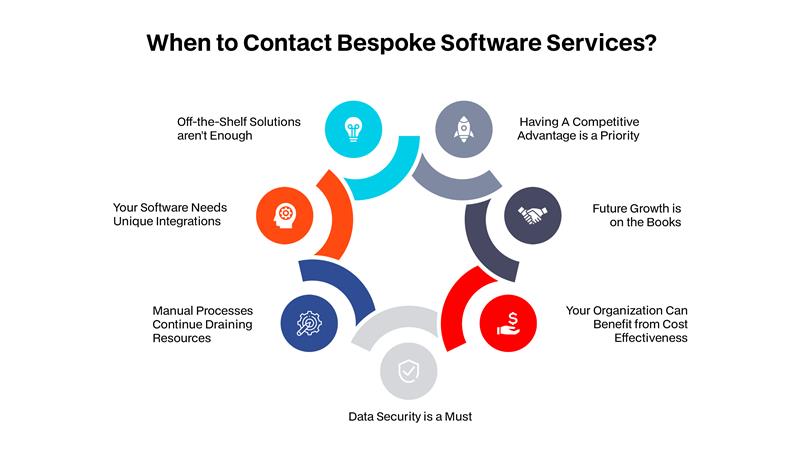
1) Off-the-Shelf Solutions Aren’t Enough
Off-the-shelf software is built to serve the widest possible market. That means your operating model must adapt to its structure.
When pricing logic, fulfillment models, or approval chains can’t be configured without friction, you are operating inside someone else’s framework. That limits how aggressively you can innovate.
Domino’s made this decision strategically. Rather than depending on third-party delivery marketplaces that charge commission fees, it invested heavily in its own digital ordering ecosystem. As a result, more than 75 percent of U.S. sales were digital in 2023.
The strategic outcome wasn’t just digital convenience. It was margin protection, ownership of customer data, and control over customer experience.
If your revenue model depends on capabilities vendors aren’t building for you, growth becomes structurally constrained.
2) Your Software Needs Unique Integrations
Most enterprises operate across ERPs (Enterprise Resource Planning), CRMs (Customer Relationship Management), etc. When these tools don’t integrate deeply, data becomes fragmented, decisions are delayed, and reporting becomes inconsistent.
Large-scale operations rely on systems that unify every process in real time, enabling precision and speed at a global level. However, when integration complexity increases with growth, vendor plug-ins stop being sufficient.
With bespoke software development, your systems can be designed from the ground up to achieve the required level of integration. Every tool, workflow, and data point works together seamlessly, creating a single, coherent platform.
For example, FedEx operates in more than 220 countries. Its proprietary logistics and tracking systems unify routing, customs clearance, and customer updates in real time. This level of integration supports operational precision on a global scale.
3) Manual Processes Continue Draining Resources
Manual work scales with headcount, whereas digital automation scales with infrastructure. The distinction isn’t operational; it’s structural. When growth depends on adding more people to complete repetitive tasks, cost expansion becomes inevitable.
Implementing intelligent automation can considerably reduce operational costs. These savings come from eliminating repetitive processing and rule-based decision tasks, allowing human capital to shift toward higher-value functions.
A practical example is UPS. The company developed ORION (On-Road Integrated Optimization and Navigation) to optimize delivery routes dynamically. The system reduced annual driving distance by approximately 100 million miles.
Therefore, if your cost base increases linearly with transaction volume, your automation architecture requires reevaluation.
4) Having a Competitive Advantage Is a Priority
If competitive advantage is central to your strategy, your technology can’t be generic.
Off-the-shelf platforms standardize processes. While standardization improves efficiency, it also reduces differentiation. If competitors use the same systems, they operate with similar structural capabilities.
If your differentiation depends on capabilities that competitors can subscribe to tomorrow, your advantage is temporary. Conversely, if your differentiation depends on systems only you control, your advantage compounds over time. That’s when competitive priority justifies bespoke software development investment.
Competitive advantage today often depends on proprietary logic, pricing algorithms, personalization engines, risk scoring models, and supply chain optimization rules. These aren’t cosmetic features; they directly influence margin, speed, and customer retention.
For instance, consider Amazon’s logistics. Proprietary robotics, forecasting, and delivery systems replaced third-party software, consequently speeding fulfillment, cutting costs, and tightening delivery windows.
Over here, the advantage isn’t just technology ownership. It’s also the ability to continuously refine algorithms without vendor constraints.
💡 Software challenges often run deeper than they first appear. Workflow bottlenecks, integration hurdles, and scaling risks can quietly slow progress if overlooked. That’s why it’s crucial to uncover these issues early, especially when building custom applications for businesses. By combining AI-driven tools with expert oversight, you can tackle these challenges head-on and deliver reliable, business-ready software faster.
5) Your Organization Can Benefit from Cost-Effectiveness
Bespoke software development is often evaluated only by initial build cost. However, that’s a narrow view.
Gartner frequently highlights Software as a Service (SaaS) sprawl as a growing enterprise cost challenge. Multiple subscriptions accumulate over time, increasing the total cost of ownership.
Forrester’s Total Economic Impact studies show that custom digital platforms often achieve positive returns on investment within three years. These savings emerge from reduced licensing, integration simplification, and operational efficiency gains.
So, the strategic question isn’t “What does it cost to build?” It’s “What does dependency cost over five years?”
When vendor costs scale directly with headcount and transaction volume, margin compression follows. Bespoke infrastructure stabilizes long-term financial trajectory.
6) Future Growth Is in the Books
Scaling amplifies operational complexity in ways that generic platforms can’t anticipate.
When transaction volume, regional coverage, or data load grows rapidly, standard systems struggle to maintain performance, often requiring costly workarounds.
Shopify merchants generated more than $ 9 billion during Black Friday – Cyber Monday 2023, highlighting peak-load demands. Netflix built Open Connect, its proprietary content delivery network, to control streaming performance globally and reduce dependency on third-party bandwidth providers.
The logic is straightforward: if growth will multiply data, transactions, or user activity, software that cannot scale inherently becomes a bottleneck.
Bespoke systems are engineered for your projected load, allowing seamless scaling, stable performance, and future-proof adaptability.
Without bespoke software development architecture, companies face downtime, slower operations, or expensive migrations, directly impacting revenue and customer satisfaction.
🔥 Hot Tip! Don’t just hand off your custom app and hope it works out. As the project owner, it’s crucial to stay in control, maintain clarity, and guide development toward a future-ready tech strategy. This guide shows you exactly how to outsource custom development without compromising on quality or oversight.
7) Data Security Is a Must
Security risk is financial risk, reputational risk, and regulatory risk combined. Generic, off-the-shelf systems implement standard protections that cannot account for your unique workflows, compliance requirements, or data classifications.
For institutions like JPMorgan Chase, annual technology investment exceeds $15 billion, much of which is dedicated to proprietary cybersecurity systems. Bespoke software allows encryption protocols, access controls, and auditing processes to be designed specifically for your operations.
So, if your organization processes sensitive data, operates under strict regulations, or relies on customer trust, off-the-shelf security leaves gaps.
On the other hand, bespoke software development ensures that protection aligns precisely with your risk profile and compliance obligations. Therefore, it reduces breach probability and exposure.
Ready to Connect with a Bespoke Software Development Company?
Struggling to find the right team to bring your bespoke software vision to life? Look no further!
With 20+ years of experience, DPL has built future-proof custom digital solutions across multiple industries, delivering efficiency, innovation, and performance.
Fill out the form below, and let’s discuss how we can turn your IoT ideas into reality.