
The Impact of AI on Custom Web Application Development


Artificial Intelligence (AI) in web application development turns “We hope this works” into “We know this works.” Around 72% of businesses already embed AI into their web app workflows among other functions, which is why the global AI market is set to hit $990 billion by 2027.
This isn’t a minor upgrade; it’s a full-scale transformation that makes every line of code smarter, every feature faster, and every decision sharper. But only if you act now.
Old methods can’t keep pace. Not when users expect instant, hyper-personalized experiences. And definitely not when cyber threats evolve daily and traffic spikes unpredictably.
Ignore AI, and your app risks becoming just another fish floundering to survive. So, now is the moment to turn guesswork into certainty, slow iterations into instant insights, and reactive development into predictive growth.
It’s time to flip the script and fast with custom web application development.
💡 AI is reshaping web app development. Understanding where to embed intelligence, anticipate pitfalls, and streamline workflows is what separates leaders from the rest. Here are 10 ways AI is transforming custom web app development, highlighting the key areas to focus on, That way, you’ll gain insight to make smarter, future-proof decisions before your next project.
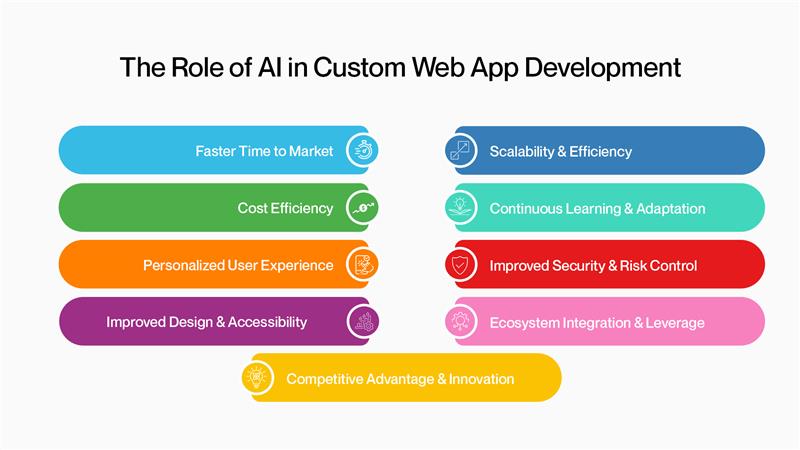
The Role of AI in Custom Web App Development
When you weave AI into your web app development lifecycle, the benefits stop being theoretical. Instead, they show up in your timelines, your costs, your user experience, and yes, your bottom line.
Here’s a quick, no-fluff look at what AI actually delivers once it enters your development workflow.
1) Faster Time‑to‑Market
AI is transforming custom web app development, making the process faster and more efficient.
AI-powered code generation writes standard functions and boilerplate code, i.e. the routine, repetitive code that sets up the basic structure of an app instantly. This frees developers to focus on unique features.
Automated testing further accelerates development. AI detects bugs and inconsistencies immediately, rather than spending days debugging. This enables teams to move straight to iteration and improvement.
AI also supports rapid prototyping, creating an early, functional version of the app that demonstrates key features and workflows within hours instead of days.
Why it matters for your web app:
- You get to launch Minimum Viable Products (MVPs) quickly and collect real user feedback.
- You can spend more time improving UX, gamification, and innovative features instead.
- You get to iterate faster to stay ahead of competitors.
AI-driven development also allows teams to experiment with multiple feature variations simultaneously. Therefore, they can discover which ideas truly resonate with users before committing to full-scale builds.
💡 Are you a startup thinking of adding AI to your web app? AI can transform your startup, but only if applied strategically. From validating your market and spotting competitive gaps to streamlining operations, the right approach saves time, cuts costs, and keeps you ahead. Check out our introductory guide on AI software development for startups to see how to leverage AI effectively across every function, without wasting resources on trial and error.
2) Cost Efficiency
AI makes custom web application development more cost-effective by cutting down on repetitive work and streamlining processes.
In addition to reducing code generation hours, automated testing reduces the need for large QA teams and prevents expensive fixes after launch. With significantly less time spent on manual QA, releases are expediated while budgets stay in check.
Why it matters for your web app:
- Organizations can redduce staffing needs for routine coding and testing.
- You can avoid expensive rework caused by late bug discovery.
- You get to optimize resources to focus on high-value features that differentiate your app.
As you can see, AI empowers teams to deliver more functionality with fewer resources, making every development dollar count.
💡 Don’t let AI adoption be a shot in the dark. Map your AI app development cost early, align it with scalable infrastructure, and prioritize high-impact features. Overlooking these steps can lead to wasted investment, poor adoption, and stalled innovation. Plan strategically to ensure your AI initiatives deliver measurable ROI, perform reliably under real-world conditions, and give your software a competitive edge.
3) Enhanced User Experience & Personalization
AI transforms web apps by making every interaction smarter, more adaptive, and deeply personalized.
User Experience (UX) is about how effortless and satisfying it feels for someone to navigate your app. AI-powered personalization engines observe user behavior, learn preferences, and dynamically adjust content, features, or recommendations.
For instance, Netflix uses AI to tailor suggestions, increasing engagement and retention. Moreover, Spotify’s AI-driven playlists keep users active on the platform for hours daily.
AI also uncovers hidden friction points in custom web application development. By tracking clicks, scrolls, and session flows, it highlights confusing or underused features. This, in turn, helps teams prioritize improvements based on real user data.
Why it matters for your web app:
- You can deliver experiences that feel intuitive, relevant, and tailored for each user.
- Your apps get to anticipate user needs, reducing abandonment rates.
- You make product decisions grounded in behavioral data, not assumptions.
By using AI to understand users in real time, your app evolves continuously, turning insights into experiences that keep users coming back.
4) Improved Design and Accessibility
AI elevates web app design by ensuring interfaces are visually appealing and highly functional and inclusive.
Good design goes beyond colors and layouts; it organizes content, guides user attention, and makes navigation intuitive. Accessibility further ensures that users with disabilities, such as vision or motor impairments, can use the app without barriers.
AI-powered tools automatically detect issues like low contrast, missing labels, improper tab order, or unclear navigation. This reduces hours of manual auditing. In fact, companies using AI-driven design checks report faster resolution of usability and accessibility issues.
AI also provides actionable insights for continuous improvement in custom web application development. By analyzing clicks, scrolls, session patterns, and drop-offs, it identifies confusing elements and suggests layout adjustments.
Why it matters for your web app:
- Your app maintains consistent design and visual hierarchy across devices.
- You get to create inclusive experiences for all users, boosting satisfaction and reach.
- Your team will be able to detect and fix design issues before they affect real users.
By combining AI with design and accessibility, your web app becomes more efficient, inclusive, and user-friendly. This improves engagement, retention, and overall business outcomes.
5) Scalability and Maintenance Efficiency
Scaling a web app isn’t just about adding servers; it’s about ensuring performance, reliability, and seamless user experience as your user base grows. AI makes this possible by predicting load spikes, optimizing resources, and automating routine maintenance.
Maintenance efficiency goes beyond fixing bugs. It’s about keeping your app healthy before issues arise. Therefore, it reduces downtime and frees your team to innovate.
AI continuously monitors server metrics, traffic patterns, and application logs. For instance, Netflix dynamically adjusts streaming resources during peak hours. That way, millions of users can experience uninterrupted video.
Predictive maintenance tools further spot anomalies like slow database queries or outdated libraries, alerting teams before these issues affect users. Some platforms report up to 40% reduction in unplanned downtime with AI-driven monitoring.
Why it matters for your web app:
- Apps can automatically scale resources to handle growing traffic without slowing down performance.
- Your team gets to detect and resolve potential failures before they impact users.
- You can reduce manual maintenance and operational overhead, letting developers focus on innovation.
This means your app grows and evolves intelligently, staying reliable, responsive, and ready for expansion at every stage.
💡 AI in your web app isn’t just a feature; it powers future growth. Skip essential steps, like clean data, scalable infrastructure, or explainable AI, and your app risks poor adoption, wasted investment, and falling behind competitors. Here are 9 tips for successful AI business application development that show you exactly how to get it right, ensuring your AI delivers real impact, measurable ROI, and keeps you ahead of the market.
6) Continuous Learning and Feature Adaptation
AI keeps custom web apps evolving by continuously learning from user behavior and adapting features in real time. Instead of static functionality, apps can adjust workflows, recommend content, or tweak features based on actual usage.
Take Duolingo for instance. The app uses AI to adapt lesson difficulty, suggest exercises, and highlight new features dynamically. Not only does this keep users engaged, but it also improves retention.
AI also helps teams prioritize custom web application development efforts. By tracking which features are most used or ignored, it identifies what to enhance, remove, or replace, reducing wasted effort.
Why it matters for your web app:
- AI continuously refines features to match evolving user needs.
- You get to keep users engaged by showing relevant content and functionality.
- You can make data-backed decisions about which features to invest in.
With AI, your web apps evolve alongside your users, delivering more value and keeping engagement high.
7) Enhanced Security and Risk Mitigation
AI strengthens web‑app security by actively analyzing system behavior and detecting anomalies in real time.
AI models continuously monitor traffic, login patterns, and user actions to create a baseline of normal activity. When deviations like repeated failed logins occur, the system flags them instantly.
AI also helps teams prioritize risk. Threats are scored based on severity, potential impact, and likelihood, allowing developers to address critical issues first. For example, Microsoft uses AI-powered threat detection in Azure to prevent cyber-attacks by automatically identifying unusual patterns and blocking malicious activity before it affects users.
Why it matters for your web app:
- AI helps identify and neutralize threats before they affect users.
- Your team can focus on high-risk vulnerabilities, reducing wasted effort.
- You get to maintain consistent app stability and user trust.
By integrating AI into custom web application development, your app can anticipate threats and block them. This ensures a secure and reliable experience for every user.
8) Ecosystem Integration and Platform Leverage
Ecosystem integration means your web app can connect and work seamlessly with other platforms, services, and networks. This makes them part of a broader digital ecosystem. Instead of functioning as isolated tools, AI enables apps to communicate, share data, and coordinate tasks automatically. This connectivity lets apps deliver value beyond their own features.
For example, Microsoft Teams integrates Outlook, SharePoint, and third-party apps like Salesforce using AI. The system automatically routes data, predicts potential conflicts, and ensures workflows across platforms run smoothly. Users can schedule meetings, update tasks, and access files without switching apps or manually syncing data.
AI also continuously monitors these integrations. When APIs change or new services are added, AI adapts connections automatically, reducing errors and manual maintenance. This ensures apps scale across ecosystems efficiently while remaining reliable and responsive.
Why it matters for your web app:
- Extend your app’s functionality by connecting with multiple platforms effortlessly.
- Reduce manual integration effort and prevent workflow disruptions.
- Turn your app into a central hub, unlocking new growth and strategic opportunities.
So, this enables a web app to become part of a larger network, collaborating, adapting, and scaling to deliver measurable business value.
9) Competitive Advantage & Innovation
AI gives organizations a strategic edge in custom web application development by enabling capabilities that set their apps apart in competitive markets. Companies like Amazon, Netflix, and Tesla use AI to innovate beyond basic functionality. Amazon leverages AI for product recommendations and supply chain optimization, and Netflix uses AI to personalize content at scale. Furthermore, Tesla continuously improves vehicle software through AI-driven insights.
Another example of this comes from our work on Pakistan’s first Human Rights Information Resource Portal, developed with the EU for the Ministry of Human Rights. The portal centralizes knowledge, digitizes reports, and provides secure, accessible information for all citizens. This project shows how strategic, well-executed development can deliver measurable results and set new standards for impactful web solutions. Learn more.
These innovations let organizations offer services competitors can’t match, turning their apps into strategic assets.
AI also enables intelligent workflow orchestration and predictive business analytics, giving companies the ability to anticipate trends, optimize operations, and uncover new revenue opportunities. By deploying AI in these ways, organizations position their apps as market leaders, not just tools.
Why it matters for your web app:
- Stand out in competitive markets by offering AI-powered capabilities competitors cannot replicate.
- Convert technology into a strategic advantage rather than just an operational improvement.
- Continuously innovate and introduce features that redefine market expectations.
With AI, your web app becomes more than a product; it becomes a differentiator. This helps your brand or organization to maintain a leadership position and stay ahead of industry rivals.
Look No Further for a Web Application Development Service
If you’re searching for a web app developing partner to bring your idea to life, we’re here to help. From building smart features to integrating with other platforms, we focus on creating apps that solve real problems for your users.
Share your project in the form below, and we’ll help ensure your next web application runs smoothly and delivers measurable results.