AI Agent vs Chatbot – What Does Your Business Need?

Standout customer service is one of the top goals of organizations in the next three years. After all, this factor alone can increase revenue by 80%.
For this reason alone, many organizations have embraced AI agents and chatbots. These AI-powered automations can easily take on some of the responsibilities of live agents. That way, the latter only focus on complex issues that require human insight.
Yet while both terms are used interchangeably, they’re far from the same. So, before you invest in them, you need to fully understand AI agent vs chatbot.
What Is a Chatbot?
A chatbot is software that simulates human conversation through text or voice interfaces by processing natural language inputs and generating contextually relevant responses.
Technically, a chatbot is a dialogue management system built on top of Natural Language Processing (NLP), Natural Language Understanding (NLU), and sometimes Natural Language Generation (NLG) components.
💡Before you move on, you should know that chatbots and virtual assistants aren’t the same either. Chatbots and virtual assistants play different roles in delivering customer service. Whereas the former is more suitable for structured, high-volume interactions such as FAQs, the latter is best for context handling, personalization, or multi-step task execution. To determine which to use, simply assess the level of intelligence and autonomy of the issues you wish to solve.
Chatbots can be broadly categorized into several technical types based on how they process language and generate responses.
- Rule-based chatbots are the most traditional form, operating on predefined scripts, decision trees, or pattern-matching rules such as regular expressions. These systems follow fixed conversational flows, making them reliable for structured tasks but limited in flexibility.
- Retrieval-based chatbots use machine learning models for intent classification and semantic similarity matching to retrieve the most appropriate response from a predefined dataset. They often rely on embeddings and vector search to improve contextual relevance. However, they can’t generate entirely new responses beyond their trained corpus.
- Generative chatbots are powered by large language models (LLMs) built on transformer architectures. These systems generate responses probabilistically, token by token, enabling open-domain conversation and dynamic output creation.
Chatbots may be classified by purpose. For instance, task-oriented chatbots are designed for specific goals such as booking or customer support. On the other hand, open-domain chatbots are built for free-form conversation and broader knowledge interaction.
💡Another important distinction you should know is that between LLM and chatbots. LLMs are the underlying AI engines capable of understanding, reasoning, and generating language. On the other hand, chatbots are the applications built on top of them to interact with users. In short, the difference between LLM and chatbot is that the former power intelligence while the latter power conversation.
Common Use Cases of Chatbots
Over the past few years, chatbots have become quite popular, automating structured, high-volume conversational tasks across industries. To be more specific, and to highlight AI agent vs chatbot differences, here are the main use cases for this technology.
- Customer Support Automation – Chatbots manage FAQs, troubleshooting guidance, order tracking, returns processing, and basic technical support. They reduce ticket volume and provide 24/7 availability.
- Lead Qualification and Sales Assistance – Bots easily collect contact details, ask qualifying questions, score leads based on predefined criteria, and route prospects to sales representatives. They can also recommend products based on user inputs.
- E-commerce Assistance – Chatbots help users browse products, compare features, check inventory, apply discount codes, and track shipments.
- IT Helpdesk and Internal Support – Organizations deploy chatbots for password resets, policy inquiries, HR queries, onboarding guidance, and knowledge base access.
- Banking and Financial Services – Chatbots can be set up to handle balance inquiries, transaction summaries, card activation, fraud alerts, and simple financial queries.
- Surveys and Feedback Collection – Conversational bots gather structured feedback, conduct polls, and collect post-interaction ratings.
Chatbots don’t necessarily have to be limited to customer support though. You can explore non-conventional use cases where structured conversation can drive unexpected value.
For instance, chatbots have proven to be powerful in areas such as internal knowledge management, employee onboarding, and mental wellness check-ins. In fact, we created an AI chatbot for healthcare called Michael AI Bot to help app users receive mindfulness suggestions based on their current predicaments.
Limitations of Chatbots
Before jumping onto the chatbots bandwagon, you should be familiar with the limitations you may face. The main ones you may expect are:
- Limited Autonomy – Since they’re reactive systems, chatbots respond to prompts but don’t independently initiate complex actions or pursue goals.
- Domain Restriction – Most task-oriented chatbots operate within predefined intent sets. So, any queries outside trained scenarios often result in fallback responses.
- Context Handling Constraints – Session-based memory may be shallow. This may cause context loss in longer or more complex conversations.
- Integration Complexity – Deep enterprise integrations, such as with your ERP and CRM, require custom middleware and robust API orchestration.
- Hallucination Risk – Generative bots and LLM-powered chatbots may produce plausible but incorrect responses when operating without retrieval grounding.
What Is an AI Agent?
An AI agent is a goal-oriented system that can perceive its environment, make decisions, and take actions autonomously to achieve specific objectives. So, instead of executing predefined instructions, this tech can reason, plan, and adapt based on context and feedback.
💡Don’t make the mistake of confusing agentic chatbots with AI agents. While agentic chatbots combine conversation with some autonomous capabilities, true AI agents operate independently, plan multi-step workflows, and execute tasks across systems. That too without requiring user interaction most of the time.
AI agents can be categorized into –
- Reactive Agents – Reactive agents operate on a direct stimulus–response mechanism. They don’t keep internal memory of past states and don’t perform long-term planning.
- Deliberative Agents – This type of AI agents maintains an internal representation (model) of the environment and uses planning algorithms to determine future actions.
- Learning Agents – Learning agents improve their performance over time by incorporating feedback from interactions with the environment.
- Autonomous Workflow Agents – Autonomous workflow agents are advanced AI systems capable of executing multi-step enterprise processes by integrating reasoning, planning, and tool usage.
Common Use Cases of AI Agents
When it comes to AI agent vs chatbot, the difference becomes most visible in real-world applications.
AI agents are built to execute complex, goal-driven tasks across systems. That’s why they’re used far beyond answering questions. They operate as autonomous digital workers capable of planning, decision-making, and action execution.
Here are some of the most common use cases of AI agents:
- Enterprise Workflow Automation – AI agents manage multi-step processes such as generating reports, approving workflows, and triggering cross-departmental tasks.
- Data Analysis and Business Intelligence – AI agents can pull data from multiple sources, perform statistical analysis, detect trends, and generate structured insights. They may also create dashboards or executive summaries automatically.
- IT Operations and DevOps Support – Artificial intelligence agents monitor infrastructure, detect anomalies, run diagnostics, apply fixes, and escalate issues if necessary. They operate continuously and proactively, reducing manual intervention.
- Research and Content Generation – AI agents gather information from various sources, synthesize findings, draft structured documents, and refine outputs based on defined objectives.
- Customer Operations Optimization – Instead of simply answering customer queries (like a chatbot), AI agents can resolve cases by updating records, issuing refunds, adjusting subscriptions, or initiating backend processes.
Limitations to Expect from AI Agents
While AI agents are powerful and versatile, they do have their own set of constraints, mainly:
- Dependency on Data Quality – AI agents rely heavily on accurate, structured, and up-to-date data. Poor-quality, incomplete, or inconsistent data can lead to incorrect decisions, faulty task execution, or misleading outputs.
- Complexity and Implementation Costs – Deploying AI agents is resource-intensive. Building robust agents requires investing in the likes of integrations, memory and state management, and security measures.
- Limited Understanding of Ambiguity – Even with LLMs and advanced reasoning, AI agents may misinterpret vague or ambiguous goals. As a result, they may produce suboptimal or unintended actions.
- Risk of Over-Autonomy – Because AI agents act independently, mistakes can spread rapidly if there are insufficient monitoring, validation, or rollback mechanisms.
- Maintenance and Updates – AI agents require ongoing tuning, retraining, and policy updates to remain effective. Without continuous maintenance, their performance can degrade over time.
- Computational Requirements – Advanced agents using LLMs, planning algorithms, and multi-system orchestration demand significant compute resources. This can impact cost and latency, especially for real-time applications.
Chatbots vs AI Agents: The Differences
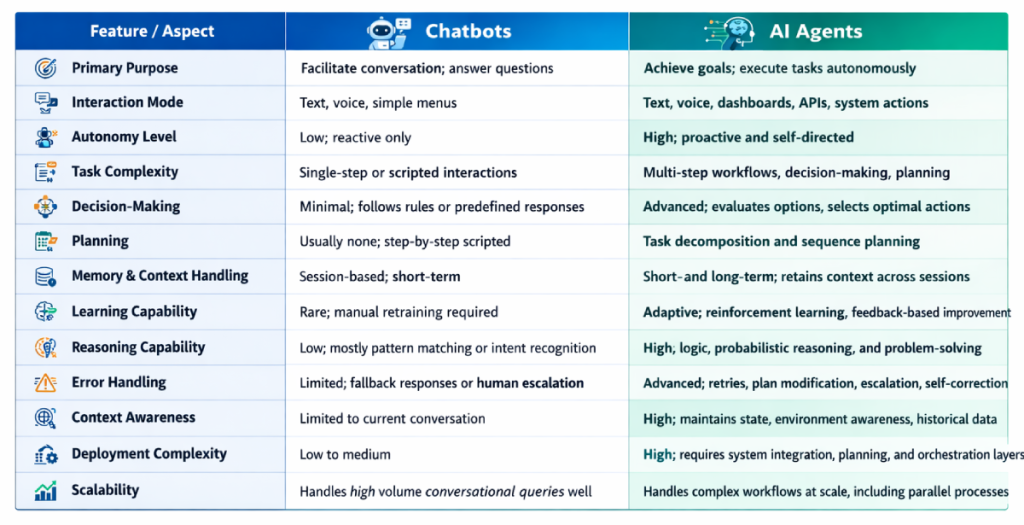
Now, the fun part of this AI agent vs chatbot comparison. The actual differences.
Primary Purpose
Chatbots are primarily designed to facilitate conversation and respond to user queries within a predefined scope. Their focus is on delivering information or guiding users through structured tasks.
On the other hand, AI agents are goal-oriented systems built to achieve objectives, execute tasks, and deliver outcomes autonomously, often across multiple systems.
Interaction Mode
Chatbots interact mainly through text or voice interfaces, such as websites, messaging apps, or virtual assistants.
AI agents, however, operate across multiple channels, including dashboards, APIs, automated workflows, and conversational interfaces. This, in turn, enables them to act both conversationally and operationally.
Autonomy Level
Chatbots respond only when prompted by a user. Meanwhile, AI agents are proactive and self-directed. They’re further capable of initiating actions, monitoring environments, and adjusting operations without constant human input.
Task Complexity
Chatbots handle single-step or scripted interactions. That makes them more suitable for FAQs, lead qualification, or appointment booking.
On the other hand, AI agents manage multi-step workflows that require planning, coordination, and execution across various systems.
Decision-Making
Chatbots have limited decision-making ability. They follow predefined rules or recognizing intents to select responses.
As for AI agents, they can evaluate multiple options, choose optimal actions, and adapt decisions based on context, constraints, or real-time data.
Planning
Planning is one of the important differentiators when it comes to AI agent vs chatbot.
Chatbots rarely perform any planning beyond simple decision trees. However, AI agents utilize task decomposition and sequencing, breaking complex goals into actionable steps and prioritizing them strategically to achieve the desired outcome efficiently.
Memory and Context Handling
Chatbots typically retain short-term session memory, which means context can be lost once a session ends.
AI agents maintain both short- and long-term memory. Therefore, they can track historical interactions, retain context across sessions, and make informed decisions based on prior data.
Learning Capability
Chatbots rarely improve autonomously and require manual updates or retraining to refine responses.
In contrast, AI agents use machine learning or reinforcement learning techniques to learn from feedback, adapt policies, optimize workflows, and improve performance over time.
Reasoning Capability
Chatbots rely on pattern matching and intent recognition with limited reasoning whereas AI agents possess advanced reasoning abilities. The latter can use logic, probabilistic inference, and sometimes LLM-driven capabilities to evaluate situations, predict outcomes, and decide the best course of action.
Error Handling
Chatbots generally have basic error handling, such as fallback responses or escalation to humans.
AI agents are more advanced in this regard. They feature robust error management, including detecting failures, retrying actions, modifying plans, or escalating issues autonomously.
Context Awareness
Chatbots maintain context only within a single session or conversation.
AI agents exhibit high context awareness, tracking task states, environmental changes, and historical data to make informed and continuous decisions.
Deployment Complexity
Chatbots are relatively simple to deploy, often requiring only conversational scripts and basic integrations.
On the other hand, AI agents are highly complex. They require planning modules, system orchestration, memory management, and robust integration across enterprise tools.
Scalability
The final comparison of AI agent vs chatbot is related to scalability.
Chatbots can handle high volumes of conversational queries effectively, but are limited to the scope of their scripts.
As for AI agents, they’re designed for scalable multi-step workflows. Therefore, they can easily multiple complex processes in parallel while maintaining context and task integrity.
Chatbots or AI Agents: Which to Choose
If you can’t have both, you’re probably wondering whether to build a chatbot or an AI agent first. To help you make that decision, you need to consider the following factors.
Your Organization’s Objective
Start by clarifying what you want the system to achieve.
If your primary goal is to answer customer queries, guide users, or provide information, a chatbot is sufficient.
If you need the system to execute tasks, make decisions, or orchestrate workflows across multiple systems, an AI agent is the better choice.
Task Complexity
Simple, repetitive, or single-step tasks like booking appointments are well-suited for chatbots.
On the other hand, complex, multi-step tasks that require planning, integration, and decision-making are where AI agents shine.
Required Level of Autonomy
Chatbots are reactive and require user prompts for every interaction.
If your workflow demands proactive behavior such as monitoring systems or adjusting plans automatically, an AI agent is necessary.
Integration Needs
If the system only needs to pull or push simple data (e.g., FAQ answers from a database), a chatbot is enough.
For deep integration with enterprise systems, APIs, or multiple tools, an AI agent provides the required orchestration capabilities.
Learning and Adaptation Needs
When it comes to AI agent vs chatbot, both learn and adapt differently.
Chatbots generally don’t learn or adapt unless manually updated.
If you want the system to improve performance over time, handle exceptions better, or optimize workflows automatically, AI agents are the right choice.
Resource and Deployment Constraints
Chatbots are simpler and faster to implement. They’re also less expensive than their counterparts.
AI agents require more time, technical expertise, and computational resources for deployment, integration, and maintenance.
💡If you’re intrigued by the idea of having your own chatbot, you’re probably as curious about how much you’ll be billed for creating one. When inquiring about how much does it cost to make a chatbot, you’ll need to factor several aspects such as complexity, functionality, and deployment scope. So, make sure to define what you expect from your chatbot before contacting a development team.
Risk and Oversight Requirements
For critical tasks where mistakes can be costly, AI agents require monitoring, governance, and fail-safe mechanisms.
Alternatively, chatbots pose lower risk as they only provide information and don’t act autonomously.
User Interaction Expectations
If the solution is user-facing and primarily conversational, a chatbot may be sufficient. If the focus is on task completion behind the scenes or cross-system automation, an AI agent is better suited.
Let the Experts Help You Make Up Your Mind
Don’t spend another minute contemplating between AI agent vs chatbot. Simply contact us via the form below with your queries so we can guide you further.
DPL’s AI chatbot app development services has successfully automated customer service operations via a range of AI agents, chatbots, and other innovative solutions. So, get in touch with your ideas so that our experts can create them for you.